The Albert Memorial: A Nation's Grief Cast in Gold
For eighty years, Prince Albert sat in black. The gilded statue at the heart of London's most extravagant memorial had been coated in dark paint -- some said to hide it from Zeppelin raids during World War I, others blamed atmospheric pollution that ate through the original gold leaf. Either way, the figure of Victoria's husband became an unintentional metaphor: a monument to grief, darkened by time. When restorers stripped the black coating in the late 1990s and re-gilded the statue, Albert emerged gleaming into daylight for the first time since the Victorian era. The transformation was startling.
The Widow's Wish
When Prince Albert died on 14 December 1861 at the age of forty-two, suggestions for a memorial ranged from establishing a university to funding international scholarships. Queen Victoria wanted none of it. She desired, as she put it, a memorial 'in the common sense of the word.' The Lord Mayor of London, William Cubitt, convened a committee and began raising funds. Control of the project quickly migrated from the Lord Mayor's office to people close to the Queen, particularly her secretary General Charles Grey and the keeper of the privy purse Sir Charles Phipps. An initial proposal for an obelisk was rejected. Architect George Gilbert Scott's design -- an ornate Gothic canopy sheltering a seated figure of the Prince -- was formally approved in April 1863 after lengthy negotiations over cost.
An Encyclopedia in Stone
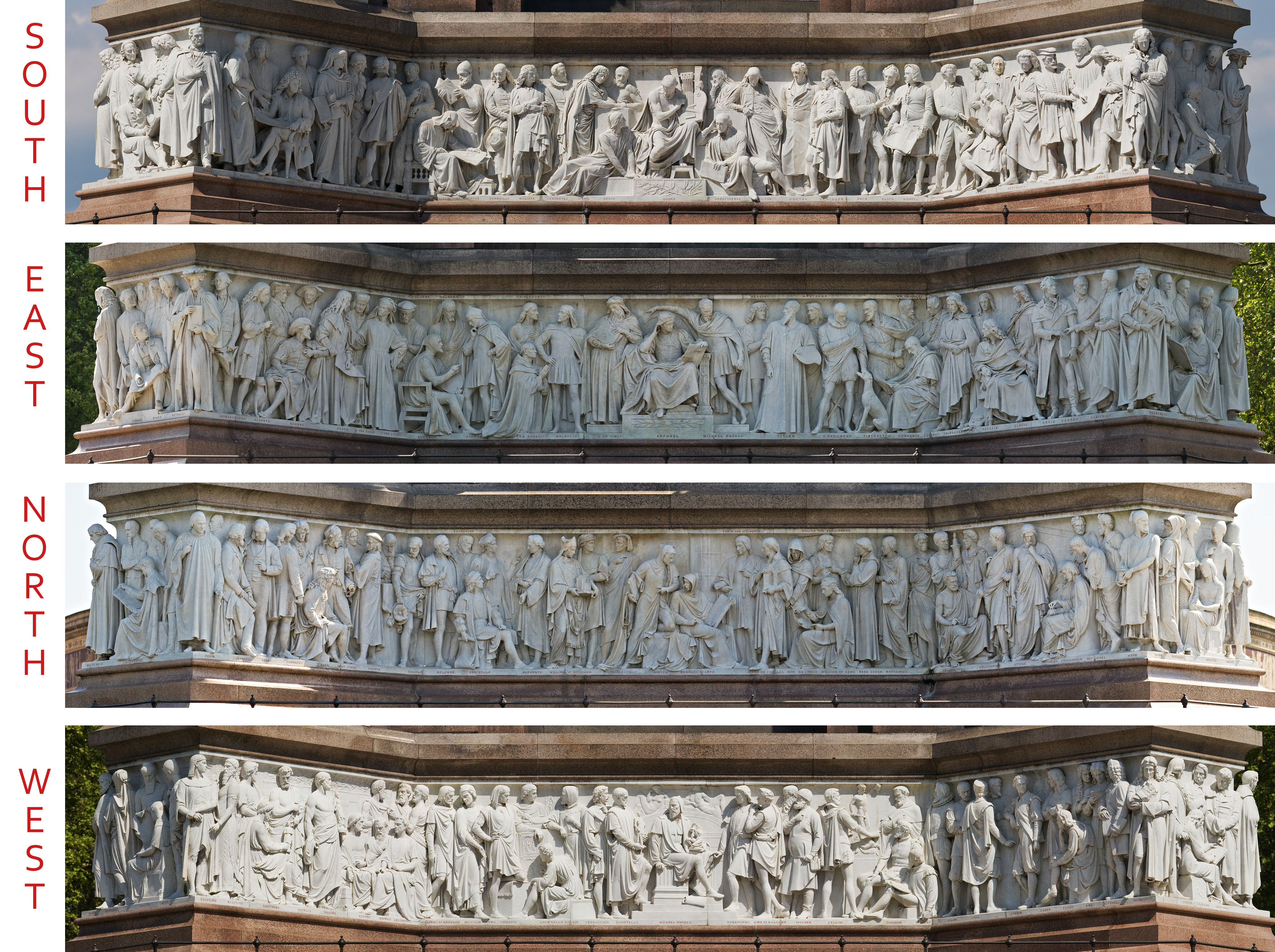
The memorial took over ten years to complete, at a cost of 120,000 pounds -- roughly fifteen million in today's money -- paid entirely by public subscription. At 176 feet tall, it resembles the canopy over a church's high altar, scaled up to monumental proportions. The structure is an encyclopedia of Victorian values rendered in stone, mosaic, and bronze. Four exterior mosaics represent poetry, painting, architecture, and sculpture, flanked by historical figures from Homer and King David to Raphael and Michelangelo. Eight statues on the pillars personify the sciences: Astronomy, Geology, Chemistry, Geometry, Rhetoric, Medicine, Philosophy, and Physiology. Higher still, eight more figures represent the cardinal and theological virtues. Gilded angels raise their arms heavenward near the summit, crowned by a gold cross.
A Collaboration of Sculptors
The memorial demanded an army of artists. Henry Hugh Armstead coordinated the effort, creating some eighty figure sculptures on the podium's southern and eastern sides. John Birnie Philip carved the north and west. The continental groups around the base -- Commerce, Europe, America, Asia, Africa, Agriculture, Engineering, and Manufactures -- were divided among leading Royal Academy sculptors including Thomas Thornycroft, Patrick MacDowell, John Bell, and William Theed. John Henry Foley began the central figure of Albert but died before completing it. The statue was finished by Thomas Brock, in what became Brock's first major work. The mosaics were designed by Clayton and Bell and manufactured by the firm of Salviati in Murano, Venice, using enamel, polished stone, agate, onyx, jasper, cornelian, crystal, marble, and granite.
Darkness and Light
Queen Victoria opened the memorial in July 1872, with the statue of Albert ceremonially 'seated' in 1876. By the late twentieth century, the monument had fallen into decay. The cross atop the tower had been put on sideways during an earlier restoration. Paint peeled, stonework crumbled, and Albert sat in his dark coating, all but invisible against the blackened canopy. The comprehensive restoration of the 1990s cleaned, repainted, and re-gilded the entire structure. The cross was returned to its correct position. Albert's statue was restored to its original brilliance. Today the memorial stands in Kensington Gardens directly across from the Royal Albert Hall, the two structures facing each other across Kensington Gore -- one a monument to grief, the other a celebration of the arts Albert championed. Public tours of the Frieze of Parnassus are held on the first Sunday of each month, offering visitors a closer look at the 169 life-sized figures of composers, poets, painters, architects, and sculptors carved into the podium.
From the Air
The Albert Memorial (51.50N, 0.18W) is in Kensington Gardens, directly north of the Royal Albert Hall. The gold-topped canopy is visible from altitude in clear conditions. Nearby airports: London Heathrow (EGLL) 11nm west, Northolt (EGWU) 10nm northwest. Best viewed from 2,000ft with Hyde Park and Kensington Gardens visible below.