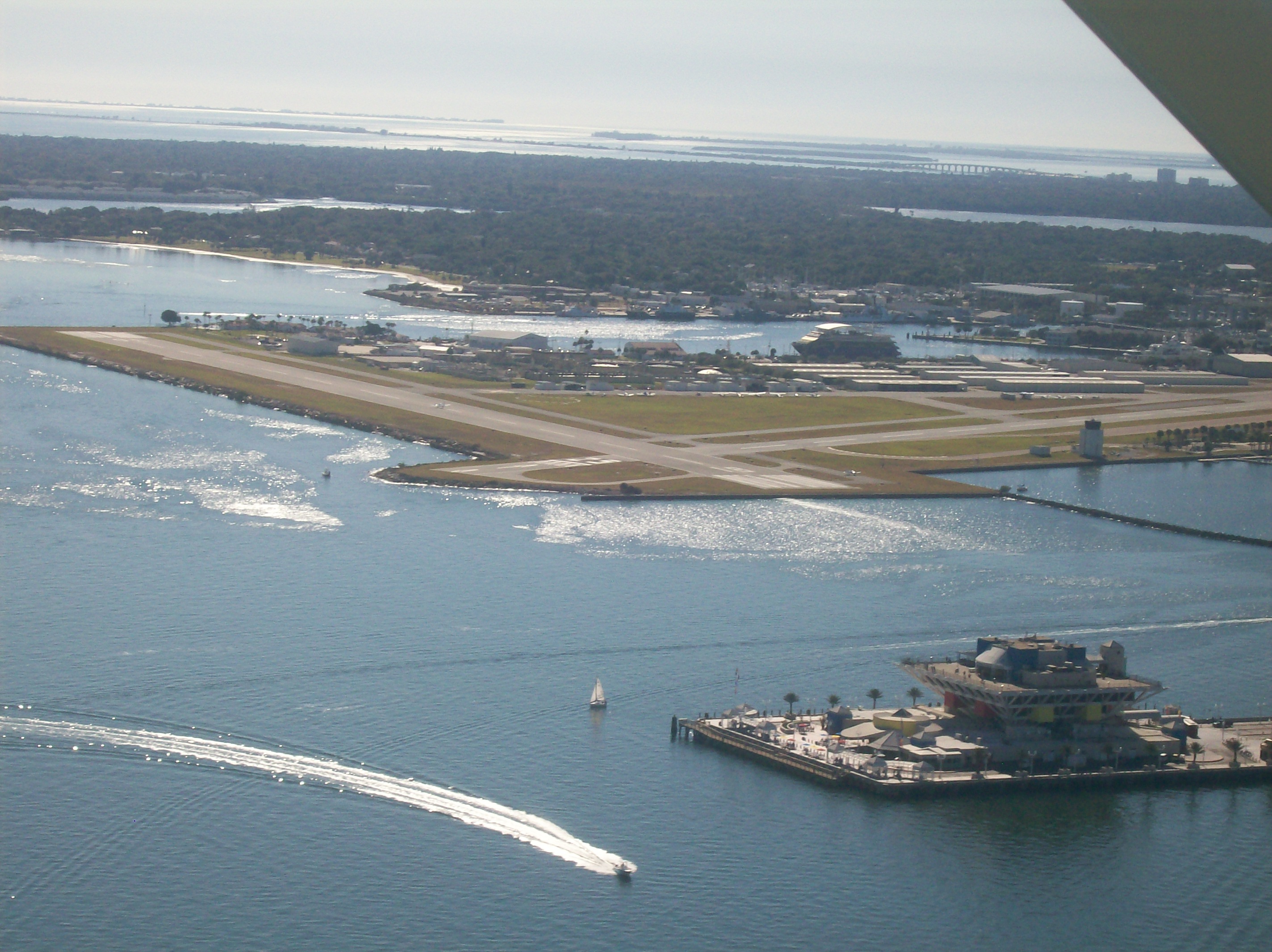
Albert Whitted Airport: Where Commercial Aviation Was Born
On January 1, 1914, a Benoist XIV flying boat lifted off from St. Petersburg's central yacht basin carrying one passenger: A.C. Pheil, a former mayor. Pilot Tony Jannus had just flown the first scheduled commercial airline flight in history. The fare was $5 for the 23-mile trip across Tampa Bay. Fourteen years later, a new airport opened on the same downtown waterfront, named for a local boy who became one of the Navy's first 250 aviators and never charged anyone for a ride in his homemade airplane. Albert Whitted Airport has operated at the edge of downtown St. Petersburg ever since, surviving world wars, referendums that tried to turn it into a park, German submarine patrols, hurricane damage, and the relentless pressure of waterfront real estate. It sits seven feet above sea level. Its longest runway is 3,677 feet. Its history is enormous.
The Aviator Who Never Charged a Fare
Lieutenant James Albert Whitted was a St. Petersburg native commissioned as a Naval Aviator at age 24, just as America entered World War I in 1917. He was among the U.S. Navy's first 250 Naval Aviators. He served as chief instructor of advanced flying at NAS Pensacola and was later assigned to Naval Station Guantanamo Bay. Back home in St. Petersburg, Whitted designed and built his own airplanes: the Bluebird and the Falcon. He took people up in the Bluebird constantly, his aerial maneuvers leaving spectators in awe, and he never once charged for the flights. He and his brother Clarence ran a small commercial flying business with their homemade planes. On October 12, 1928, the city renamed its airport after him. Construction had begun that same month; the field opened in the summer of 1929.
Blimps, Airlines, and the Coast Guard
The new airport attracted attention quickly. In 1929, the Goodyear Tire and Rubber Company agreed to base one of its famous airships at the field, making Albert Whitted one of the first airports in America to host blimps. National Airlines launched service from the airport in 1934. In 1934-1935, the Public Works Administration built Coast Guard Air Station St. Petersburg in the airport's southeast corner. That station would become one of the most consequential tenants in the airport's history. When World War II began, Coast Guard aircraft flew patrols against German submarines prowling the Gulf of Mexico and the Atlantic. After the submarine threat faded, the station pivoted to search and rescue. Consolidated PBY-5A Catalinas, Martin PBM Mariners, and eventually the massive P5M Marlin seaplanes operated from the field. By the mid-1950s, helicopters joined the fleet.
Training Wings
During World War II, Albert Whitted Airport was converted into a primary flight training base for the U.S. Navy and Marine Corps. Hundreds of Naval Aviation cadets under the Navy's V-5 pre-commissioning program learned to fly in Stearman N2S and Waco biplanes over the waters of Tampa Bay. The airport hummed with the sound of radial engines and the sight of students practicing their patterns above the downtown waterfront. When the war ended, Navy training ceased and civilian activity returned. The Coast Guard remained as the sole military presence until 1976, when its need for larger HC-130 Hercules aircraft made the airport's short runways untenable. The Coast Guard relocated to St. Petersburg-Clearwater International Airport, establishing the new Coast Guard Air Station Clearwater.
The Referendum That Failed
In 2003, a group called Citizens for a New Waterfront Park gathered enough signatures to place a ballot question that would have closed Albert Whitted Airport and converted it into a city park. Waterfront land in downtown St. Petersburg was immensely valuable. The city offered two counter-questions in the referendum: one on keeping the airport permanently, and one on accepting government grants for its improvement. Residents voted overwhelmingly to keep the airport. Since then, more than $11 million in capital improvements have followed. A $4 million terminal building opened in October 2007, housing the Hangar Restaurant and Flight Lounge on its second floor. A new $3 million air traffic control tower became operational in August 2012, funded in part by a $990,000 economic stimulus grant. The Grand Prix of St. Petersburg, part of the IndyCar Series, uses the airport grounds every spring.
Seven Feet Above Sea Level
Albert Whitted Airport sits at an elevation of seven feet, with two asphalt runways: Runway 7/25 at 3,677 by 75 feet, and Runway 18/36 at 2,864 by 75 feet. In October 2024, Hurricane Milton destroyed hangars and scattered planes and debris across the facility, prompting a $1.2 million demolition and removal contract. The airport has always lived at the mercy of the elements and the politics of waterfront development. The Florida DOT named it the 2009 Florida General Aviation Airport of the Year. Today it hosts flight schools, charter services, the Civil Air Patrol, and a restaurant where diners watch small planes taxi past the windows. It is a working airport in a city that once voted to keep it forever, on the same waterfront where commercial aviation began.
From the Air
Albert Whitted Airport (KSPG) is located at 27.765°N, 82.627°W on the downtown St. Petersburg waterfront, directly on Tampa Bay. Elevation 7 feet MSL. Two runways: 7/25 (3,677 x 75 ft) and 18/36 (2,864 x 75 ft). The airport is immediately identifiable from altitude by its position jutting into Tampa Bay from the downtown peninsula. The Sunshine Skyway Bridge is visible to the south, and St. Pete-Clearwater International (KPIE) lies approximately 10 nm to the north. Tampa International (KTPA) is about 17 nm to the northeast across the bay. Exercise caution for Class D airspace and potential IndyCar event TFRs in spring. The downtown St. Petersburg skyline provides a clear visual landmark.