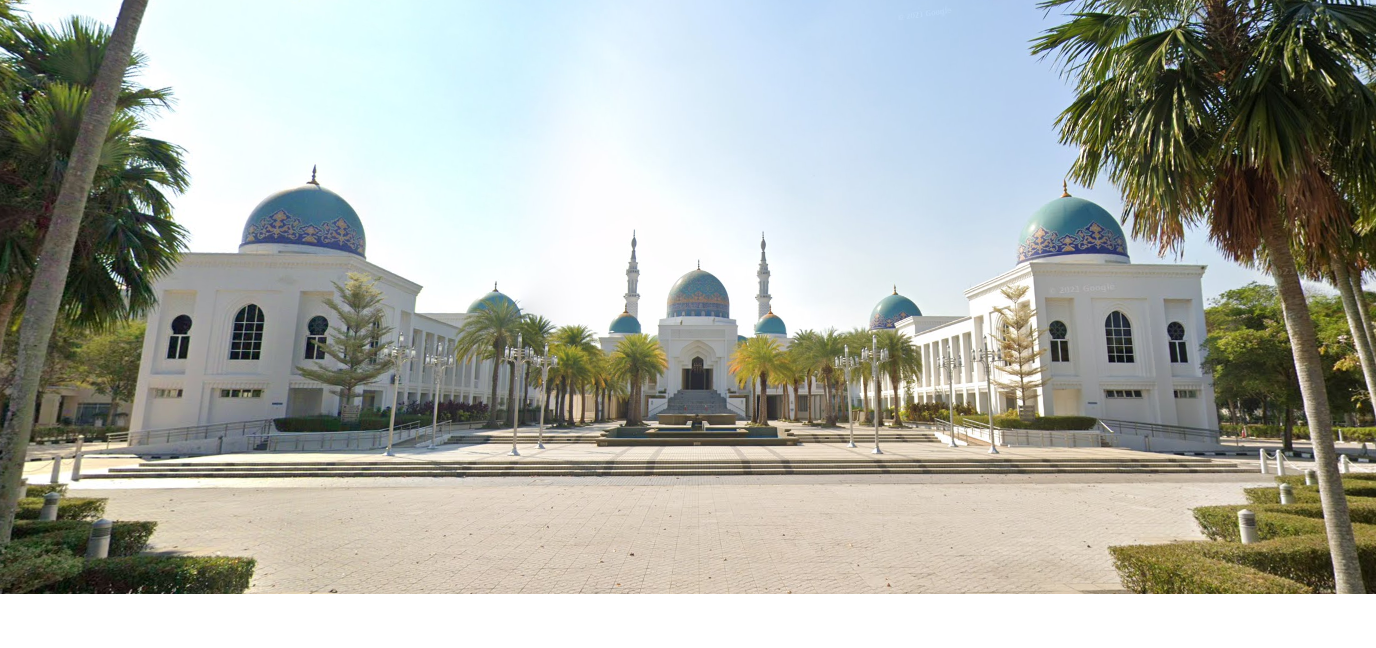
Albukhary Mosque
Seven blue domes catch the equatorial light in Alor Setar, each one representing a continent where Islam has taken root. The Albukhary Mosque is not a building that belongs to any single tradition. Its main dome echoes the Shah Mosque in Isfahan. Its twin minarets, standing 47.92 meters tall, borrow from the Mamluk style with nods to Al-Masjid an-Nabawi in Medina. Its courtyard, with geometric water features and reflective pools, mirrors the Mausoleum of Imam al-Bukhari in Samarkand. Planted in the capital of Malaysia's northernmost peninsular state, it is a deliberate act of architectural synthesis — a single structure meant to contain the breadth of Islamic heritage across centuries and continents.
One Man's Vision in Kedah's Capital
The mosque exists because of Tan Sri Syed Mokhtar Albukhary, one of Malaysia's wealthiest and most prolific philanthropists. Through the Albukhary Foundation, he commissioned the mosque as the spiritual anchor of a larger complex in Alor Setar, the quiet capital of Kedah state. The groundbreaking ceremony took place on 15 January 1999, officiated by then-Prime Minister Mahathir Mohamad. Construction began in March 2000 and was completed by 2001 — a remarkably fast timeline for a building of this ambition. Sultan Abdul Halim Mu'adzam Shah, the Sultan of Kedah, officially inaugurated it on 22 November 2001, a date that coincided with the sixth day of Ramadan. The mosque shares its name with a sister building in Kuala Lumpur, the Masjid Albukhary KL, built by the same foundation five years later.
Isfahan to Medina, Filtered Through Malaysia
Architect Abdul Harris Othman of RDA Harris Design Group designed the mosque with an explicitly eclectic mandate: draw from Turkey, Iran, Egypt, and Morocco to showcase the diversity of Islamic architectural tradition. The result is a building where no single origin dominates. The seven blue domes that crown the exterior are the most immediately striking feature, their color a nod to the tilework of Persian mosques. Inside the main dome, the 99 Names of Allah are carved in intricate calligraphy. The minarets combine Mamluk proportions with details inspired by the Prophet's Mosque in Medina, creating towers that feel both ancient and composed. Step through the entrance into the sahn — the central courtyard — and the sensory register shifts again. Water moves through geometric channels, and reflective pools create the stillness associated with Timurid architecture. The main prayer hall holds approximately 3,000 worshippers, but during Eid prayers, the entire complex accommodates up to 15,000.
More Than a Mosque
The Albukhary Mosque is the centerpiece of the Sharifah Rokiah Centre of Excellence, named after the founder's mother. The complex surrounding it is as ambitious as the mosque itself. Albukhary International University, a non-profit private institution, occupies the same grounds — education and worship sharing a single campus. Souq Albukhary, a commercial market designed with architecture inspired by the Citadel of Bukhara in Uzbekistan, connects the spiritual to the commercial in a way that echoes the traditional role of mosques as community hubs. Medical facilities, including a dialysis center and clinics serving the underprivileged, extend the foundation's mission beyond the spiritual. An orphanage and an old folks' home complete the picture: a complex that functions as a small city of care, with the mosque's blue domes at its heart.
A Gallery of Its Own Making
In December 2020, the mosque opened the Albukhary Mosque Gallery, the first of its kind in Kedah. The gallery documents the building's own history and architectural evolution, turning the mosque into both a place of worship and a museum of its own creation. For a structure barely two decades old, this might seem premature. But the Albukhary Mosque was built with the ambition of connecting Kedah to the wider Islamic world, and the gallery makes that ambition explicit — tracing the lines of influence from Isfahan's tilework to Samarkand's water gardens to the rice fields of northern Malaysia. In a state better known for its paddy fields than its architecture, the mosque has become Alor Setar's most distinctive landmark, proof that a building can be simultaneously rooted in a specific place and in conversation with a civilization that spans the globe.
From the Air
Located at 6.15°N, 100.39°E in Alor Setar, the capital of Kedah state in northern peninsular Malaysia. The seven blue domes are visible from lower altitudes against the flat terrain of Kedah's rice-growing plain. Sultan Abdul Halim Airport (WMKA) is the nearest airport, approximately 10 km north of the mosque. Penang International Airport (WMKP) lies about 90 km to the south. From 5,000–10,000 feet, the mosque complex stands out clearly from the surrounding low-rise urban landscape and agricultural areas.