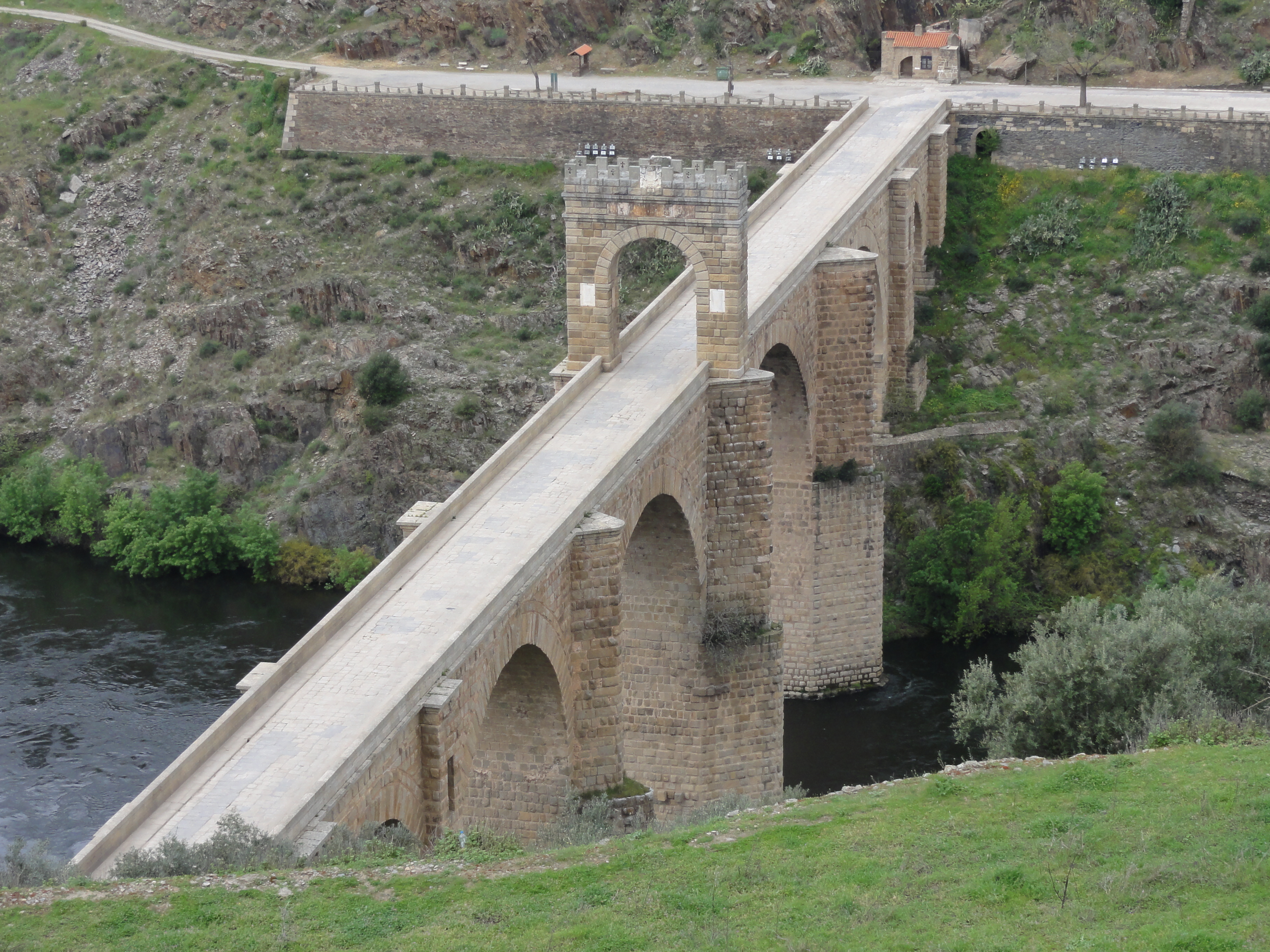
Alcantara Bridge
The name gives it away. Alcantara comes from the Arabic al-Qantarah, meaning simply "the arch." When the Moors arrived in Iberia centuries after the bridge was built, they found it so astonishing that they named the entire town after it. The bridge itself had already been standing for half a millennium by then, its six stone arches spanning the Tagus River gorge in western Spain as if the Romans had poured them yesterday. Nearly two thousand years later, those arches still carry traffic.
Trajan's Commission
Emperor Trajan ordered the bridge built in 98 AD, and construction took place between 104 and 106 AD in what was then the Roman province of Lusitania. The project was not the work of a single city. Twelve local municipalities shared the expense, their names inscribed on an archway over the central pier in a rare surviving record of Roman civic cooperation. The architect was Gaius Julius Lacer, who designed a structure so confident in its permanence that he built a small temple at one end and was buried within it. An inscription attributed to Lacer reads: "I have built a bridge which will last forever." Given that nineteen centuries have passed and the bridge still stands, the boast seems less like hubris and more like engineering competence.
Six Arches Over the Gorge
The bridge stretches roughly 194 meters across the Tagus at a point where the river cuts through a deep granite gorge. Its six semicircular arches are not uniform; the two central spans reach approximately 29 meters each, making them among the largest Roman arches ever built. The roadway rises to about 48 meters above the normal water level, a height that has protected it from all but the most extreme floods. The entire structure is built from local granite blocks, fitted with such precision that many joints remain tight without mortar. Above the central pier stands a triumphal arch, added to honor Trajan, creating a gateway effect for travelers crossing between the provinces. The small temple dedicated by Lacer sits at the southern approach, its crypt still containing the remains of the engineer who staked his reputation on forever.
Scarred but Standing
Surviving two millennia has not been painless. The bridge has been partially destroyed and rebuilt multiple times. During the Reconquista, one arch on the Moorish side was broken to impede military crossings. Wars between Spain and Portugal damaged it further. In 1214, the Moorish tower at one end was replaced. During the War of the Spanish Succession in the early 1700s and again during the Peninsular War in the early 1800s, arches were deliberately blown up for strategic reasons and later reconstructed. The triumphal arch above the central pier was also damaged and restored. Each time, the fundamental Roman engineering held. The foundations, the piers anchored deep in the gorge bedrock, the basic proportions of the arches -- all survived what human conflict and river floods threw at them.
A Bridge That Became a Town
What makes Alcantara remarkable is not simply its age but its continued relevance. The town that grew around it took the bridge's Arabic name and kept it. The bridge itself remains in use, though modern traffic is carefully managed to preserve the ancient structure. Downstream, the Alcantara Dam now controls the Tagus, reducing the flood surges that once threatened the piers. The gorge setting remains dramatic: steep rock walls dropping to dark water, the pale granite of the bridge catching light against the arid hills of Extremadura. Lacer's temple still guards the southern end, a small classical building where an engineer lies buried beneath the evidence of his own genius. Few structures anywhere in the world so thoroughly justify the confidence of their builder.
From the Air
Located at 39.72N, 6.89W in Extremadura, western Spain, where the Tagus River cuts through a deep gorge near the Portuguese border. The bridge is visible from moderate altitudes as a pale stone structure spanning a narrow rocky canyon. The Alcantara Dam and reservoir are visible upstream. Nearest major airport is Talavera la Real (LEBZ / Badajoz) approximately 120 km to the south. Terrain is hilly and arid with elevations around 200-400 m.