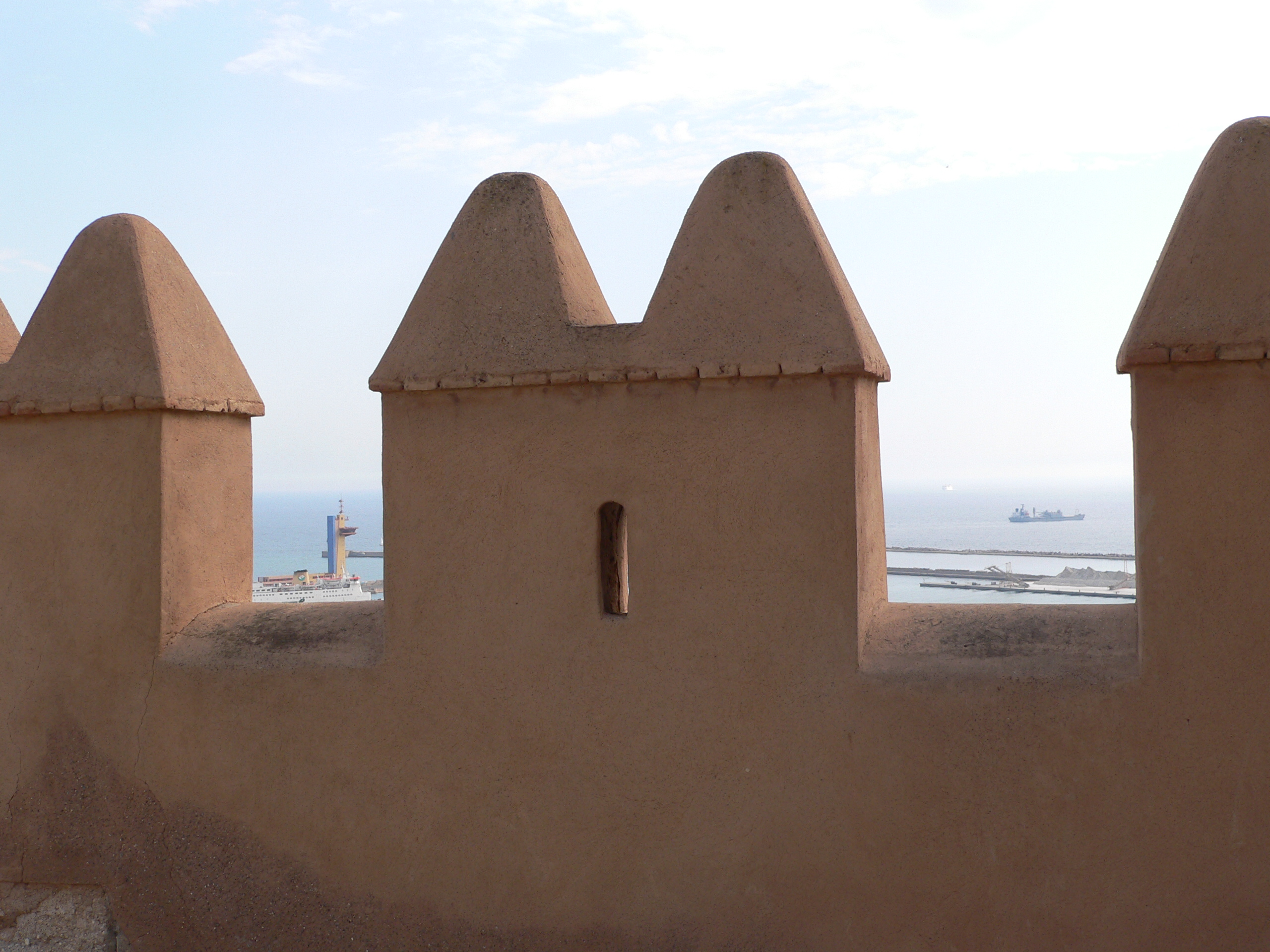
Alcazaba of Almería
Conan the Barbarian has stormed these walls. Indiana Jones has explored their corridors. The Night King's armies have marched beneath their towers. The Alcazaba of Almeria has served as a backdrop for some of cinema's most famous scenes, but its real history -- a millennium of conquest, reconstruction, and adaptation -- is more dramatic than any screenplay. Perched above the city and the Mediterranean, this is the second-largest Muslim-era fortification in Spain, a citadel that witnessed the rise and fall of Al-Andalus from a ringside seat.
The Caliph's City
In 955, the Caliph of Cordoba Abd ar-Rahman III elevated Almeria to the status of medina -- a city -- and ordered the construction of a defensive citadel on the hilltop above. The timing was strategic: Almeria's port was becoming one of the most important in the western Mediterranean, a hub for the silk trade and naval operations. The Alcazaba grew over the following centuries into a layered complex of walls, towers, and enclosures that reflected the evolving needs of successive rulers. The renowned Muslim scholar Abul Walid Al-Baji was reportedly buried within its grounds, according to the 12th-century biographer Ibn Bashkawal, linking the fortress to the intellectual as well as the military life of Al-Andalus.
Three Enclosures, Three Eras
The Alcazaba is organized into three distinct walled enclosures, each representing a different phase of the fortress's history. The first and largest served as the original Muslim military camp, a refuge where the civilian population could shelter during sieges, supplied by massive cisterns carved into the rock. The second enclosure, separated from the first by the Muro de la Vela -- the Wall of the Sail -- housed the governors, their soldiers, and their households, along with a mosque, baths, and administrative buildings. The bell on this wall warned citizens of approaching ships, fires, and dangers. The third and outermost enclosure is the most modern: a castle built by the Catholic Monarchs Isabella and Ferdinand after the Christian reconquest of Almeria, designed to withstand the gunpowder artillery that had made the earlier Moorish fortifications obsolete.
From Citadel to Sound Stage
Almeria's arid landscape and well-preserved fortifications caught Hollywood's attention in the 1980s. Arnold Schwarzenegger wielded his sword through the Alcazaba's courtyards in the 1982 Conan the Barbarian. Sean Connery returned as James Bond in Never Say Never Again, filmed partly within these walls. Steven Spielberg used the fortress for scenes in Indiana Jones and the Last Crusade. Most recently, Gal Gadot's Wonder Woman battled through the Alcazaba in Wonder Woman 1984. Television followed: the sixth season of Game of Thrones transformed the fortress and the nearby Muralla de Jayran into the capital of Dorne, the kingdom of House Martell. The inner courtyard and gardens served as the set for the syndicated series Queen of Swords. Each production found in the Alcazaba what the original builders intended: a place that looks and feels like power made physical.
Layers Upon Layers
Most of the archaeological finds from the Alcazaba are now housed in the Museo de Almeria, though some reside in the Museo de la Alhambra in Granada. The objects span the full arc of the fortress's occupation: ceramics and metalwork from the Caliphate period, architectural fragments from the Taifa kingdoms that succeeded it, weapons and coins from the Christian era. Walking the circuit of the walls, visitors pass through more than a thousand years of construction techniques -- from the rammed-earth foundations of the earliest Muslim fortifications to the dressed stone of Charles III of Spain's 18th-century additions. The gardens in the inner courtyard, replanted with Mediterranean species, offer a quiet contrast to the martial architecture surrounding them. On clear days, the view from the upper ramparts extends across the entire bay of Almeria and out over the Mediterranean, the same vista that made this hilltop so strategically valuable to every civilization that claimed it.
From the Air
Located at 36.84°N, 2.47°W on a prominent hilltop overlooking Almeria and its bay on the southeastern Mediterranean coast of Spain. The fortress is clearly visible from altitude as a large walled complex on the hill above the city center. Nearest airport: LEAM (Almeria Airport), approximately 9 km east. Best viewed at 2,000-5,000 ft AGL, where the three enclosures and the relationship between fortress, city, and port are all visible.