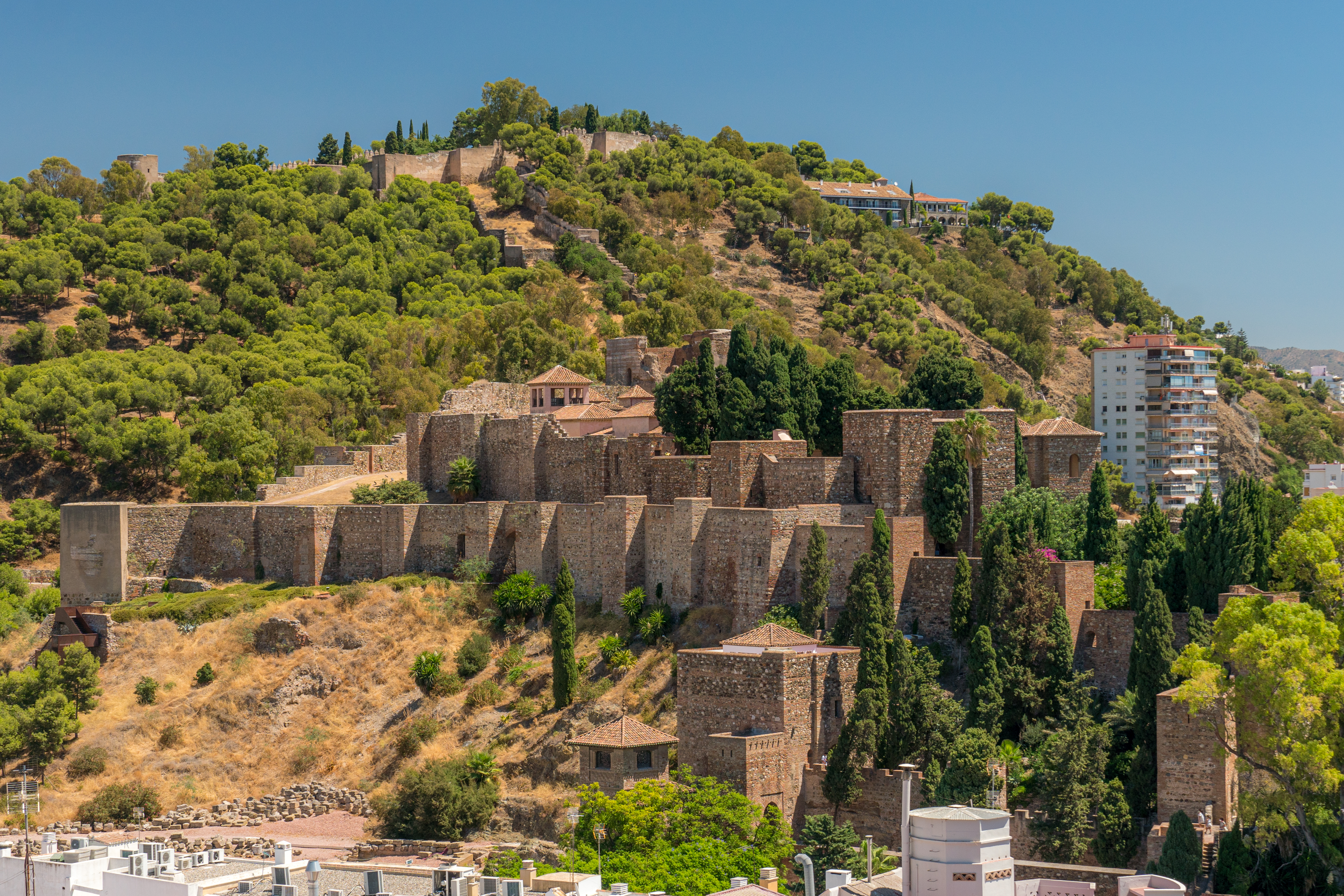
Alcazaba of Malaga
To reach the palace at the heart of the Alcazaba of Malaga, you must pass through five gates. Each bend in the walled corridor was designed to slow and expose attackers, funneling them past towers where defenders could rain down fire. The Alcazaba's architects understood that a fortress should be difficult to enter, and they built accordingly. This is not the sprawling, confident palace complex of the Cordoba caliphate. This is the architecture of a dynasty under threat, where military impregnability mattered more than grandeur, and every courtyard sits behind another wall.
Three Thousand Years on a Hill
Phoenicians fortified this hilltop around 600 BC. Romans built a villa and industrial facilities here after 205 BC. Their theatre, dating to the 1st century AD, sits adjacent to the Alcazaba's entrance, its semicircular seating still visible. After the Muslim conquest of the Iberian Peninsula in the early 8th century, Abd ar-Rahman I constructed a fortress on the hill between 756 and 788. The current Alcazaba was begun in the 11th century during the fractious Taifa period, when Al-Andalus splintered into competing kingdoms, and was modified repeatedly through the 14th century. Columns and carved capitals from the Roman theatre were reused in the Alcazaba's gates, a practical recycling that binds the site's layers together physically as well as historically.
Walls Within Walls
The Alcazaba comprises two concentric walled enclosures, the inner one crowning the hilltop and containing the palace complex. Each enclosure bristles with defensive towers. A walled corridor connects the Alcazaba to the higher Castle of Gibralfaro above it, creating a fortified system that controlled both the hill and the port below. The outer enclosure contains the Pozo Airon, a well cut 30 meters into the bedrock to reach a natural water source that could sustain the citadel's inhabitants during a siege. In the inner enclosure, the Taifa-era palace preserves a southern pavilion with a wide portico of arches, possibly dating from the rule of Yahya I around 1021-1036. A small annex features pairs of intersecting multifoil arches that echo the 10th-century Great Mosque of Cordoba while foreshadowing the later Aljaferia Palace in Zaragoza.
Courtyards of Water and Stone
Northeast of the older Taifa palace stands a Nasrid palace arranged around two rectangular courtyards, most of it reconstructed in the 20th century from archaeological remains. The Patio de los Naranjos, the Courtyard of the Orange Trees, preserves two original pools with their paved tile decoration intact. The Patio de la Alberca features a long central reflecting pool surrounded by original tilework, a smaller cousin of the famous pools at the Alhambra in Granada. Between the Nasrid palace and the Torre del Homenaje lies the Barrio Castrense, the Military District, thought to date from the 11th century. Its eight houses connected by narrow streets housed the ruler's officials and servants. One of the largest homes had its own hammam and toilets. Closed to the public today, the Barrio Castrense survives as one of the best-preserved areas of the citadel precisely because later centuries left it alone.
The View from the Top
The Alcazaba overlooks Malaga's port from its perch on the hillside, and the view explains why every civilization that held this coast wanted this hill. Phoenician traders scanning the harbor for ships, Roman governors surveying their province, Moorish rulers watching for Christian fleets: the strategic logic never changed. The Torre de Maldonado, an outer fortification tower remodeled by the Almohads in the 12th-13th century, still bears vestiges of their decoration. A 16th-century chamber built after the Christian conquest features a wooden Mudejar ceiling and houses a model of the entire complex. Walking through the Alcazaba is an exercise in reading architectural styles like geological strata. Phoenician walls, Roman columns, Taifa arches, Nasrid tilework, and Christian additions share the same hill, each layer building on the one before.
From the Air
Located at 36.72N, 4.42W on a hillside in central Malaga overlooking the port. The fortress walls and terraced gardens are visible from the air at 2,000-3,000 feet. The Castle of Gibralfaro sits above it on the hilltop. The Roman theatre at its base and the Malaga Cathedral nearby serve as reference points. Nearest airport: Malaga-Costa del Sol (LEMG), approximately 8 km southwest.