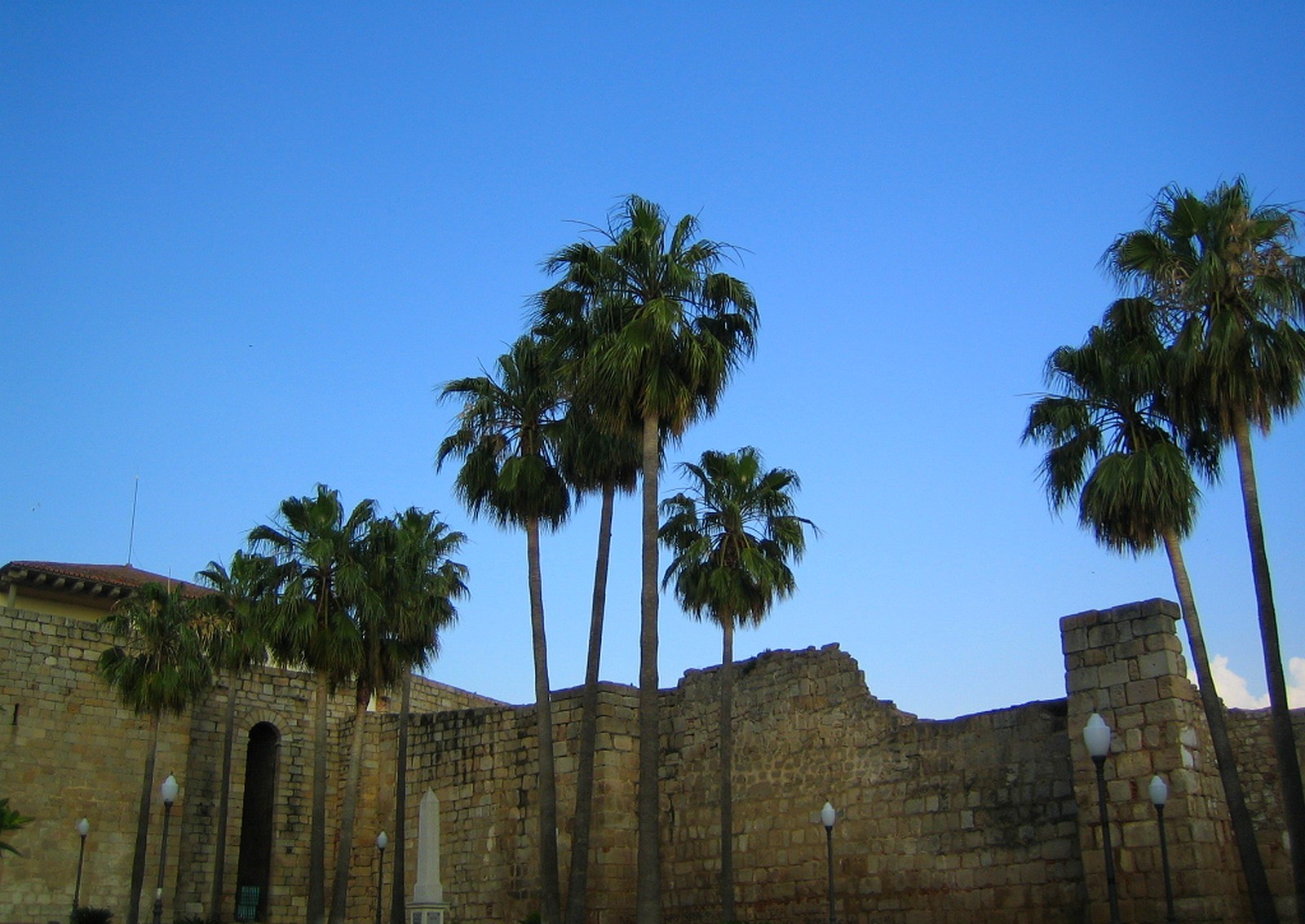
Alcazaba of Mérida
The walls are Roman, but the fort is not. When Emir Abd ar-Rahman II of Cordoba ordered a fortress built at Merida in 835 AD, his builders did what practical conquerors have always done -- they took what was already there. Roman walls, Visigothic stonework, granite fragments from structures that had stood for eight centuries -- all were recycled into something new, a squared citadel that would become the first Muslim alcazaba on the Iberian Peninsula. The city had rebelled against Cordoban authority in 805, and this fortress was the emir's answer: a permanent statement of control planted beside the Roman bridge over the Guadiana River.
Geometry of Control
The Alcazaba's design is a study in military efficiency. Each of its four sides measures 130 meters, the walls rising 10 meters high and 2.7 meters thick, forming a massive square that dominates the riverfront. Twenty-five towers with quadrangular bases project from the walls at regular intervals, serving double duty as defensive positions and structural counterforts that brace the walls against siege and time. Inside, the builders included an aljibe -- a rainwater tank with a cistern designed to collect and filter water drawn from the Guadiana below. Even cut off from the river, the garrison could survive. Access from the Puente Romano passes through a small enclosure called the Alcarazejo, a checkpoint where authorities controlled the flow of people and goods into the city.
Layers Beneath the Fortress
Excavations within the Alcazaba have revealed that the fortress sits atop centuries of earlier construction. A well-preserved segment of Roman road runs beneath the Islamic-era foundations, extending to the nearby Morerias Archaeological Area. An urban Roman dwelling, renovated multiple times across the centuries, faces the same ancient street. Part of the original Roman city wall is also visible, braced by a massive buttress built from recycled granite fragments and dated to roughly the 5th century AD -- suggesting that even the Visigoths, before the Moorish conquest, had already been patching and repurposing the Roman infrastructure. Each layer of occupation left its mark in the ground, a palimpsest of civilizations readable only through archaeology.
From Fortress to Government House
Over the horseshoe-shaped arch of the military gate, an inscription still celebrates Abd ar-Rahman II's patronage -- a rare survival of early Islamic epigraphy on the peninsula. After the Christian reconquest, the Alcazaba's function shifted but its importance endured. A convent of the Order of Santiago was annexed to the fortress, and today that same complex houses the council offices of the Extremadura regional government. The Alcazaba is part of the Archaeological Ensemble of Merida, recognized as a UNESCO World Heritage Site, alongside the Roman theatre, amphitheatre, and aqueducts that surround it. Standing on its walls, you look out across the Puente Romano -- a bridge the Romans built, the Moors crossed, and modern traffic still uses -- and see two thousand years of continuous habitation compressed into a single view.
From the Air
Located at 38.91N, 6.35W in Merida, Extremadura, adjacent to the Puente Romano over the Guadiana River. The square fortress is clearly visible from the air beside the long Roman bridge. The Roman theatre and amphitheatre complex lies to the east. Nearest airport is Badajoz (LEBZ), approximately 60 km west.