Alcazar of Seville
Pedro I of Castile had a problem that only his enemies' artisans could solve. In the 1360s, having conquered Seville from the Moors more than a century earlier, the Christian king wanted to build a palace of extraordinary beauty. He turned to Mudejar craftsmen -- Muslim artisans living under Christian rule -- and they created something that defied the logic of conquest: a palace built by the conquered for the conqueror, in the style of the conquered, on the ruins of the conquered's own citadel. The Royal Alcazar of Seville is that paradox made permanent, and it remains the oldest royal palace in continuous use in Europe.
A Citadel's Many Lives
The site's history begins in the 10th century, when the Umayyads established an Islamic citadel here. The Abbadid dynasty expanded it into a larger palace complex in the 11th century, and the Almohads -- the Berber dynasty that controlled much of North Africa and Iberia -- developed it further in the 12th and early 13th centuries. When Ferdinand III of Castile captured Seville in 1248, the complex became the seat of Christian royal power. But the transformative moment came under Pedro I during the 1360s, when he commissioned a new palace within the existing compound. The result is a masterwork of Mudejar architecture: Islamic geometric patterns, carved stucco, and glazed tilework executed with virtuosity, enclosing spaces designed for a Christian court. The craftsmen who built it came from Seville, Toledo, and possibly Granada -- artisans whose skills had been refined over centuries of Islamic artistic tradition.
Gardens Where History Layers
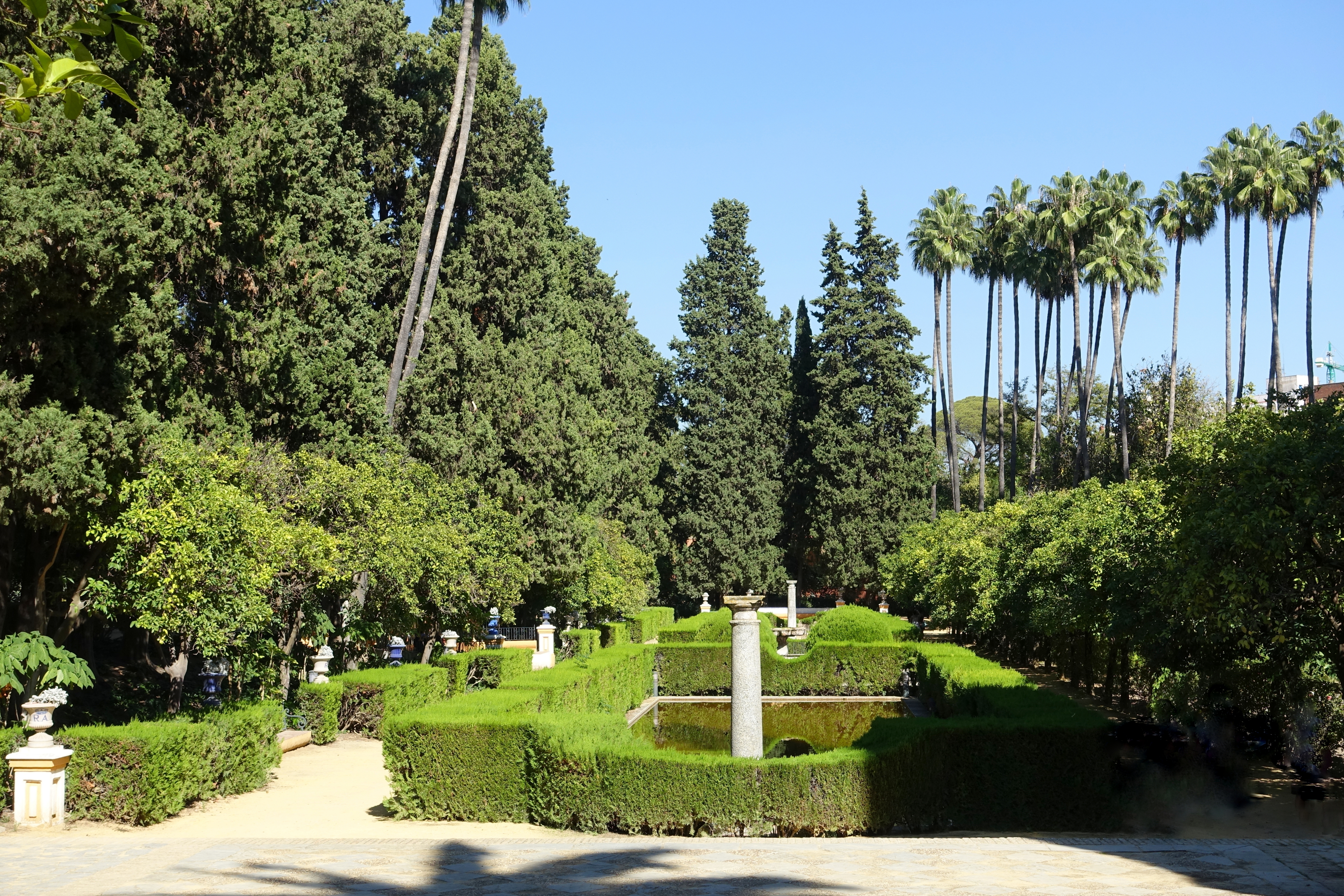
The gardens of the Alcazar are themselves a palimpsest. Islamic garden design -- with its emphasis on water, geometry, and enclosed paradise -- was overlaid with Renaissance and later Baroque modifications, creating a landscape that reads differently depending on which century you focus on. Fountains designed to cool the air in the Andalusian heat feed channels that trace the outlines of medieval plantings. Orange trees planted in formal rows scent the air with blossoms in spring. Pavilions from different eras dot the grounds, some Moorish in inspiration, others purely European. The gardens became internationally famous as a filming location for Game of Thrones, where they stood in for the Water Gardens of Dorne, an ironic echo of the Alcazar's own history of being reimagined by successive cultures.
The Art of Beautiful Contradiction
What makes the Alcazar architecturally remarkable is not just its beauty but its refusal to resolve its contradictions. Arabic inscriptions praise Allah alongside Gothic vaulting. Geometric tilework patterns that follow Islamic rules about the representation of living things share walls with figurative Christian imagery. Pedro I, called both "the Cruel" and "the Just" depending on which side of his politics you stood, seems to have deliberately cultivated this hybridity. An inscription in Arabic on the walls of the palace reads, in the voice of the Muslim craftsmen: "Glory to our lord the Sultan Don Pedro." It is a sentence that could only have been written in medieval Iberia -- a place where cultures blended even as they warred, and where a Christian king's greatest aesthetic achievement was a building that looked like the palaces of his enemies.
A Palace That Still Works
The Alcazar remains one of the official residences of the Spanish royal family, making it the oldest palace in Europe still used for its original purpose. When the Spanish monarch visits Seville, the upper floors of the palace -- renovated repeatedly over the centuries -- still serve as royal apartments. Below, tourists walk through the same courtyards and halls, separated from functioning statecraft by a few flights of stairs. The Alcazar's designation as a UNESCO World Heritage Site in 1987, together with the adjacent Seville Cathedral and the General Archive of the Indies, recognized what the building has always embodied: a place where conquest and art, religion and beauty, destruction and creation coexist in an uneasy, magnificent whole.
From the Air
Located at 37.383N, 5.991W in central Seville, Spain. The Alcazar's extensive gardens and courtyards are visible from altitude as a large green space adjacent to Seville Cathedral. Nearest airport: LEZL (Seville-San Pablo, ~10 km northeast). The Guadalquivir River is the prominent waterway through the city.