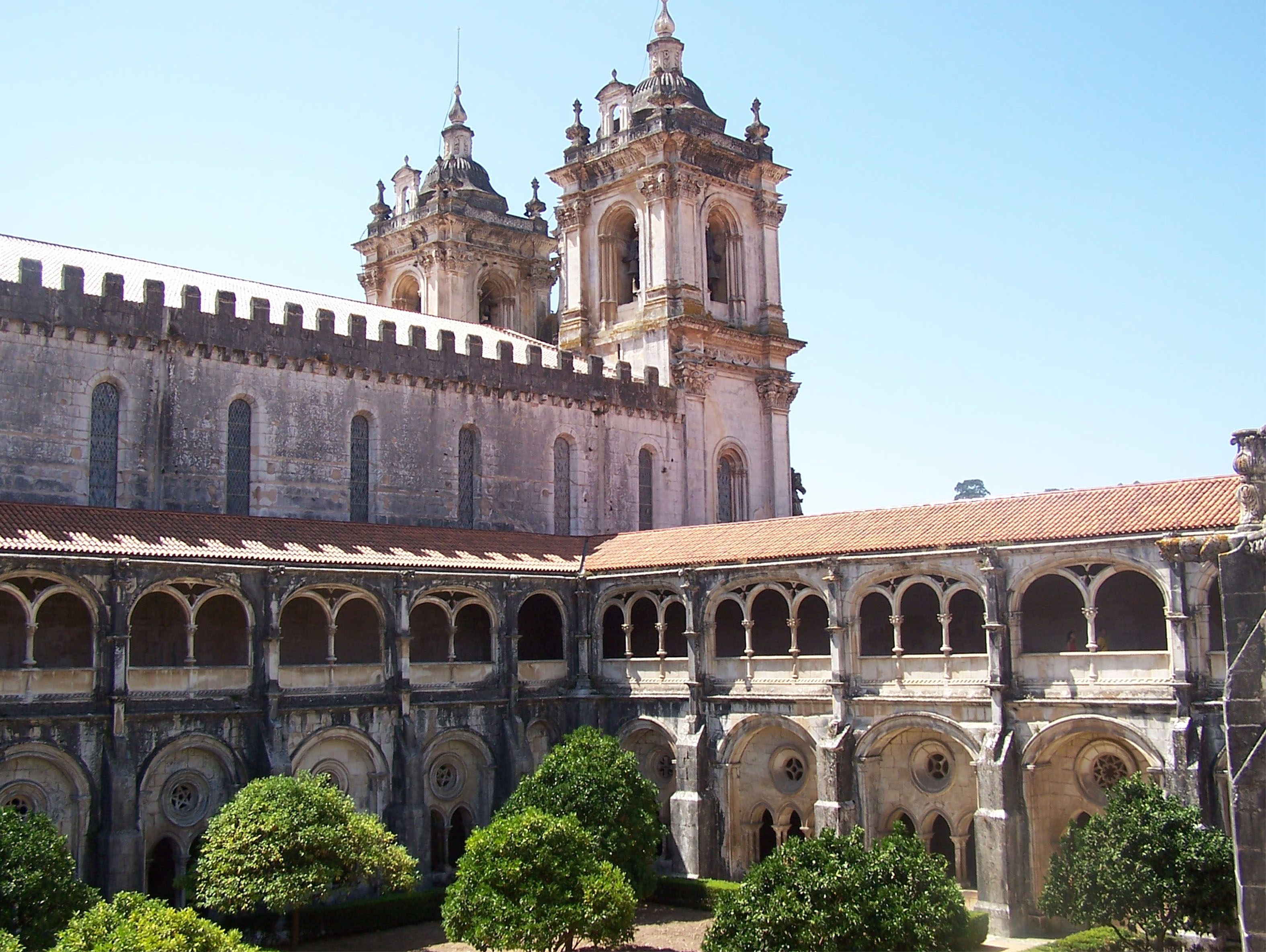
Alcobaca Monastery
According to legend, King Pedro I of Portugal had the corpse of his murdered lover crowned queen and forced the court to kiss her decomposing hand. Whether or not the story is true, the magnificent Gothic tombs of Pedro and Ines de Castro still face each other across the transept of Alcobaca Monastery, positioned so that on the day of resurrection, the first thing each will see is the other's face. This macabre romance is only one chapter in the story of Portugal's most important medieval monastery, a place where power, faith, and architecture converged for nearly seven centuries.
A King's Gratitude in Stone
The monastery owes its existence to a battlefield promise. In March 1147, King Afonso Henriques -- Portugal's first king -- conquered the Moorish city of Santarem during the Reconquista. Grateful for victory, he gifted the surrounding lands to Bernard of Clairvaux and the Cistercian Order. Construction began in 1178, and what rose from the Portuguese countryside was nothing less than the first truly Gothic building in the nation. The church, consecrated in 1252, stretches 106 meters in length, making it the largest in Portugal -- a distinction it still holds after more than 800 years. Its three aisles soar to 20 meters, and the Cistercian insistence on austerity left the columns and walls bare of decoration, allowing the architecture itself to speak through proportion and light.
The Murdered Lover and the Mad King
The monastery's most haunting residents arrived after tragedy. Ines de Castro, the Galician noblewoman beloved by Crown Prince Pedro, was assassinated in 1355 on the orders of Pedro's own father, King Afonso IV, who feared her family's political influence. When Pedro became king, his vengeance was swift and terrible -- he had two of her killers' hearts torn out. He then ordered Ines's remains transferred to a lavish tomb at Alcobaca. The pair of 14th-century tombs rank among the finest Gothic sculpture in Portugal. Pedro's rests on carved lions, Ines's on half-human, half-beast figures. Angels attend both, and the sides overflow with reliefs depicting scenes from their lives and from scripture, including a Last Judgement where the lovers' fate will be decided for eternity.
Monks, Fish, and a River Through the Kitchen
At its peak around 1300, Alcobaca supported nearly 1,000 monks and operated as a self-sufficient empire of farming, fishing, and trade -- the richest monastery in Portugal. The ingenuity of monastic life is on display in the kitchen, rebuilt in the mid-18th century and tiled floor to ceiling. Its enormous central chimney rests on eight iron columns, but the real marvel is engineering, not decoration: the monks diverted a branch of the River Alcoa directly through the kitchen, channeling fresh water and live fish to where they were needed most. In the refectory next door, monks ate in silence while a brother read scripture from a pulpit carved into the wall, accessible only through an arched gallery and staircase -- one of the monastery's most harmonious architectural details.
Survival Through Fire and Revolution
Alcobaca survived the catastrophic 1755 Lisbon earthquake with only minor damage to the sacristy. Far worse came from human hands. During the Peninsular War, Napoleon's troops looted the library, ransacked the royal tombs, and burned interior decorations. In 1834, Portugal dissolved its monasteries entirely, and the last monks walked out of Alcobaca's gates forever. What remains is a palimpsest of centuries: the original 12th-century Gothic bones, a Manueline sacristy corridor with its distinctive twisted rib vaulting, the Cloister of Silence built by King Dinis I with one of the largest medieval Cistercian cloisters in Europe, and a Room of the Kings lined with blue-and-white 18th-century azulejo tiles narrating the monastery's history. UNESCO recognized this layered masterpiece in 1989, adding it to the World Heritage list.
Echoes in the Nave
Walking through Alcobaca today, the scale still astonishes. The nave's slender proportions -- 17 meters wide, 106 meters long -- create a corridor of light that draws the eye irresistibly forward. The Royal Pantheon, built in the late 18th century, holds the 13th-century tomb of Queen Urraca of Castile, its sides carved with Apostles under rounded arches in a style that blends Romanesque and Mudejar influences. In the Chapter House, Baroque statues created by the monastery's own monks fill a room where daily life was once governed by readings from the Rule of Saint Benedict. The monastery is both a monument to the power that built it and a reminder of how fragile that power proved. Seven centuries of continuous occupation ended in a single decree, but the stone endures.
From the Air
Located at 39.55N, 8.98W in Portugal's Oeste region, roughly midway between Lisbon and Coimbra. The monastery complex is visible from moderate altitude as a large pale structure in the town of Alcobaca. Nearest airports include LPMT (Monte Real Air Base, ~25 km north) and LPJF (Lisbon Portela, ~110 km south, ICAO: LPPT). Approach from the west offers views of the rolling agricultural landscape that once sustained the monastery's vast estates.