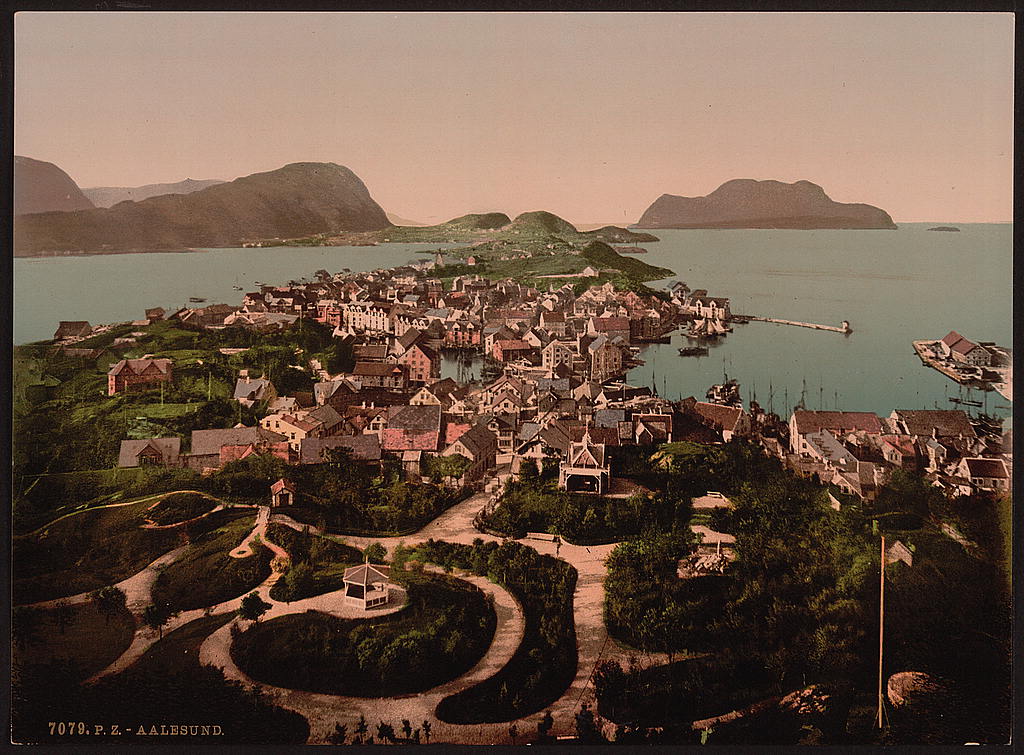
Alesund Fire
A cow kicked a torch. That is the local explanation for how, on the night of January 23, 1904, the Norwegian coastal city of Alesund began to burn. By the time the sun rose over the Sunnmore coast, nearly 850 wooden houses had been reduced to ash, more than 10,000 people had fled into the freezing January darkness, and the city center had effectively ceased to exist. Only one person died -- an elderly woman who went back inside her house to retrieve her purse. The catastrophe that followed would transform Alesund from a cramped timber fishing port into one of Europe's finest collections of Art Nouveau architecture.
A Gale-Fed Inferno
The fire started around 2 AM on the island of Aspoya, inside the Aalesund Preserving Co.'s factory. A strong southwesterly gale was already hammering the coast. When two fire crews reached the scene, smoke and sparks rained so thickly that their horses panicked and had to be blindfolded before they could be led forward. The factory was already engulfed, and by the time hoses were connected, four neighboring buildings were ablaze. Water pressure was too low to reach the rooftops. The wind lofted embers across streets, across blocks, across the open water of the Brosund channel. Firefighters established line after line -- at Prestegate, at Langeberggate, at Hellegate -- and abandoned each one as sparks jumped their positions. At one point, a warehouse 1.5 kilometers away ignited from windblown embers. The fire chief made a final stand at the Brosund water gap, but by then the wind had shifted from southwest to northwest, scattering flames across an ever-widening area.
Into the January Night
As the fire spread, it became clear that most of Alesund's population would have to leave. There was almost no shelter left within the town. A fortunate few escaped by boat. The elderly and sick were loaded onto wagons and carts, but most of the 10,000 residents fled on foot along Volsdalsvegen, carrying whatever they could grab in the few minutes between the alarm and the approaching wall of heat. They made for the villages of Volsdalen and Norve, tramping through the cold with children and bundles. Others took a path over the north side of Aksla mountain. The regional governor, Alexander Kielland, reported that more than 200 people spent the night huddled in Borgund Church. By morning, the town was a field of smoking rubble. Of the roughly 1,080 houses within the town borders, only about 230 remained standing.
The Kaiser's Ships
Help arrived with remarkable speed. Kaiser Wilhelm II of Germany, who had been a frequent summer visitor to the Norwegian fjords, received word while the fire was still burning. His first telegram reached Alesund before the embers had cooled. He dispatched four ships loaded with personnel, food, medicine, building materials, and equipment -- a gesture that left a lasting mark on the city's relationship with Germany. Aid poured in from across Norway and abroad, and the reconstruction effort began almost immediately. The question was not whether to rebuild, but how.
Reborn in Stone and Ornament
The answer was Jugendstil -- the Germanic name for Art Nouveau. Norwegian architects, many of them trained in Germany, designed a new city center in the flowing, organic style that was sweeping European capitals. Where cramped wooden houses with rudimentary sanitation had once stood shoulder to shoulder, masonry buildings rose with turrets, spires, and facades decorated with dragons, flowers, and human faces. The irony is hard to miss: a catastrophe that left a city in ruins also liberated it from medieval crowding. Modern historians have concluded that the fire was actually positive in terms of city development. Today, Alesund's Art Nouveau district is one of the most architecturally unified in Europe, a streetscape of curving stone and wrought iron that owes its existence to a single disastrous night. The Jugendstil Centre, housed in a former pharmacy from 1907, tells the story of destruction and reinvention.
Walking the Rebuilt City
Alesund spreads across several islands at the mouth of the Storfjorden, its colorful facades reflected in the harbor waters. Climbing the 418 steps to the summit of Aksla -- the same mountain that sheltered fleeing residents in 1904 -- reveals the full panorama: the Art Nouveau rooftops, the surrounding islands, and the open Norwegian Sea beyond. The fish-processing industry that powered the old wooden city is still visible in the harbor, though tourism now rivals it. From above, the dense, orderly blocks of the rebuilt center contrast sharply with the older wooden neighborhoods that survived on the fringes, a visible boundary between what the fire took and what it left behind.
From the Air
Alesund is located at 62.47N, 6.16E on the Sunnmore coast of western Norway, spread across several islands. Approach from the west over the Norwegian Sea for the most dramatic view of the island-city layout. The Art Nouveau district is visible as a dense cluster of pastel-colored masonry buildings around the harbor. Aksla mountain (189m) rises behind the town center. Nearest airport is Alesund Airport, Vigra (ENAL), located on an island approximately 15 km northeast. Altitude recommendation: 1,500-3,000 ft for harbor detail. The Storfjorden extends inland to the southeast.