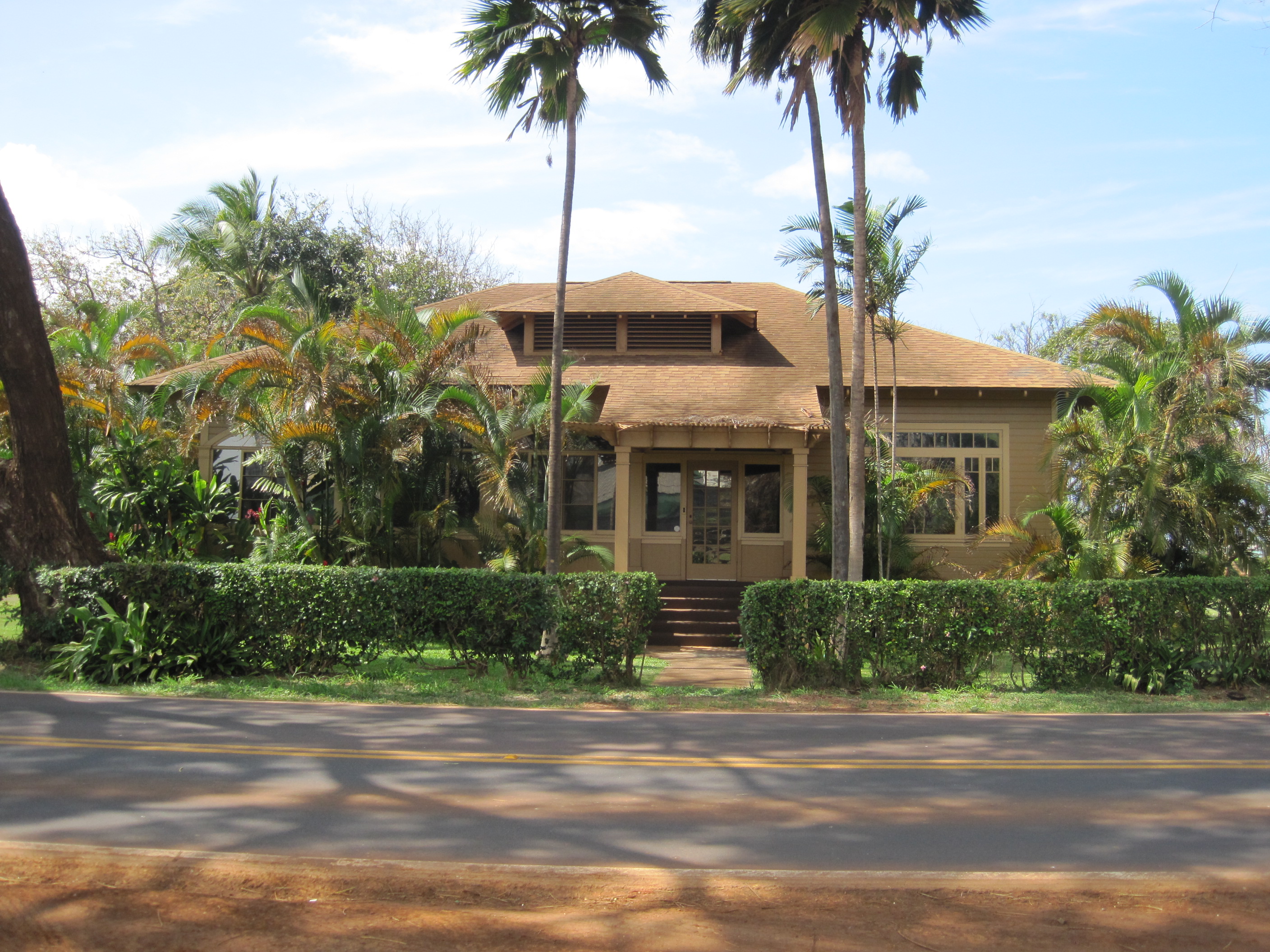
Alexander & Baldwin Sugar Museum
The problem was water. In the 1870s, Samuel Thomas Alexander and Henry Perrine Baldwin owned 561 acres of sugarcane fields between Pāia and Makawao on Maui's central plain. Rain fell abundantly on the windward slopes of Haleakalā, miles away through dense rainforest, while their fields baked in semi-arid sunshine. Alexander's solution was audacious: a 17-mile irrigation aqueduct tunneled and carved across the mountain, diverting water from where it was plentiful to where it was profitable. Completed in 1878 at three times its estimated cost, the Hamakua Ditch transformed Maui's dry forests into some of the most productive sugarcane land in the Pacific. Today, the Alexander & Baldwin Sugar Museum in Puʻunēne tells the story of that transformation from the former mill manager's house.
Missionary Sons, Sugar Kings
Both founders came from missionary families. Alexander's parents had been among the early Protestant missionaries to Hawaiʻi; Baldwin was the son of Dwight Baldwin, the minister and doctor who had served Lahaina through the devastating epidemics of 1848-1849. The two families became friends when the Alexanders and Baldwins arrived from New England in the early 1830s, and their children intermarried. Alexander became manager of the Waihēe sugar plantation near Wailuku in 1863 and hired Baldwin as his assistant. By 1870, they had formed the Pāia plantation under Alexander's name. When the Reciprocity Treaty of 1875 removed American tariffs on Hawaiian sugar, the partners saw the opportunity — but only if they could solve the water problem that limited production on Maui's leeward slopes.
An Aqueduct Across a Volcano
Alexander knew about Hawaiian irrigation systems from his time at Lahainaluna School, but what he proposed was on an entirely different scale. He negotiated a 20-year lease of water rights from King Kalākaua for just $100 per year, and his brother James surveyed the route. Construction began in 1876. For two years, workers carved channels and tunnels through the volcanic rock of Haleakalā's slopes, racing against a deadline in the lease. They finished in 1878. The cost overrun was staggering, but the results were transformative. Water flowed from Haleakalā's rainforests to the dry central plain, and sugar production exploded. The partners sold surplus water to neighboring plantations, compounding their advantage. By 1877, Baldwin had built the Hamakuapoko Mill near the irrigated fields, and in 1881 the Kahului Railroad connected the sugar to the growing port of Kahului.
From Partnership to Empire
Success bred expansion. In 1884, Alexander organized Hawaiian planters into the Sugar Factors group, which evolved into the California and Hawaiian Sugar Company — C&H, a brand still recognized on grocery shelves. In 1898, Alexander and Baldwin purchased a controlling interest in Hawaiian Commercial & Sugar Company from the sugar baron Claus Spreckels. By 1899, they owned two of Maui's railroad lines. The partnership officially incorporated as Alexander & Baldwin on June 30, 1900, with offices in Honolulu and San Francisco. When the McKinley Tariff raised sugar duties in 1889 and prices crashed to two cents a pound, Baldwin used the downturn to buy land cheaply and build irrigation projects on Kauaʻi. Alexander, meanwhile, became an adventurer — bicycling through Europe in 1893 and sailing the Pacific in 1896, visiting the Marquesas Islands where his missionary parents had once traveled.
One of the Big Five
Alexander & Baldwin grew into one of the "Big Five" corporations that dominated Hawaiʻi's territorial economy, controlling sugar production, shipping, land, and eventually tourism. The company purchased the Matson Navigation Company and was added to the Dow Jones Transportation Average. Baldwin's descendants owned The Maui News until 2000. The museum in Puʻunēne occupies the former mill manager's house beside the sugar mill that anchored the company's Maui operations. Inside, it traces the arc from missionary children planting cane by hand to an industrial empire that reshaped an archipelago. The irrigation channels still run. The sugar industry has largely ended, but its imprint on Maui's landscape — the cleared fields, the water infrastructure, the plantation towns — remains visible from any altitude.
From the Air
Located at 20.87°N, 156.45°W in Puʻunēne, on Maui's central isthmus between the West Maui Mountains and Haleakalā. The former sugar mill complex and museum are visible near the Puʻunēne crossroads. Nearby airport: Kahului Airport (PHOG/OGG), approximately 2 nm north. At 3,000-5,000 ft AGL, the vast former cane fields of the central plain are clearly visible, along with the irrigation infrastructure that transformed this landscape. Haleakalā rises to 10,023 ft to the southeast.