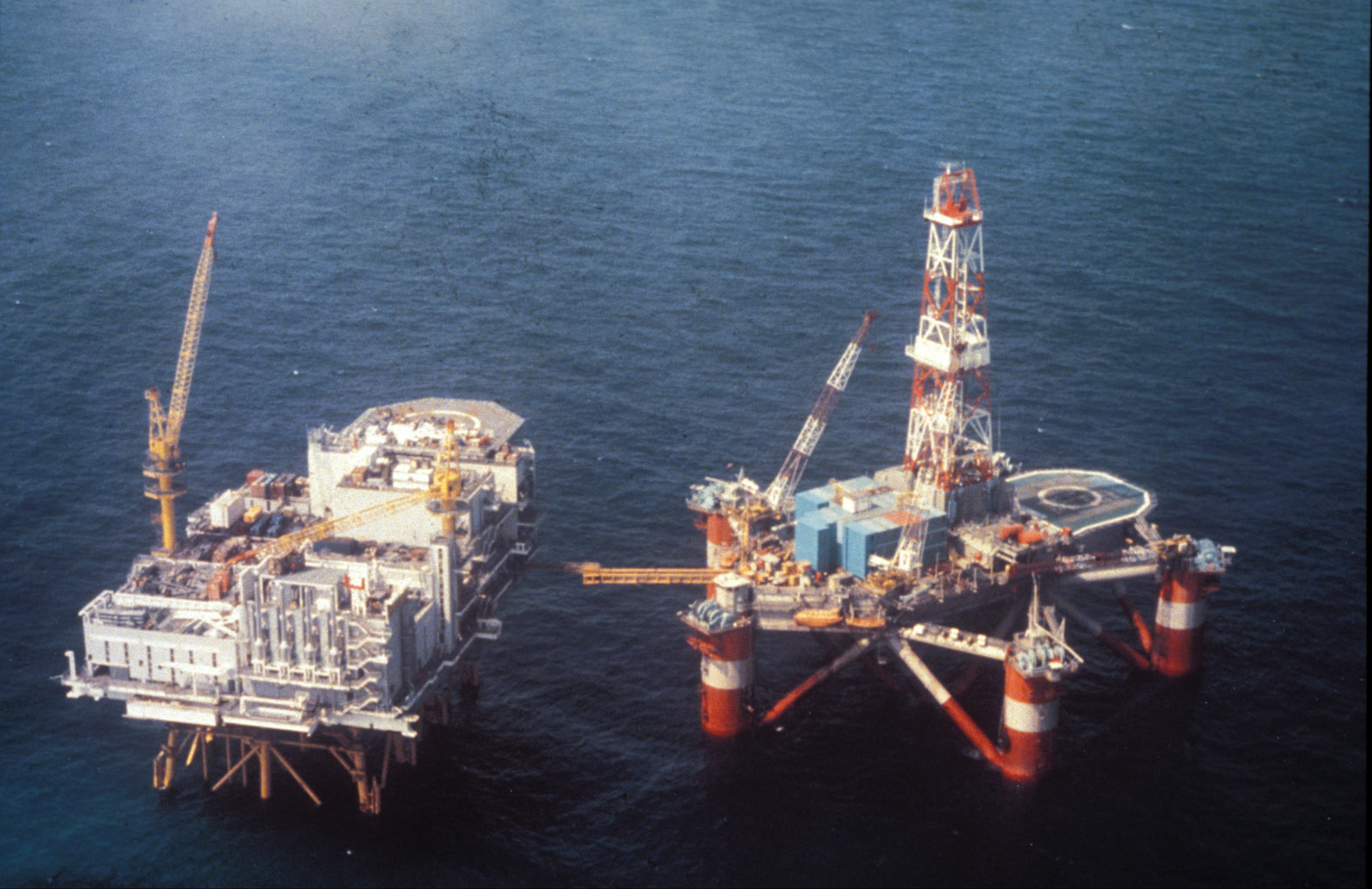
Alexander L. Kielland (Platform)
A six-millimeter weld held a small sonar bracket to a steel bracing tube. When that weld failed on the evening of 27 March 1980, a fatigue crack unzipped through the structure of the Alexander L. Kielland, a semi-submersible platform serving as a floating hotel for oil workers in the Ekofisk field. Within fourteen minutes, the entire rig capsized in twelve-meter swells and forty-knot winds. Of the 212 men aboard, 123 died -- making it the deadliest offshore disaster in Norwegian history and, at the time, the worst oil rig catastrophe the world had ever seen.
A Floating Village in the North Sea
Named after the Norwegian novelist Alexander Lange Kielland, the rig was built at a French shipyard and delivered to the Stavanger Drilling Company in July 1976. It was designed as a mobile drilling unit, but by 1980 it served a different purpose entirely: a "flotel," providing living quarters for workers on the nearby Edda 2/7C production platform. Additional accommodation blocks had expanded its capacity to 386 people. Situated roughly 320 kilometers east of Dundee, Scotland, the Kielland floated in one of the world's most demanding marine environments. The North Sea's relentless swells and wind subjected every weld, brace, and cable to constant cyclic stress -- forces that, unknown to anyone, were slowly widening a crack that had likely existed since the rig was built.
Fourteen Minutes
Early that evening, more than 200 men were off duty. Some watched a film in the cinema. Others ate in the mess hall. Rain fell through dense fog, and the rig had just been winched away from the Edda platform when a sharp crack echoed through the structure, followed by a deep trembling. The Kielland heeled thirty degrees and held, suspended by a single remaining anchor cable. For fourteen agonizing minutes, men scrambled in a world tilted sideways. Four lifeboats launched, but a safety mechanism prevented three of them from releasing -- the hooks could not disengage under load. At 18:53, the last cable snapped. The rig flipped. A fifth lifeboat surfaced upside down, and its occupants righted it, pulling nineteen men from the freezing water. Others clung to rafts thrown from the Edda platform. Seven men managed to swim to the Edda itself. Hours later, a Dutch vessel from Smitlloyd arrived and heard voices calling through the fog, but the visibility was so poor that no one could be seen. Most of the dead were from Rogaland, the oil-industry heartland of Norway.
The Flaw in the Steel
An investigation completed in March 1981 traced the catastrophe to bracing D-6, a structural member connecting one of the rig's five support columns. A small fillet weld joining a non-load-bearing flange plate -- the bracket that held a sonar device -- had a poor profile that reduced its fatigue strength. The flange plate showed lamellar tearing, and cold cracks riddled the underlying groove weld. Paint found on part of the fracture surface suggested the damage dated to the rig's original construction in 1976. When D-6 failed, the remaining structural members lacked the redundancy to absorb the load. They broke in rapid sequence, and the entire column collapsed. The design contained no fail-safe against a single-point failure of this kind.
What the Dead Changed
The Kielland disaster reshaped offshore safety worldwide. North Sea installations adopted clear command hierarchies for emergency abandonment -- the fourteen-minute window had been survivable, but no one held the authority to order evacuation quickly enough. The failure of the lifeboats led the International Maritime Organization to mandate on-load release hooks for all lifeboats on merchant ships and oil rigs, a requirement that endures today. The rig was recovered on the third attempt in 1983 and scuttled in Nedstrand Fjord after investigators finished their work. A memorial called "Broken Chain," depicting a fractured chain link weighing five tonnes and standing four meters high, was erected in 1986 on the coast of Kvernevik. But closure came slowly. A 2025 study by the University of Stavanger concluded that families and survivors had been failed by the original investigations. The Norwegian government issued an apology, and in June 2025 the Storting voted to award compensation -- forty-five years after the platform turned upside down in the dark.
From the Air
Located at 56.46N, 3.10E in the Ekofisk oil field, central North Sea, roughly 320 km east of Dundee, Scotland. The site is open water with no visible surface features today. Nearest airports: Stavanger Sola (ENZV), Aberdeen Dyce (EGPD). Fly at 2,000-5,000 ft to survey the surrounding oil platforms of the Ekofisk complex. Expect frequent low cloud, fog, and strong winds characteristic of the North Sea.