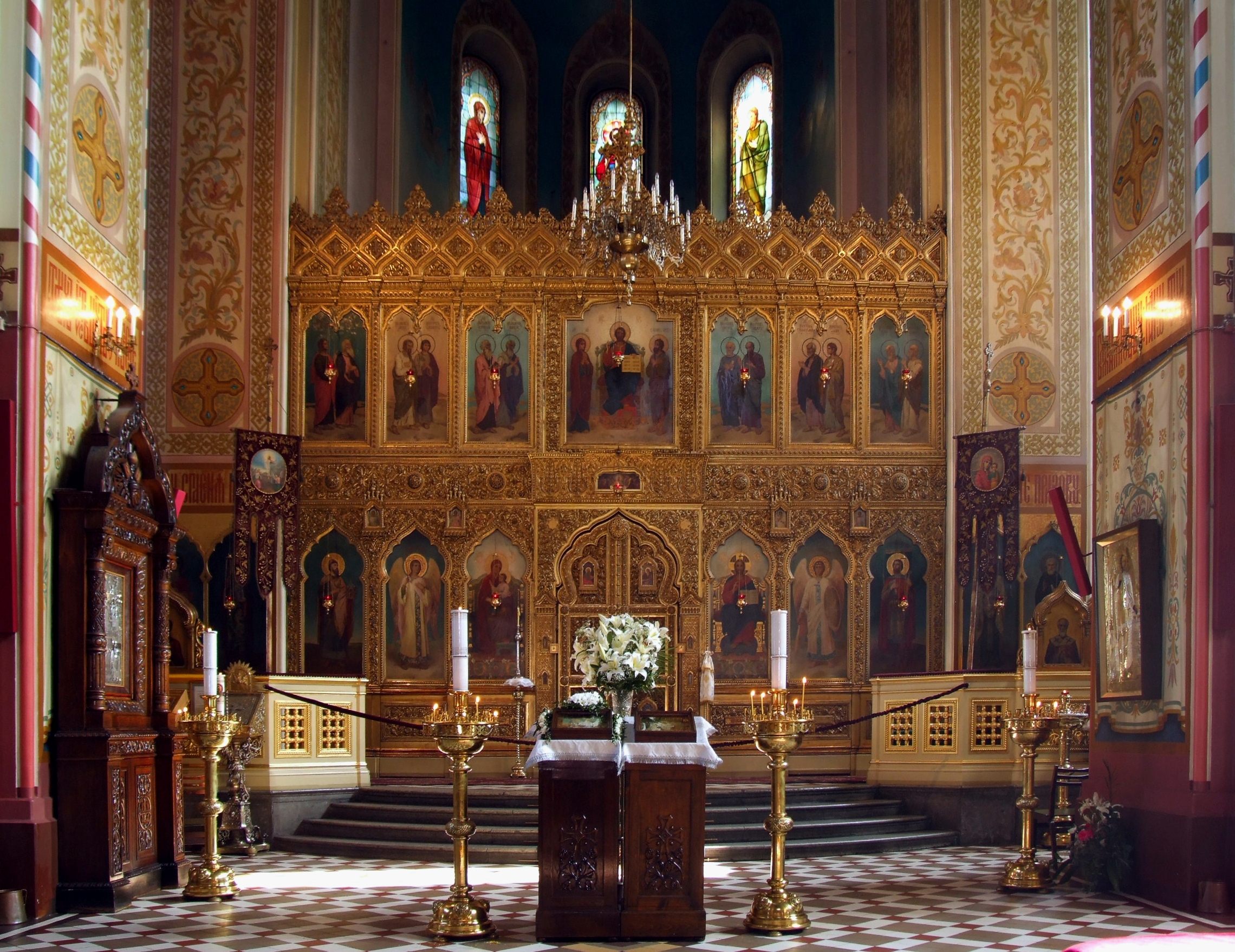
Alexander Nevsky Cathedral, Tallinn
On Toompea hill in Tallinn, the Russian Empire built a cathedral. It went up between 1894 and 1900, in the typical Russian Revival style of the era - five black-grey onion domes crowned with gold crosses, walls of pale stucco articulated with limestone, mosaics of Byzantine saints inside the porches. From its position on the high ground of the upper town, the Alexander Nevsky Cathedral looks down at the medieval Lutheran Toomkirik a hundred meters away and out across the lower town's Hanseatic spires. That was the point. Tallinn in the 1890s was the capital of Estland, a province of the Russian Empire whose population was largely Estonian-speaking and Lutheran. The cathedral was the empire's argument, in stone and gold, that the people who lived here belonged to it.
Russification in Architecture
The cathedral was designed by Mikhail Preobrazhensky, a St. Petersburg architect specializing in the Russian Revival idiom that Tsar Alexander III had adopted as the official style of imperial Orthodoxy. It is named for Alexander Nevsky, the 13th-century prince of Novgorod and Vladimir who defeated the Teutonic Knights on the ice of Lake Peipus in 1242 - a particularly pointed dedication in a city whose medieval Old Town had been built by those same Teutonic and Hanseatic Germans. The construction was funded partly by an imperial subsidy. The site, the highest visible point in central Tallinn, was chosen deliberately. The cathedral became part of a broader Russification campaign in the Baltic provinces during the 1880s and 1890s: laws making Russian the language of administration, restrictions on Lutheran clergy, pressure on Estonian and Latvian schools. The cathedral's 1900 consecration came at the height of that campaign. The young priest who began his ministry there in the 1950s, Aleksy Ridiger, would go on to become Patriarch Alexy II of Moscow, head of the Russian Orthodox Church from 1990 until his death in 2008.
Almost Demolished, Twice
Estonia declared independence in 1918. Almost immediately, Estonian politicians and architects began discussing what to do about the cathedral. To many, it was a monument to an empire whose forced russification they had just escaped. In 1924 the Estonian architect Karl Burman proposed either demolishing it or rebuilding it as a Pantheon of Estonian Independence. A demolition was actually scheduled for 1 May 1929 and then cancelled. The parliament debated the question repeatedly through the 1920s and 1930s. The cathedral survived. After 1944, when Estonia was occupied by the Soviet Union, the new Soviet authorities were officially atheist - and were not about to tear down a Russian-built church in a Soviet republic. The building was left to deteriorate; many of its sister cathedrals across the Soviet Union were converted into warehouses or museums of atheism. After Estonia regained independence in 1991, the building and its interior have been meticulously restored. The mosaics inside the porches - including a depiction of Vsevolod I Yaroslavich, the medieval Kievan Rus prince - have been cleaned and the gilded crosses replaced.
A Living Parish in a Free Country
Today the cathedral is the primary seat of the Estonian Orthodox Church of the Moscow Patriarchate, the larger of two Orthodox jurisdictions in Estonia. (The other, the Estonian Apostolic Orthodox Church, answers to the Ecumenical Patriarchate in Constantinople and uses other parishes.) The congregation here is largely Russian-speaking - a community of about 300,000 ethnic Russians who have lived in Estonia for generations. They go to confession and to liturgy here. They light candles. They have their children baptized in the marble font. They have nothing to do with the Russian Empire that built the cathedral, and most of them want nothing to do with the policies of the Russian Federation today. They are Estonian citizens or residents. They are also Orthodox, and this is their cathedral.
The Argument Returns
After Russia's full-scale invasion of Ukraine in 2022, the question of the cathedral returned to Estonian public debate. Mario Kadastik, a member of the Estonian parliament from the Estonian Reform Party, proposed creating a park in its place. Other politicians have proposed that the building be transferred from the Moscow Patriarchate to the Constantinople-affiliated Estonian Apostolic Orthodox Church. Some have proposed nothing, on the grounds that the cathedral is now part of Tallinn's heritage regardless of why it was built. The Estonian government in 2024 began the legal process of requiring the cathedral's parish to formally separate from the Moscow Patriarchate. The discussion is uncomfortable in every direction. Tearing down a church to make a political statement is an action with its own historical resonances; leaving it untouched is an argument that history is permanent. There is no neat answer. Most Estonians appear to want the building to stay - as a reminder of what was done, and as a place where people who live here today can still pray.
What You See From Toompea
Climb the steps from the lower town up to Toompea and the cathedral is the first thing you see when you reach the platform. Climb a little further, past the cathedral and the Toompea Castle - which now houses the Estonian parliament, the Riigikogu - and you reach the viewing platforms above the city walls. From there, you look down at red Hanseatic roofs, the spire of St. Olaf's Church, the Baltic harbor. The cathedral itself is in your peripheral vision. It is bigger than the parliament building. It is where it is. The history that put it there is not erasable, and the people who pray inside it now did not commission it. The two facts coexist, somewhat uneasily, the way many things in Tallinn coexist - a city that has been Danish, German, Swedish, Russian, Soviet, and Estonian, and has not stopped being any of them.
From the Air
Coordinates 59.436°N, 24.739°E. The cathedral stands on Toompea hill in central Tallinn, immediately recognizable from the air by its five large grey-black onion domes contrasted against the red roofs of the Old Town. Best viewed at 2,000-3,000 feet AGL on approach to or departure from Tallinn. Nearest airport is Tallinn Airport (EETN), about 5 km southeast of the Old Town. Lennart Meri Tallinn Airport's approaches give clear views of Toompea on certain runway alignments.