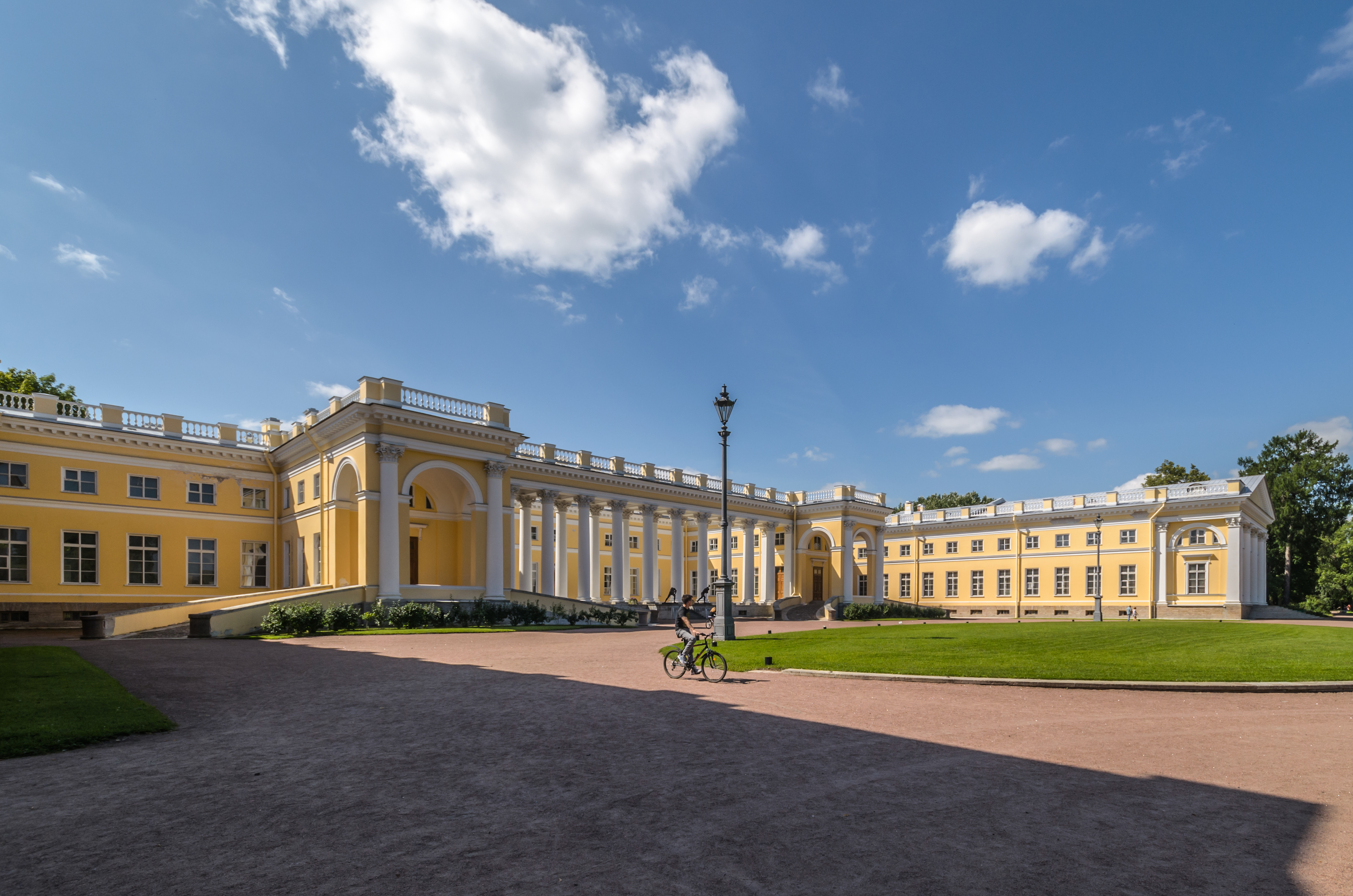
Alexander Palace
Catherine the Great commissioned the Alexander Palace in 1792 as a wedding present. Her favorite grandson - the Grand Duke Alexander Pavlovich, fifteen years old and about to marry a German princess - needed a country house at Tsarskoye Selo, near her own enormous Catherine Palace. The architect was Giacomo Quarenghi, the Italian whose neoclassical idiom had defined her Saint Petersburg. The result is restrained where the Catherine Palace is operatic: a long horizontal mass with a colonnade at the center, calm proportions, large windows. It does not look like a palace where a dynasty would end. But it is.
Quarenghi's Plain Masterpiece
Construction ran from 1792 to 1796. The two-story palace sits on a plateau about 30 miles south of central Saint Petersburg, in the imperial retreat that the Romanovs had been developing since the time of Peter the Great's daughter Elizabeth. Where the Catherine Palace next door is exuberant Rastrelli Baroque - all blue, white, and gold - Quarenghi's Alexander Palace is calm Palladian neoclassicism. The double colonnade between the two main wings is its defining feature. The architect's son later wrote that his father considered it his masterpiece. Catherine's grandson Alexander used it as a summer residence and, after he became Tsar Alexander I in 1801, mostly handed it back; he preferred the larger Catherine Palace next door. Alexander I gave the building to his brother, the future Nicholas I, who used it as a summer residence and remodeled the interiors heavily. The famous Mountain Hall, with its built-in indoor slide for his children, dates from this period.
Where Nicholas II Was Born
Alexander III and his Danish-born wife Maria Feodorovna lived in the western wing in the 1860s and 1870s, before he became Tsar. Their first child, the future Nicholas II, was born in the palace in 1868. After Alexander III died in 1894, Maria continued to visit her son and her daughter-in-law Alexandra Feodorovna here - though, as the diaries make clear, those visits became fewer as the relationship between the dowager empress and the new young empress deteriorated. Nicholas and Alexandra had four daughters and one son: Olga, Tatiana, Maria, Anastasia, and Alexei. Olga was born at the Alexander Palace; the others were born at Peterhof. After the Bloody Sunday massacre of 9 January 1905, when imperial troops killed unarmed petitioners outside the Winter Palace, Nicholas decided that the Winter Palace was no longer safe enough. The family moved permanently to the Alexander Palace. They would never live anywhere else.
Art Nouveau and Hemophilia
Alexandra Feodorovna - born Princess Alix of Hesse, granddaughter of Queen Victoria, raised in Darmstadt and Windsor - imported her tastes. To the horror of the imperial court, she remodeled the former two-story ballroom in then-modern Jugendstil and Art Nouveau, styles the Russian aristocracy considered middle-class and inappropriate for a tsarina. The Maple Room and her famous Mauve Boudoir date from these renovations. The palace was wired for electricity, equipped with a telephone system, and given a hydraulic lift between the empress's suite and the children's rooms upstairs. A film projection booth was installed in the Semicircular Hall when motion pictures arrived. The atmosphere inside was that of a wealthy late-Victorian English family. The Tsarevich Alexei, born in 1904, had inherited hemophilia from Victoria's bloodline through Alexandra. His suffering, and Alexandra's increasingly desperate reliance on the peasant healer Grigori Rasputin to comfort the boy, would become one of the public scandals of the dynasty's last years.
Colonel Romanov, Under House Arrest
Nicholas II abdicated on 2 March 1917 (Old Style), in a railway carriage at Pskov. Thirteen days later he returned to the Alexander Palace not as Emperor of Russia but as Citizen Romanov. The Provisional Government, under Alexander Kerensky, placed the imperial family under house arrest. They were confined to a few rooms of the palace. Their movements were restricted to a small section of the park, watched over by guards with fixed bayonets. Their correspondence was screened. They lived this way for five months, doing chores, planting a vegetable garden, conducting lessons for the children, attending Orthodox services in the palace church. Their tutors and a small staff stayed with them. In August 1917, the family was moved east to Tobolsk in Siberia. In April 1918, after the Bolshevik takeover, they were moved to Yekaterinburg in the Urals. On the night of 17 July 1918, in the cellar of the Ipatiev House, all seven members of the family - Nicholas, Alexandra, the four daughters, and the thirteen-year-old Alexei - were shot, along with their physician and three servants. The Soviet government did not publicly acknowledge the murders for decades. The remains were not formally identified until 1998.
Restoration as a Question
The Alexander Palace survived World War II battered but intact. For most of the Soviet period it was used as a museum, a recreation center, and a writers' rest home. After 1991 it slowly began to attract restoration funds, many of them from the World Monuments Fund and from private donors interested in the Romanov story. In 2010 three of the largest public rooms reopened - the Semi-Circular Hall, the Portrait Hall, the Marble Drawing Room. In 2014 the Russian government finally allocated significant money for a more complete restoration of the imperial family's private apartments. The palace closed in September 2015 for the work, and in August 2021 reopened the east wing - the New Study, the Moorish Bathroom, Nicholas II's Working Study, the Mauve Boudoir, the Imperial Bedroom, the Mountain Hall. The first floor of the wing, which once held the children's rooms, now houses an exhibition of objects belonging to imperial children across dynasties. To walk through these rooms is uncomfortable. The Romanovs were autocrats. They presided over a state that ruled millions of subjects with brutality. Their personal lives - the family photographs, the children's furniture, the toys - are nevertheless heartbreaking. Two facts that do not cancel each other. The palace, restored, holds both.
From the Air
Coordinates 59.721°N, 30.393°E. The palace lies in the town of Pushkin (formerly Tsarskoye Selo), about 30 km south of central Saint Petersburg. Recognizable from the air by its long, low Palladian profile and the central colonnade between two wings, set in extensive parkland next to the larger Catherine Palace. Best viewed at 2,000-3,000 feet AGL. Nearest airport is Saint Petersburg Pulkovo (ULLI), about 18 km northwest. Pushkin Airport (the site of the 1981 Tu-104 crash) is just 5 km east of the palace.