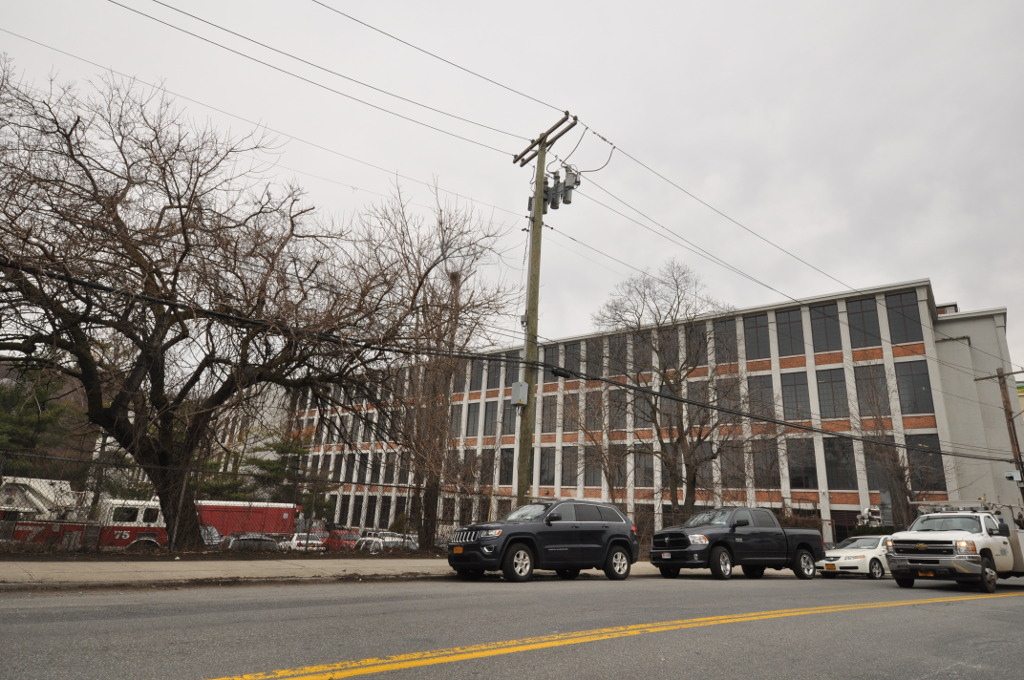
Alexander Smith Carpet Mills Historic District
The looms are gone, but the buildings remain. Along the banks of the Saw Mill River in northeastern Yonkers, nineteen mill buildings and six rows of workers' housing sprawl across a district that once produced more carpet than any complex in the world. The Alexander Smith Carpet Mills operated here from 1871 to 1954, employing 7,000 workers at their wartime peak and revolutionizing the carpet industry with machines invented on site. Today the factory floors hold painters, sculptors, and photographers, and Yonkers Deputy Planning Commissioner Louis Albano calls the district "our little baby SoHo going on in the Nepperhan Valley."
The Loom That Changed Everything
Alexander Smith, born in 1818, established his carpet works in Yonkers along the Saw Mill River, building the main mill in 1871 and expanding it between 1876 and 1883 into a three-story, fifty-two-bay-wide building in the Second Empire style, complete with a four-story tower and a five-story tower. But the real breakthrough came from his collaborator, engineer Halcyon Skinner. Skinner designed the Axminster power loom, also known as the Moquette Loom, and patented it in 1877. The machine could produce intricately patterned carpet at a speed and cost that hand-weavers could not match. Royalty rights were sold to European and American companies at twenty cents per yard of carpet produced. The invention did not merely improve the industry. It remade it entirely, turning decorative floor coverings from a luxury into a middle-class staple and turning Yonkers into the carpet capital of America.
Moquette Row
The workers who fed the looms needed somewhere to live, and the company built it for them. Between 1881 and 1886, six rows of housing known as Moquette Row, North and South, went up near the mills. The tenants were immigrants, arriving from Scotland, Ireland, and Ukraine to work the machines that Skinner had invented. The housing was functional, not luxurious, built to keep laborers close to their shifts. At its peak during World War II, the complex employed 7,000 people. By the time the mills closed in 1954 and the company relocated to Greenville, Mississippi, the workforce had shrunk to 2,400. The Smith company was eventually absorbed into Mohawk Carpet, which became the Mohasco Corporation. The buildings that remained in Yonkers fell quiet, their massive interiors slowly decaying along the riverbank.
Artists Move In
Rebirth came slowly, one studio at a time. As early as the 1980s, a handful of tenants began working out of the old factory buildings, drawn by the same qualities that attract artists everywhere: vast spaces, natural light from the clerestory windows, and cheap rent. When private developers acquired two buildings at 540 and 578 Nepperhan Avenue in 2005, they found twenty-five artists already in residence. This nucleus grew into the YOHO Artist Community. The developers nurtured the group through events and promotion, and over eight years the community expanded from twenty-five to eighty-five artists. The trend spread to other sections of the mills under different owners, and the developers began collaborating on events and lobbying city officials to formalize what was already happening organically.
From Factory Floor to Arts District
In April 2015, Mayor Mike Spano proposed the Carpet Mills Arts District. The Yonkers City Council cast a unanimous vote in favor in March 2016, and Spano signed the legislation on April 5. The formal boundaries stretch from Lake Avenue to Ashburton Avenue and from Nepperhan Avenue to Saw Mill River Road, encompassing a dozen buildings. The district received a $500,000 capital grant for improvements including landscaping, signage, and lighting. Annual Open Studios events, which had been drawing the public to YOHO for years, expanded into a citywide Yonkers Arts Weekend. The zoning change encouraged restaurants, galleries, and retail shops to join the artists already in residence. The district was added to the National Register of Historic Places in 1983, long before the arts revival, recognizing the architectural and industrial significance of eighty-five contributing buildings that document a century of American manufacturing from 1871 to 1930.
From the Air
Located at 40.943N, 73.884W in Yonkers, Westchester County, along the Saw Mill River northeast of Getty Square. The mill complex is visible as a cluster of large industrial buildings along Nepperhan Avenue and Saw Mill River Road. Nearest airports: KTEB (Teterboro, 12nm southwest), KHPN (Westchester County, 14nm north). The Hudson River is visible to the west; the Saw Mill River Parkway runs nearby.