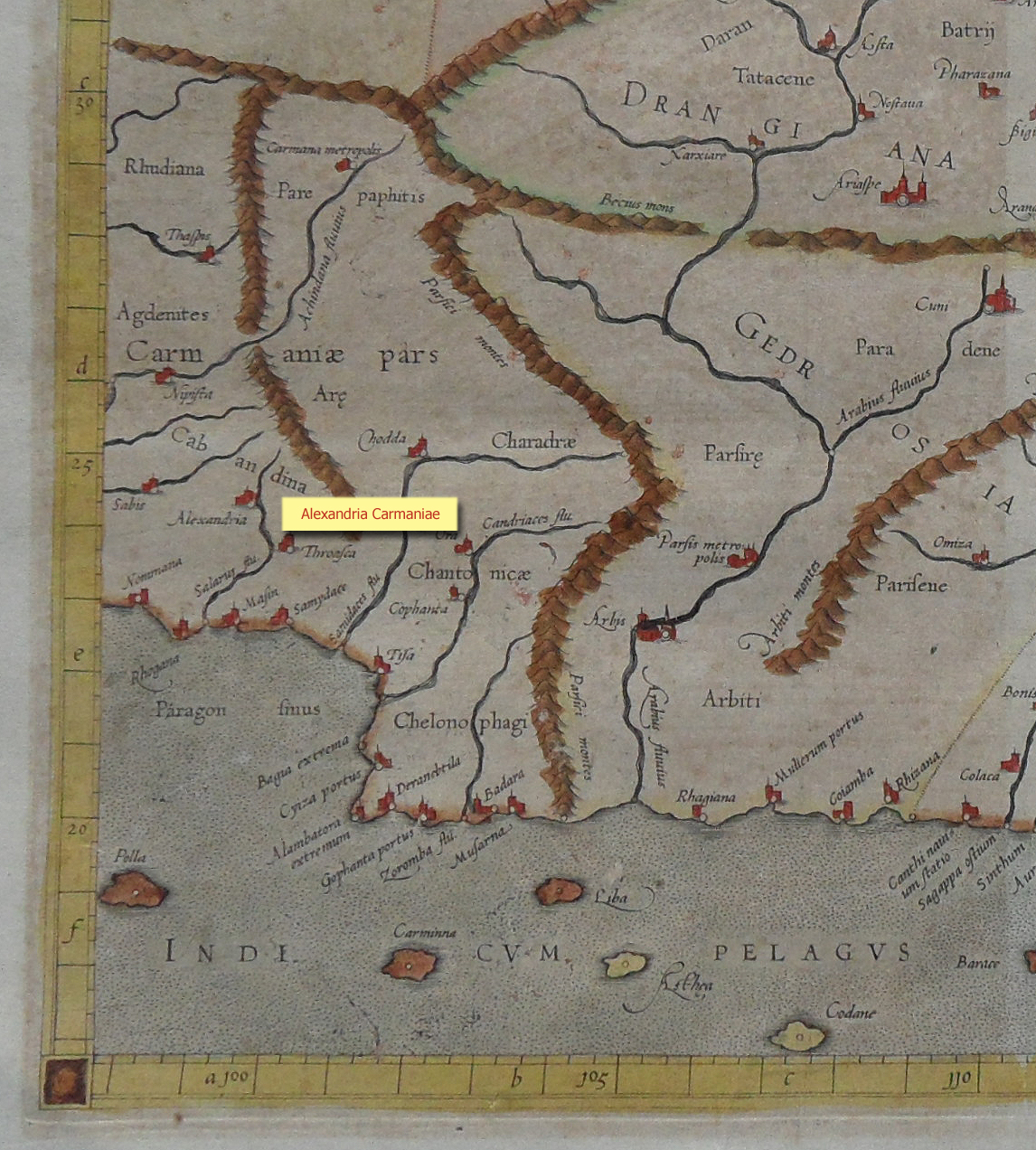
Alexandria Carmania
Somewhere near the village of Gulashkird in southeastern Iran lie the remains of a city that Alexander the Great founded in January 324 BC. Or they might not. Alexandria Carmania is one of the seventy-plus cities Alexander founded or renamed during his campaigns, and unlike many of the others, it has never been definitively located. The city was established after one of the most harrowing episodes in military history -- the reunion of Alexander's exhausted army with the fleet of his admiral Nearchus, who had sailed along the coast while Alexander marched his troops through the brutal Gedrosian Desert. The celebration was enormous. The city Alexander built to mark the occasion has been lost ever since.
The Reunion at Minab
Alexander's crossing of Gedrosia -- the arid wasteland of what is now the Makran coast of Iran and Pakistan -- had nearly destroyed his army. Thousands of soldiers, camp followers, and animals perished from heat, thirst, and starvation during the 60-day march through terrain that defeated every previous army that attempted it. Meanwhile, Nearchus had been tasked with sailing the fleet from the Indus River along the coast to the head of the Persian Gulf. The two forces reunited near the mouth of the Minab River in what was then the satrapy of Carmania. Alexander, relieved and triumphant, founded a city to commemorate the reunion. The location made strategic sense: reliable water from the Minab, positioned at the convergence of mountain passes from Afghanistan and the route into Gedrosia, with good access to Indian Ocean ports at nearby Hormosia.
The Search for a Lost City
For centuries, scholars have tried to pin Alexandria Carmania to a specific location. The most commonly cited candidate is Gulashkird, a village in Iran at roughly 27 degrees 57 minutes north latitude. The British explorer Percy Sykes argued for Rudbar, 5 kilometers north of Gulashkird, based on surface finds of Greek pottery he discovered there. Other candidates include the village of Gav Koshi, unexplored ruins northwest of Gulashkird, and even a site called Shahr-i Dakyanus near Jiroft -- named, intriguingly, after the Roman Emperor Decius. The 1569 world map of Gerardus Mercator, drawn from Ptolemy's second-century geography, places Alexandria Carmania further west on the Salarus River. The historian Peter Fraser went furthest of all, arguing that the city might never have existed. All the main candidates, however, cluster within a few kilometers of each other in the Minab River valley.
Survival Through the Centuries
If Alexandria Carmania is Gulashkird, then the city survived well into the medieval period under the name Camadi. Marco Polo passed through. The Arab geographer al-Muqaddasi described it as a strongly fortified town with a castle called Kushah, surrounded by lush orchards and fields supported by extensive qanat irrigation -- the underground water channels that made Persian agriculture possible in arid landscapes. The contrast between this description and the barren terrain visible today speaks to the environmental changes that have swept through southeastern Iran over the past millennium. Water that once sustained orchards and vineyards has been diverted, aquifers depleted, and the qanat systems that once threaded underground for miles have fallen into disrepair. If Alexandria Carmania still lies beneath the soil near Gulashkird, it rests in a landscape that would be unrecognizable to its founder.
The Ghost of Alexander
Alexandria Carmania belongs to a specific category of historical site: the place you know existed but cannot quite find. No systematic archaeological excavation has been conducted at the most likely locations. The ruins northwest of Gulashkird remain unexplored. The Greek pottery Sykes found on the surface of Rudbar has never been followed up with a proper dig. The city sits in a region where modern political boundaries, limited archaeological funding, and difficult terrain conspire to keep the past buried. But the evidence suggests it is there -- a city founded at a moment of profound relief by a conqueror who had just walked through hell, in a valley that once ran green with water channeled through ancient engineering. Somewhere under the brown earth of Hormozgan province, Alexander's celebration continues to wait.
From the Air
The proposed site of Alexandria Carmania lies near Gulashkird, Iran, at approximately 27.949N, 57.299E. The terrain is arid and mountainous, characteristic of the transition zone between the Zagros foothills and the Makran coast. The Minab River valley runs through the area. No nearby airports serve the immediate area; the nearest major field is Bandar Abbas International (OIKB), approximately 120 km to the southwest. From altitude, the valley is visible as a relatively green corridor cutting through otherwise barren mountains -- the same geographic logic that made Alexander choose this site.