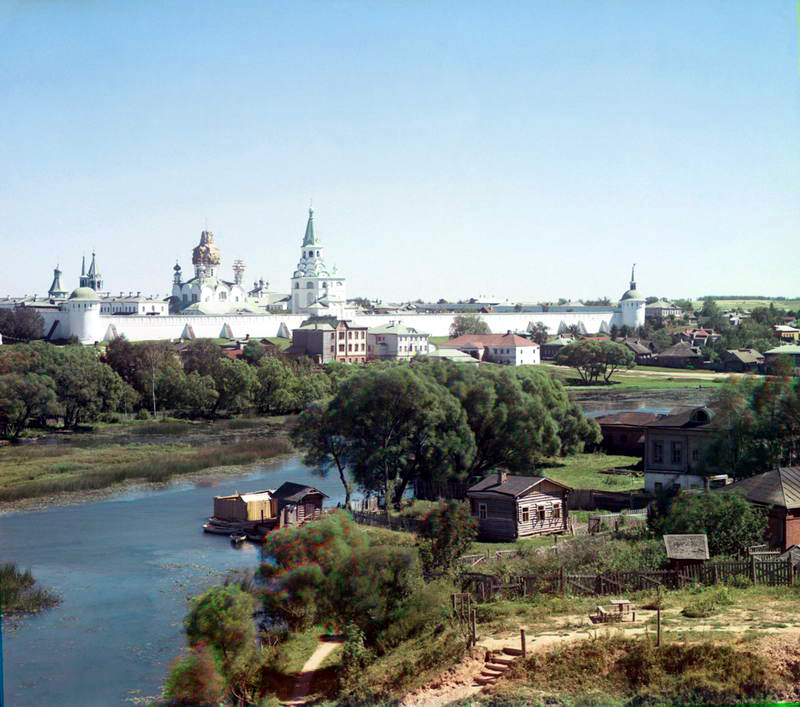
Alexandrov Kremlin
The gates of St. Sophia Cathedral in Novgorod were made by craftsmen who carved the doors, then rubbed each groove with a paste of liquid gold and mercury. Religious figures shared space with fantastical ones -- centaurs among the saints. These gates hung in Novgorod for over two centuries, until Ivan the Terrible sacked the city in 1570 and carried them away as trophies. He installed them at the Alexandrov Kremlin, his fortress in Vladimir Oblast, where they remain to this day. A building that displays stolen art as decoration tells you something about the man who lived there.
A Country Palace Turned Capital
Alexandrovskaya village dates to the mid-14th century, but it became significant when Grand Duke Vasily III built a country palace there and began bringing his family and the entire court for extended stays. The palace itself did not survive, but the Pokrovsky Cathedral, sanctified in 1513 and later rededicated as the Trinity Cathedral, still stands. Its original decoration combined red brick and white stone, though later generations painted over the brickwork. Some interior frescoes date back to the 14th century, and white stone carvings in the portals are equally old -- layers of artistry predating the building's most notorious resident by two hundred years.
Ivan's Shadow Capital
In 1565, Ivan the Terrible abandoned Moscow and moved to Alexandrovskaya. He immediately fortified the residence with bulwarks, wooden walls, and a moat, transforming a country estate into a stronghold. From here he founded the oprichnina, his personal domain of terror that operated as a state within the state. The march on the Novgorod Republic -- which ended in the city's brutal sacking -- launched from these walls. Ambassadors from Sweden, Denmark, Austria, England, and the Polish-Lithuanian Commonwealth traveled to this fortress in the Russian countryside to negotiate with the tsar. For seventeen years, Alexandrov functioned as Russia's actual capital, a place where foreign diplomats presented their credentials alongside plundered cathedral doors. Ivan also brought gates from the Transfiguration Church in Tver, dated to the 1340s and 1350s, and installed them at the western entrance. An etched image of the Holy Trinity on one of those doors survives.
Departure and Afterlife
Ivan left the fortress in 1581 and never returned. The circumstances of his departure remain bound up with one of the darkest episodes of his reign: the killing of his own son, an event traditionally associated with Alexandrov. After the tsar's exit, the fortress lost its political importance. In the second half of the 17th century, the Assumption Nunnery was established on the grounds, converting the seat of oprichnina terror into a place of contemplation and prayer. The nuns inherited a complex freighted with violent history but rich in architectural detail -- 14th-century frescoes, golden gates from Novgorod, etched doors from Tver.
Between Museum and Monastery
During the Soviet era, the fortress and its former nunnery were repurposed as a museum, their religious function suppressed along with so many others across Russia. After the collapse of the Soviet Union, the nunnery was revived, and today the Alexandrov Kremlin is shared between the museum and the religious community. Visitors walk through the same gates that ambassadors from half of Europe once entered, past the same cathedral walls where Ivan plotted the destruction of Novgorod. The Kremlin sits in the modern city of Alexandrov, a place that most travelers pass through on the way to the Golden Ring's more celebrated stops. But few sites in Russia carry such concentrated menace in their stones -- a fortress built for pleasure, converted to paranoia, sanctified by nuns, and preserved by the state.
From the Air
Located at 56.40°N, 38.74°E in the city of Alexandrov, Vladimir Oblast. The kremlin complex is visible from altitude as a walled compound with cathedral domes northeast of the city center. Best viewed at 3,000-6,000 feet. Approximately 120 km northeast of Moscow. Nearest airports: Sheremetyevo (UUEE) approximately 110 km southwest, Chkalovsky (UUMU) approximately 90 km south.