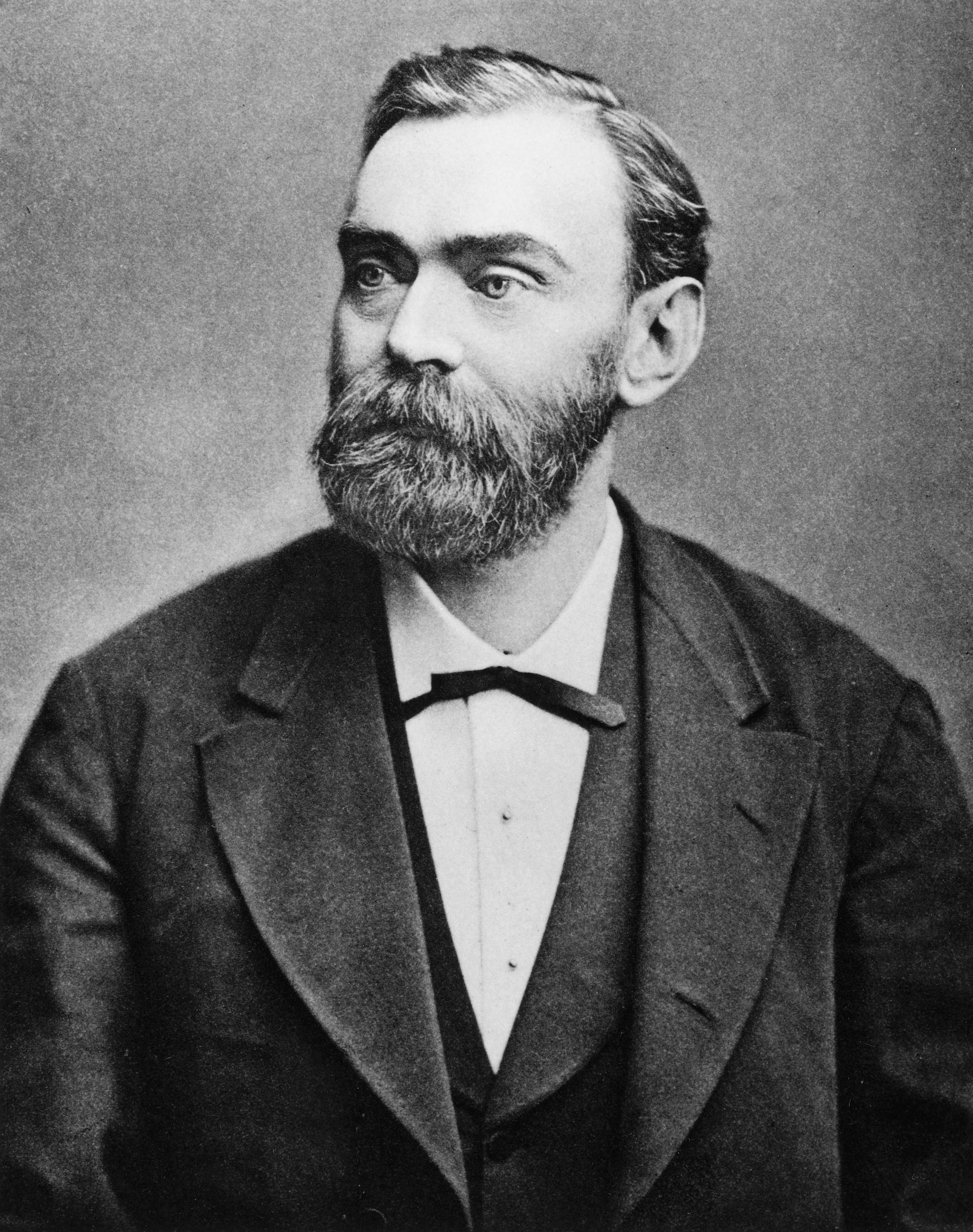
Alfred Nobel
A premature obituary changed everything. In 1888, when a French newspaper mistakenly reported Alfred Nobel's death and condemned him as a "merchant of death" who had grown rich from explosives, the Swedish chemist was very much alive to read his own damning legacy. Whether myth or truth, this moment is said to have haunted Nobel, ultimately inspiring him to transform his fortune of 31 million Swedish kronor into the Nobel Prizes. Born in this Stockholm neighborhood on October 21, 1833, Nobel spent his life mastering the contradiction between creation and destruction.
The Impoverished Genius
The Nobel family's early years in Stockholm were marked by poverty and loss. Of eight children, only Alfred and three brothers survived childhood. His father Immanuel, himself an inventor who developed the naval mine and modern plywood manufacturing, moved the family to Saint Petersburg when Alfred was nine, where sudden prosperity allowed the boy access to private tutors. Alfred proved exceptional, mastering six languages and developing a passion for chemistry. By age 18, he was studying in Paris and meeting Ascanio Sobrero, the Italian chemist who had created nitroglycerin three years earlier but refused to develop it further, calling it too unpredictable. Nobel saw potential where Sobrero saw only danger.
Taming the Beast
Nitroglycerin was devastatingly powerful but fatally unstable, prone to exploding from the slightest heat or pressure. Nobel spent years searching for a way to control it. The breakthrough came when he discovered that mixing nitroglycerin with kieselguhr, a diatomite sedite earth, created a stable compound that could be shaped into sticks and detonated on command. He patented this invention in 1867 and called it dynamite. Later innovations followed: gelignite in 1875 and ballistite in 1887. His 355 patents and ownership of the armaments manufacturer Bofors made him enormously wealthy, but the work came at a cost. Some historians believe chronic exposure to nitroglycerin contributed to his declining health, an irony not lost on doctors who later prescribed the very compound to treat his heart condition.
The Loneliest Millionaire
Despite his wealth, Nobel lived as a solitary figure plagued by depression and migraines he described as "paralyzing." He never married, though he maintained an 18-year relationship with Sofie Hess, a Viennese woman 17 years his junior whom he met in a flower shop. Their correspondence, preserved in 221 letters, reveals a complicated man capable of both generosity and cruelty. Nobel traveled constantly, maintaining residences in Hamburg, Paris, and finally Sanremo, Italy, after France accused him of treason for selling ballistite to Italy. He was an atheist who nonetheless donated generously to the Church of Sweden, a man who manufactured weapons yet dreamed of peace.
A Legacy Rewritten
Nobel's will shocked his family. Of his vast fortune, 94 percent would establish five prizes recognizing those who "conferred the greatest benefit to humankind" in physics, chemistry, medicine, literature, and peace. The Royal Swedish Academy of Sciences, which Nobel had joined, would choose the science laureates. His will specified that nationality should play no part in the selection, a radical notion in 1895. On December 10, 1896, Nobel suffered a stroke in his Italian villa and died at 63. He is buried at Norra begravningsplatsen cemetery in Stockholm, the city of his birth. By 2022, the Nobel Foundation held approximately 6 billion Swedish kronor, ensuring that the merchant of death would be remembered instead for celebrating humanity's highest achievements.
From the Air
Located at 59.36°N, 18.02°E in central Stockholm, Sweden. The neighborhood of Nobel's birth lies near Norrlandsgatan. Best viewed at 2,000-3,000 feet for urban context. Stockholm Bromma Airport (ESSB) lies 5nm west; Stockholm Arlanda (ESSA) is the main international hub 20nm north. The Nobel Prize ceremony takes place each December 10th at Stockholm Concert Hall, visible from the air along with the distinctive City Hall where the Nobel Banquet is held.