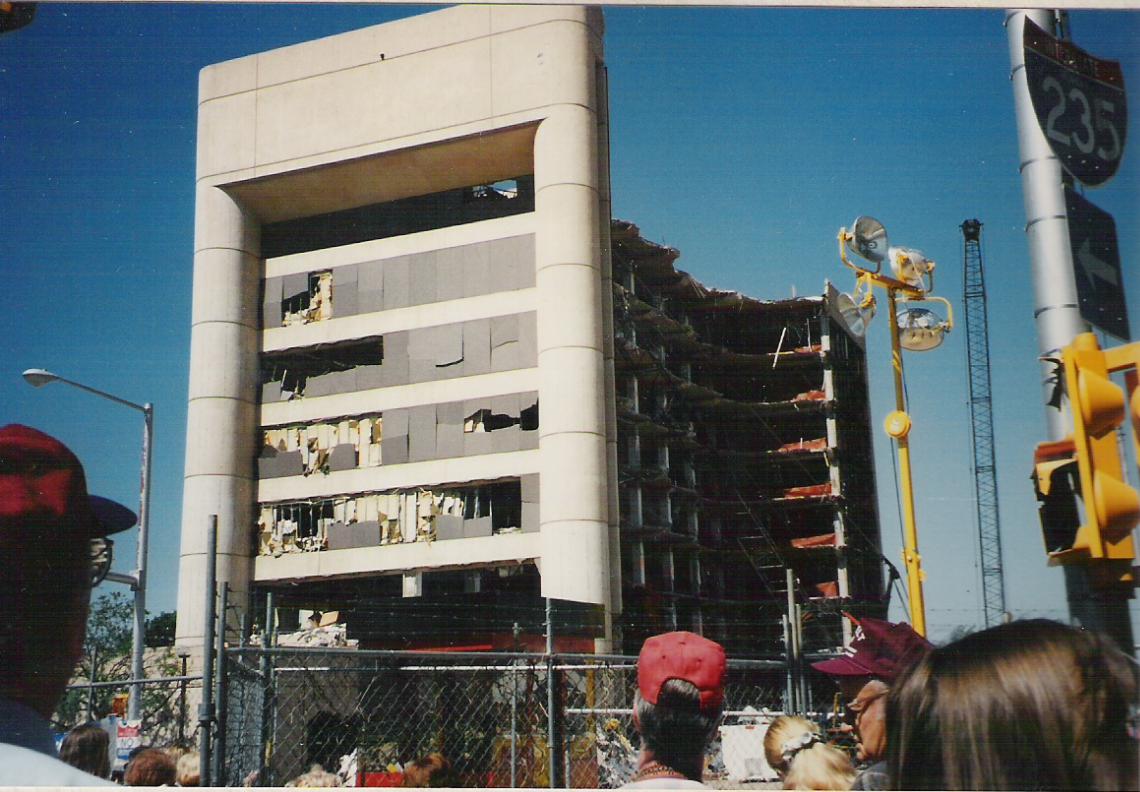
Alfred P. Murrah Federal Building
The building had been targeted before. In October 1983, members of the white supremacist group The Covenant, The Sword, and the Arm of the Lord plotted to park a van in front of the Alfred P. Murrah Federal Building and blow it up with rockets detonated by a timer. While constructing a rocket launcher, the ordnance accidentally detonated in a member's hands. The group took this as divine intervention and called off the attack. Twelve years later, at 9:02 a.m. on April 19, 1995, a different man with a different bomb succeeded where they had failed, and the nine-story reinforced concrete building at 200 N.W. 5th Street in downtown Oklahoma City entered history as the site of the deadliest act of domestic terrorism in America.
A Building and Its People
The Alfred P. Murrah Federal Building was designed by architects Stephen H. Horton and Wendell Locke and constructed by J.W. Bateson Company of Dallas, Texas. Built from reinforced concrete in 1977 at a cost of $14.5 million, it was named for federal judge Alfred P. Murrah, an Oklahoma native, and opened on March 2, 1977. By the 1990s, the building housed regional offices for the Social Security Administration, the Department of Housing and Urban Development, the Secret Service, the Drug Enforcement Administration, and the Bureau of Alcohol, Tobacco, and Firearms, along with military recruiting offices. Approximately 550 employees worked there. On the second floor was America's Kids, a day care center. An estimated 650 people were inside when the bomb went off.
Nine-Oh-Two
Timothy McVeigh parked a Ryder rental truck containing approximately 7,000 pounds of ammonium nitrate fertilizer, nitromethane, and diesel fuel in a drop-off zone directly beneath the day care center. The explosion destroyed a third of the building and caused severe damage to 324 other structures within a four-block radius. The shattered glass alone accounted for five percent of the deaths and sixty-nine percent of injuries outside the Murrah Building. The blast registered approximately 3.0 on the Richter scale at seismometers in Norman, Oklahoma. In total, 168 people were killed, including 19 children, 15 of them in the day care center. More than 800 others were injured. McVeigh was stopped by a state trooper within ninety minutes for driving without a license plate and was arrested for carrying a concealed weapon. He was convicted and executed by lethal injection on June 11, 2001. Co-conspirator Terry Nichols received multiple life sentences.
What Survived, What Was Lost
The Murrah Building contained dozens of artworks when it was destroyed. Nineteen pieces were recovered from the rubble and are now displayed at the University of Central Oklahoma's Max Chambers Library, including sculptures, photographs, tapestries, and fiber art. Seven works were lost entirely, among them Gerhardt Knodel's fiber sculpture Sky Ribbons: An Oklahoma Tribute and Jerry McMillan's bronze Palm Tree Coil. An acrylic sculpture by Fred Eversley was severely damaged but survived the blast. Rescue and recovery efforts concluded on May 1, with the bodies of all but three victims recovered. In the days following, trucks hauled 800 tons of debris daily from the site. Some debris served as trial evidence, some was incorporated into memorials, and some was donated to schools or sold to raise relief funds.
Memorial and Renewal
Several remnants of the original building still stand within the Oklahoma City National Memorial, built on the site. The east wall within the building's footprint remains intact, along with portions of the south wall. The original flagpole still flies the American flag. The underground parking garage survived the blast and remains in use, though it is guarded and closed to the public. The memorial's field of 168 empty chairs -- one for each victim, arranged in nine rows representing the nine floors -- glows at night, each chair mounted on a glass base illuminated from below. The General Services Administration broke ground on a replacement federal building in 2001, completed in 2003. Designed by Ross Barney Architects of Chicago, the new 185,000-square-foot building incorporates blast-resistant glazing, structural design that resists progressive collapse, and security barriers integrated into a water feature that maintains openness while preventing truck access.
From the Air
The site of the former Alfred P. Murrah Federal Building is at 35.47N, 97.52W in downtown Oklahoma City. The Oklahoma City National Memorial now occupies the site, identifiable by its reflecting pool flanked by two large bronze gates marking 9:01 and 9:03. The Survivor Tree, a large American elm, is visible in the memorial grounds. Nearest airports: Wiley Post Airport (KPWA) about 8 miles northwest, Will Rogers World Airport (KOKC) about 10 miles southwest. The memorial is best appreciated from ground level, but the downtown Oklahoma City grid is clearly visible from 3,000-5,000 feet AGL.