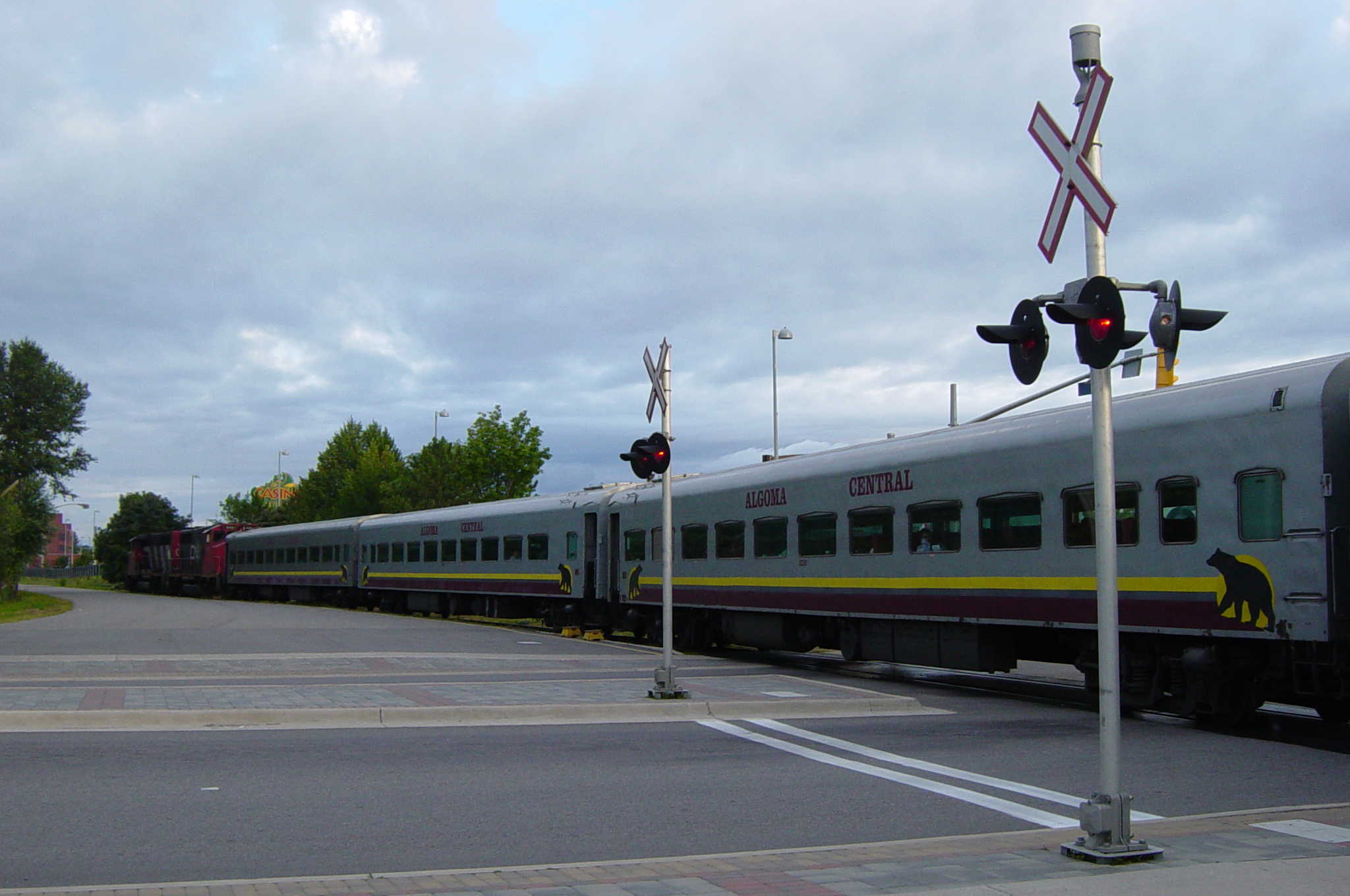
Algoma Central Railway
Stompin' Tom Connors wrote a song about it. The Group of Seven painted the landscape it crosses. For more than a century, the Algoma Central Railway has threaded its way through some of the most remote and beautiful terrain in Northern Ontario, connecting Sault Ste. Marie on Lake Huron's shore to the small town of Hearst, 296 miles to the north. The land it crosses has almost no roads. Without the railway, the forests, canyons, and lakes of the Algoma District would remain accessible only to those willing to bushwhack through boreal wilderness on foot.
An Empire Built on Iron and Pulp
The Algoma Central began as one man's supply chain. Francis H. Clergue, an American entrepreneur who had assembled a sprawling industrial empire in Sault Ste. Marie, needed a way to haul iron ore from the Helen Mine near Wawa and logs for his pulp mill. He secured a charter on August 11, 1899, and began building north from the Sault toward a junction with the Canadian Pacific Railway's main line. A branch would reach Michipicoten Harbour on Lake Superior. Clergue's ambitions ran even further: after acquiring the charter of the Ontario, Hudson Bay and Western Railway in 1901, he renamed his line the Algoma Central and Hudson Bay Railway, dreaming of tracks reaching all the way to James Bay or Hudson Bay. That dream died in 1903 when Clergue's Consolidated Lake Superior Company collapsed into bankruptcy. But the railway itself survived, and the tracks kept pushing north.
The Canyon That Saved a Railroad
By the 1960s, the railway had discovered something more valuable than ore or timber: scenery. The Agawa Canyon, a dramatic gorge carved by the Agawa River, sits 114 rail miles north of Sault Ste. Marie, completely inaccessible by road. The railway developed a tourist stopover there and struck gold of a different kind. The Agawa Canyon Tour Train became the railway's signature attraction, drawing around 100,000 visitors per year during the 1970s and 1980s. At peak season, the Algoma Central ran the longest passenger trains in North America, stretching 20 to 24 cars. Autumn was the star season, when the boreal forest exploded into a corridor of crimson, amber, and gold, framing the canyon's waterfalls and granite walls. The tour train continues to operate today under Watco, which purchased the southern segment of the line from Canadian National in 2022.
A Lifeline Under Threat
The railway's passenger service was never just a tourist attraction. For canoeists, snowmobilers, cottagers, and First Nations communities scattered through the Algoma wilderness, the train was a lifeline, the only way in or out of vast stretches of roadless bush. When Canadian National, which had acquired the line through its purchase of Wisconsin Central in 2001, announced plans to cut passenger service in 2014, the economic reality was stark. A study by BDO Canada found that passenger rail through the Algoma District generated between $38 million and $48 million in annual economic activity, supporting 220 jobs and delivering over $5 million in tax revenue. A $2.2 million federal subsidy kept trains running through 2015, but the service ultimately ended that year after a deal with Railmark Canada fell through. The Missanabie Cree First Nation began exploring taking operational control of the line in 2017, part of a broader pattern of Indigenous communities fighting to maintain transportation links in the north.
A Painter's Railway
The Algoma District's connection to Canadian art runs deep. In 2015, White Pine Pictures released the award-winning documentary Painted Land: In Search of the Group of Seven, filmed along the rail corridor. The following year, the Algoma Kinniwabi Travel Association launched the Moments of Algoma project, inviting tourists to retrace the travels of Lawren Harris, A.Y. Jackson, and their fellow painters who found in these forests, lakes, and rock faces the raw material for a national artistic identity. Interpretive installations now stand in Agawa Canyon and at the Sault Ste. Marie train station. The driving tour follows the Lake Huron and Lake Superior shoreline from Bruce Mines to Nipigon, connecting the landscapes that defined Canadian painting's most celebrated movement with the railway that first made them accessible.
New Tracks, Old Country
When Watco completed its purchase from Canadian National in 2022, the new short-line operator rebranded the southern segment as the Agawa Canyon Railroad, running from Sault Ste. Marie to Oba. Canadian National retained the northern stretch to Hearst. Watco signed a memorandum of understanding with the Missanabie Cree First Nation regarding a potential partnership, a signal that the railway's future might be shaped as much by Indigenous stewardship as by corporate strategy. From the air, the Algoma Central's path is a thin thread of cleared land cutting through endless boreal forest, crossing rivers on steel bridges, skirting lake shores, and disappearing into the canyon that made it famous. The land looks much as it did when Clergue's crews first laid rail through it more than 125 years ago.
From the Air
Centered at 49.06N, 84.10W in the Algoma District of Northern Ontario. The railway runs roughly north-south between Sault Ste. Marie (CYAM) and Hearst (CYHR). Agawa Canyon is located approximately 183 km north of Sault Ste. Marie and is visible as a deep gorge in the boreal forest. Best viewed at 5,000-10,000 ft AGL. The Montreal River bridges and Lake Superior shoreline near Michipicoten are prominent visual landmarks. The rail line itself is one of the few linear clearings visible through otherwise unbroken forest canopy.