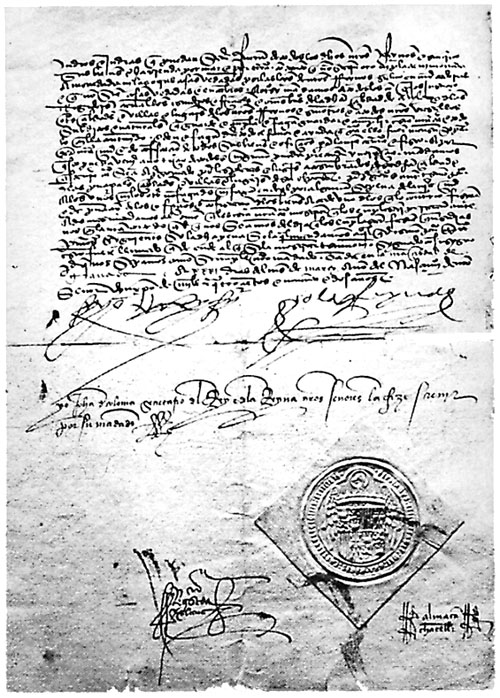
Alhambra Decree
On March 31, 1492 -- the same spring that Columbus would receive funding for his westward voyage -- Isabella I of Castile and Ferdinand II of Aragon signed an edict in the Alhambra palace ordering every unconverted Jew in Spain to leave by July 31. The document was bureaucratic in tone, legalistic in structure, and devastating in effect. It ended centuries of Jewish life on the Iberian Peninsula and scattered the Sephardic Jewish community across the Mediterranean world, from the Ottoman Empire to North Africa to the papal states of Italy. The decree's consequences are still being addressed by Spanish law more than five hundred years later.
Centuries of Coexistence, Then Collapse
Jewish communities had lived in Iberia since Roman times, and under the Muslim rulers of al-Andalus they had experienced a relative golden age. The Reconquista changed everything. As Christian kingdoms pushed southward, Jewish populations found themselves caught between shifting borders and rising religious intolerance. In 1391, a wave of pogroms and forced conversions swept across Spain, and over half the Jewish population converted to Christianity. By 1415, continuing violence had driven another 50,000 to convert. Those who converted were known as conversos, and their sincerity was immediately suspect. The Spanish Inquisition, established in 1478, existed in large part to investigate whether conversos were secretly practicing Judaism. The remaining Jewish communities, meanwhile, were accused of encouraging the conversos to return to their former faith -- the specific charge that the Alhambra Decree would cite as justification for expulsion.
The Edict and Its Human Cost
Of Spain's estimated 300,000 people of Jewish origin, over 200,000 had already converted to Catholicism by the time the decree was issued. Between 40,000 and 100,000 who remained Jewish faced a stark choice: convert or leave within four months. Many chose exile. The largest group crossed into Portugal, where they gained only a few years' reprieve before King Manuel I, pressured by Spain, declared them Christian by royal decree. Others scattered further. The Ottoman sultan Bayezid II welcomed the refugees, reportedly commenting that Ferdinand and Isabella were fools for giving away their most valuable subjects. Jewish communities took root in Thessaloniki, Istanbul, Sarajevo, and across North Africa. They carried with them the Ladino language -- a form of medieval Spanish -- their liturgical traditions, and the memory of what they had lost.
A Wound That Would Not Close
The decree was formally revoked on December 16, 1968, by the Franco regime, following the reforms of the Second Vatican Council. By then, Jews had been openly practicing their religion in Spain for a full century, and the revocation was largely symbolic. More substantive was the 2015 law passed by the Spanish government offering dual citizenship to Sephardic Jews who could prove descent from the expelled communities, intended to "compensate for shameful events in the country's past." The law expired in 2019, though descendants may still apply for Portuguese citizenship under a similar program. In 2013, the Jewish population of Spain was estimated at 40,000 to 50,000 -- a fraction of the medieval community, but a presence nonetheless, five centuries after the decree that was meant to erase it.
Signed in the Palace of the Vanquished
There is a bitter irony in the decree's location. The Alhambra, where Isabella and Ferdinand put their signatures to the expulsion order, was itself the masterwork of a vanquished civilization. The Nasrid rulers who built its courtyards and carved its arabesques had surrendered Granada to the Catholic Monarchs only three months earlier, on January 2, 1492. Jews and conversos had played an important role in financing the campaign to take Granada, raising money and acquiring weapons through their trade networks. Their reward was an edict of expulsion signed in the palace their efforts had helped conquer. The Alhambra Decree stands as one of the largest expulsions of Jews in European history, and officially the longest-lasting -- a distinction that speaks not to Spanish exceptionalism in cruelty, but to the depth of the wound it left on a nation's conscience.
From the Air
The decree was signed in the Alhambra palace complex in Granada, located at 37.176N, 3.588W atop the Sabika hill. The Alhambra is clearly visible from the air as a large fortified complex on a hill overlooking the city of Granada, with the Sierra Nevada mountains to the southeast. Nearest airport is Granada-Jaen (LEGR), approximately 15 km west of the city center.