Remember the Alhambra
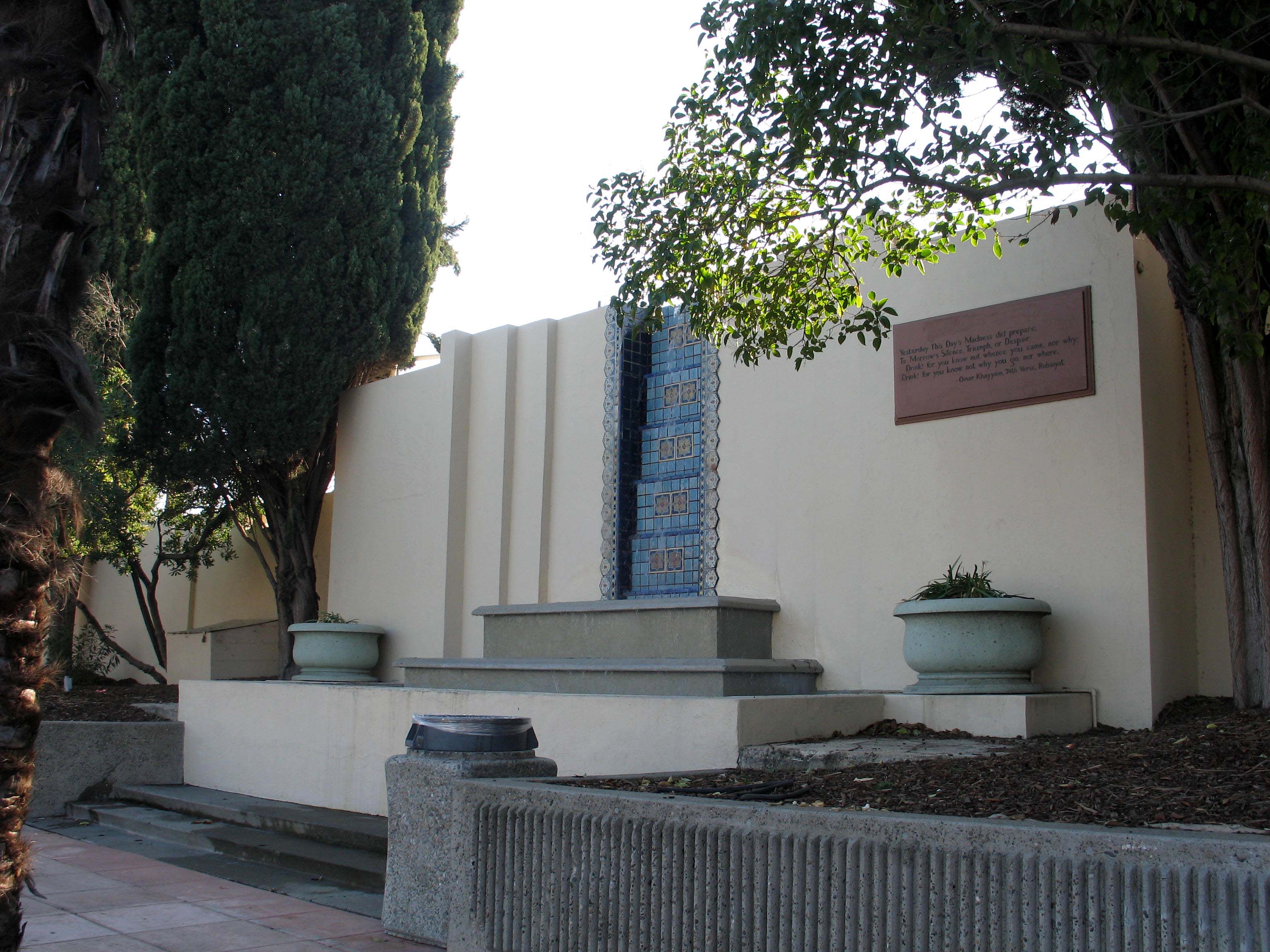
Where Sacramento's K Street once dead-ended into fantasy, a Safeway supermarket now sells rotisserie chicken. That parking lot, unremarkable in every way, holds a single clue to what stood here before: a stone fountain, still flowing, its Moorish arches incongruous among the shopping carts. It is the last surviving fragment of the Alhambra Theatre, a movie palace so lavish that its destruction in 1973 ignited a preservation movement Sacramento carries to this day. The slogan that movement adopted -- "Remember the Alhambra" -- is not nostalgia. It is a warning.
A Palace at the End of the Line
The Alhambra opened in 1927 at 1025 Thirty-First Street, directly beyond the eastern terminus of K Street, in Sacramento's East Sacramento neighborhood. The architectural firm of Starks and Flanders designed it in the Moorish style of Spain's great cities, with a large courtyard and fountain greeting patrons before they even stepped inside. The interior matched the exterior's ambition: red carpet, gold trim, and towering pillars created the atmosphere of a palace rather than a movie house. Leonard Starks, the New York-born architect who founded the firm in Sacramento in 1922, also designed the Fox-Senator Theatre, the Elks Building, C. K. McClatchy High School, and Sacramento's downtown post office. But the Alhambra was his showpiece, the building that announced Sacramento could rival San Francisco and Los Angeles in theatrical grandeur.
The Voice in the Walls
Every great movie palace had an organ, and the Alhambra's was a fifteen-rank instrument built by the Robert Morton Organ Company in 1927. In an era before synchronized sound became standard, the organ filled the theatre with mood and drama, its pipes concealed behind ornamental screens on either side of the stage. The organist scored the emotions the silent actors could only pantomime -- thunderstorms for the villains, tenderness for the love scenes, galloping rhythms for the chases. When sound film arrived and rendered the organ's narrative role obsolete, the instrument stayed on for intermissions and special performances. In 1960, the organ was removed from the Alhambra and relocated to the First Baptist Church in Stockton. It eventually found its way to the Kautz family's Ironstone Vineyards in Murphy's, California, where it continues to play -- the Alhambra's voice outlasting the Alhambra itself by more than half a century.
The Wrecking Ball and the Ballot
By the early 1970s, the Alhambra's days as Sacramento's preeminent movie house had passed. The building needed restoration, and a coalition of citizens pushed for public acquisition. In 1973, a bond measure appeared on the Sacramento ballot that would have allowed the city to purchase the theatre and preserve it. The measure failed. Without the protection public ownership would have provided, the Alhambra was demolished to clear the site for a Safeway supermarket. The public had opposed the demolition but not enough of them had voted. The speed of the loss stunned the city. One season Sacramento had a Moorish palace; the next it had a grocery store. The contrast was so absurd, so irreversible, that it crystallized something in the civic consciousness that decades of gradual demolitions had not.
A Fountain as a Tombstone
What rose from the rubble was not another building but a movement. The destruction of the Alhambra catalyzed Sacramento's historic preservation community, which organized, lobbied, and adopted "Remember the Alhambra" as its rallying cry. The phrase carried the weight of a lesson learned too late: once a building is gone, no bond measure can bring it back. That movement remains active today, having saved other Sacramento landmarks from the same fate. On the south side of the Safeway parking lot, the original fountain from the Alhambra's courtyard still stands, still functioning, its water flowing over stone arches that once welcomed moviegoers into a world of red carpet and flickering light. Shoppers pass it daily, most without a second glance. But for those who know what it represents, the fountain is less a decoration than a memorial -- proof that something extraordinary once stood on ground now given over to the ordinary.
From the Air
Located at 38.57N, 121.47W in Sacramento's East Sacramento neighborhood, at the former eastern terminus of K Street (now Alhambra Boulevard). The site is now a Safeway supermarket at 1025 Alhambra Boulevard. Sacramento Executive Airport (KSAC) is approximately 3nm south; Sacramento International (KSMF) lies 10nm northwest. The grid pattern of Sacramento's streets is clearly visible from 2,000-3,000 feet AGL, with K Street running east-west from the Capitol toward the former theatre site.