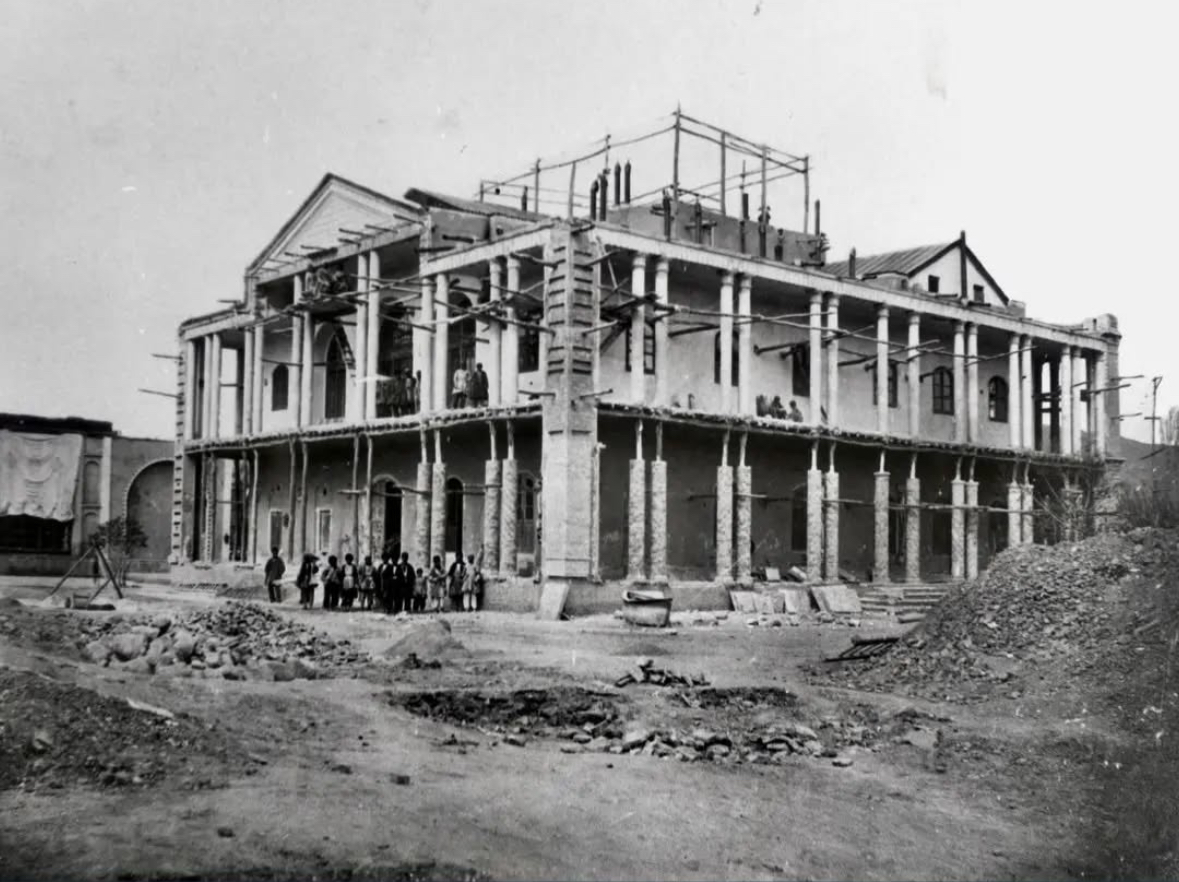
Ali Qapu (Tabriz)
The palace is gone. Where Ali Qapu once rose four stories above central Tabriz, crowned by a pediment and dome, there now stands the East Azerbaijan Governor's Office, a municipal building, and a bank. The demolition happened in the 1940s, during the Pahlavi era, erasing one of the most architecturally distinctive buildings in northwestern Iran. But the story of Ali Qapu -- its construction, its names, its music hall, and the suspicious fire that began its end -- tells as much about Tabriz's layered history as any standing monument could.
The Grand Gate and the Red Gate
Even the palace's name carried competing histories. One theory traces it to the Safavid rivalry with the Ottoman Empire. The Ottomans called the residence of their sovereign the "Bab-i Ali" -- the Sublime Porte, literally "Grand Gate." Not to be outdone, the Safavid shahs ordered their palace in Tabriz to be called "Ali Qapu," where "Ali" derives from the Azerbaijani Turkic word meaning "great" or from the Arabic for "exalted." A second theory proposes the name was actually "Ala Qapu" -- "colored gate" or "red gate" -- since "ala" in Azerbaijani Turkic means red. Both explanations point to the same impulse: this was a building meant to announce power. Some researchers even argue that the more famous Ali Qapu Palace in Isfahan was modeled after the one already standing in Tabriz.
From Safavid Throne to Qajar Stage
The palace was already standing during the reign of Shah Abbas I in the late 16th and early 17th centuries. When Abbas Mirza became crown prince under the Qajar dynasty, the building took on new life as the residence of Qajar princes, and the name Ali Qapu stuck. Under crown prince Naser al-Din Mirza, the building was entirely reconstructed in the neoclassical Qajar style, renamed Shams-ol-Emareh after a similar structure in Tehran. Four stories rose above the gardens. Mirror-decorated walls lined the reception halls. Marble gave the interiors a gravity befitting royal authority, and the painter Reza Abbasi filled ceilings with animal and floral motifs rendered in seven-colored tiles and rare stucco ornamentation. Under Mozaffar al-Din Shah, a harem building was added to the northern side of the garden.
Where Music Filled the Ceiling
The top floor held the Music Hall, a 63-square-meter room built on a cruciform plan. Its walls bore paintings, and its surfaces were covered with stucco reliefs shaped like vessels and decorative motifs -- intricate recesses that the painter Fred Richards described as resembling "pieces of a puzzle" arranged in peculiar order. The acoustics of the room were carefully engineered through these ornamental indentations. During Muharram and Ashura ceremonies, the palace garden became a gathering place for the city. Chest-beating and sword-striking rituals unfolded in the courtyard below, and the crown prince presented shawls to the leaders of mourning processions. The renowned vocalist Abul-Hasan Khan Eqbali Azar first gained fame here through his powerful performances during these ceremonies. The palace breathed with the rhythms of public life.
Three Gates and a Hidden Street
Ali Qapu had three main entrances, each with its own purpose. The first gate served crown princes and state officials. The second, on the eastern side, opened to the public -- particularly those attending Muharram rituals. The third was the harem gate, reserved for the royal family and close associates. Beyond the harem gate's northern entrance lay Haremkhaneh Street, an aristocratic quarter where merchants and scholars lived. The Shoemakers' Bazaar, known as Koshakchilar in Azerbaijani Turkic, occupied the eastern stretch. During the Qajar era, this street was one of Tabriz's most important centers and a favorite promenade. But during the Pahlavi period, the construction of government buildings consumed the historic area. Municipal works finished what modernization started, and the street all but vanished.
The Fire and the Silence
In 1933, during the governorship of Adib al-Saltaneh Sami, fire broke out and destroyed the upper floors and dome -- a rare surviving example of Zand and Qajar architecture reduced to ruin. The people of Tabriz mourned. A popular song was composed to mark the loss. Public opinion widely suspected the fire had been deliberately set, though no definitive cause was ever established. What the flames spared, the wrecking crews finished. By the 1940s, the palace was demolished entirely. The Central National Bank rose on the western portion of the site. In 1969, the harem building met the same fate, demolished to make way for an expansion of the governor's office complex. Today, near Martyrs' Square, nothing visible remains of Ali Qapu. The palace exists only in photographs, in drawings, and in that song of grief the people of Tabriz once sang.
From the Air
Located at 38.08°N, 46.30°E in central Tabriz, near modern-day Martyrs' Square. Tabriz International Airport (OITT) lies approximately 10 km to the northwest. The former palace site is now occupied by the East Azerbaijan Governor's Office and Tabriz Municipality buildings in the dense urban core. Lake Urmia is visible to the west from higher altitudes. Best approached at 5,000-10,000 ft for urban context, though no original structures remain.