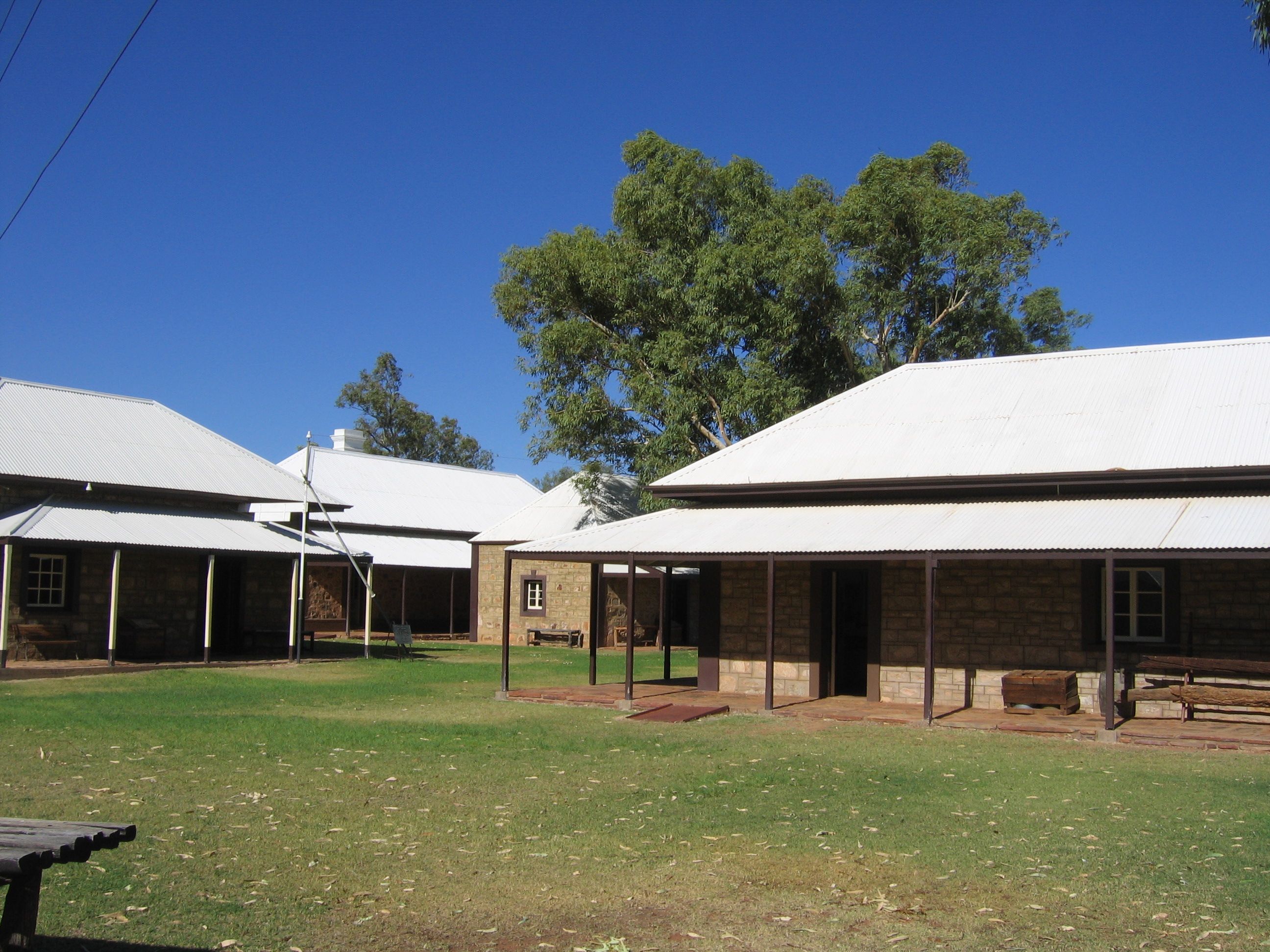
Alice Springs Telegraph Station
The waterhole had a name long before any European saw it. The Arrernte people called it Turiara, and their creation story describes an old euro man -- a type of kangaroo -- walking along the river and scratching the water from the earth. When surveyor William Mills came upon it in March 1871, searching for a route to thread the Overland Telegraph Line through the MacDonnell Ranges, he saw something simpler: a reliable water source in an arid landscape. He named it Alice Springs, after Alice Todd, wife of his employer Charles Todd, the man charged with connecting Australia to the world by copper wire. The settlement that grew beside the waterhole took the same name, and the telegraph station built there in 1872 became the first European foothold in Central Australia.
Wire Through the Desert
The Overland Telegraph Line was one of the great engineering feats of 19th-century Australia -- a 3,200-kilometre chain of wire, poles, and twelve relay stations stretching from Adelaide to Darwin, where a submarine cable connected to Java and from there to London. Construction of the Alice Springs station began in November 1871 under the supervision of Gilbert Rotherdale McMinn, adjacent to the waterhole that Mills had mapped. The station was operational by 1872, relaying Morse code messages between Darwin and Adelaide, compressing the weeks-long communication lag between Australia's interior and the rest of the world into minutes. For decades, the stone buildings beside the waterhole represented the entirety of European presence in this part of the continent -- a handful of telegraph operators, their families, and the messages that pulsed through their equipment from the outside world.
Two Stories of First Contact
The official record credits William Mills with discovering the waterhole during his 1871 survey. But the Arrernte people have their own account, passed down through generations. Errumphana, later called King Charlie by the telegraph station men, told his granddaughter Amelia Kunoth that he was among a group of warriors who encountered the surveying party at Honeymoon Gap. In the spirit of friendship, the warriors led the strangers to the waterhole. Errumphana remembered being uncertain, on first seeing the group, whether the strangers and their horses had blood in them or not. These parallel stories -- one of discovery, one of welcome -- frame the telegraph station's history. The waterhole called Atherreyrre was a significant camping and ceremonial site for the Arrernte long before it became a relay point for colonial communication, and the Arrernte people continue to occupy their traditional lands around Alice Springs today.
Characters of the Outback
The telegraph station's postmasters were a colorful cast. Mueller, the first, left to become Warden of Goldfields at Arltunga, was dismissed in 1906, convicted of embezzling 42 pounds, and served six months in Port Augusta Gaol. He returned to the same goldfield as a prospector and later became a bookkeeper at Bond Springs cattle station, where he was remembered as an educated man who "enjoyed his liquor, often to excess, a habit which hindered the execution of his duty at times but not his popularity." Mueller Street in Alice Springs bears his name. Thomas Bradshaw, postmaster from 1899 to 1908, fought his forced retirement at age 65 all the way to the High Court of Australia -- and lost. Bradshaw Primary School now carries his name. These men lived at the edge of the known world, managing a vital link in the global communications chain from a cluster of stone buildings beside a desert waterhole.
The Bungalow's Painful Chapter
When a new post office was built in the growing town of Alice Springs in 1932, the telegraph station closed. What followed was one of the darker chapters in the site's history. The buildings were repurposed as an institution for Aboriginal children of mixed descent -- classified by the government as "half-castes" -- relocated from a facility at Jay Creek. Known as The Bungalow, the institution was proclaimed an Aboriginal reserve by the Department of Native Affairs on 8 December 1932. Children lived and were educated there until 1942, when the approach of World War II led to their evacuation south to Mulgoa in New South Wales and Balaklava in South Australia. The Australian Army then occupied the buildings. Today, the restored stone structures operate as a heritage attraction, cafe, and mountain biking destination. The site was listed on the Northern Territory Heritage Register in 2004, its layers of history -- Arrernte, colonial, institutional, military -- preserved in the same weathered stone.
From the Air
Located at 23.67S, 133.88E, approximately 4 km north of Alice Springs town centre. The telegraph station historical reserve is visible as a cluster of restored stone buildings beside a waterhole in the Todd River channel. Best viewed at 3,000-5,000 feet AGL. Alice Springs Airport (YBAS) is 15 km to the south. The MacDonnell Ranges form a prominent east-west ridge to the south of the site.