
Alishan Forest Railway
The train whistle rises thin in the mountain air as the locomotive begins its trick. At the Dulishan Spiral, the Alishan Forest Railway executes one of railroading's rarest maneuvers: a series of Z-shaped switchbacks where the train reverses direction repeatedly, zigzagging up a gradient so steep that no conventional curve could manage it. The engine that was pulling now pushes. Then pulls again. Passengers watch the same mountainside pass their window three times, each time from a higher vantage, as the narrow-gauge track climbs from the subtropical plains around Chiayi City at 30 meters elevation to the alpine forests of Alishan at 2,216 meters. It is 86 kilometers of engineering audacity that was never meant to carry passengers at all.
Logging an Empire's Appetite
The railway exists because of trees. In 1900, Japanese colonial surveyors began exploring the Alishan mountains and found vast stands of cypress and Taiwania -- aromatic, rot-resistant timber prized for construction and shipbuilding. Route planning began in 1903, was shelved in 1904 due to the Russo-Japanese War, then restarted when the Osaka-based contractor Fujita-gumi was hired in 1906. The company imported 13-ton Shay locomotives -- American-designed geared engines built for steep grades -- and laid track from Chiayi (then called Kagi) to Liyuanliao. But the terrain defeated them. Financial troubles and the sheer difficulty of building through mountainous jungle forced Fujita-gumi to abandon the project in 1908. The Japanese government stepped in two years later, importing heavier 18-ton Shays and extending the line to Zhaoping by 1913. The main line was complete, and the timber began flowing downhill.
The Highest Station in the Empire
What transformed the Alishan line from an industrial railway into a cultural phenomenon was a 1933 extension to Niitakaguchi station, perched near Mount Niitaka -- now called Yushan, and at 3,952 meters the highest peak in both Taiwan and the entire Japanese Empire. The railway operated an express service for hikers: board at Kagi, ride to Niitakaguchi with a single stop at Shohei, sleep overnight at a mountain lodge, and summit the next day in seven to eleven hours depending on fitness. The railway had become a gateway to the roof of the empire. It was also becoming a window onto one of the most dramatic climate transitions in Asia -- the vegetation visible from the train changes from tropical lowland to temperate forest to alpine scrub over the course of a single morning's ride.
Typhoons, Landslides, and Stubbornness
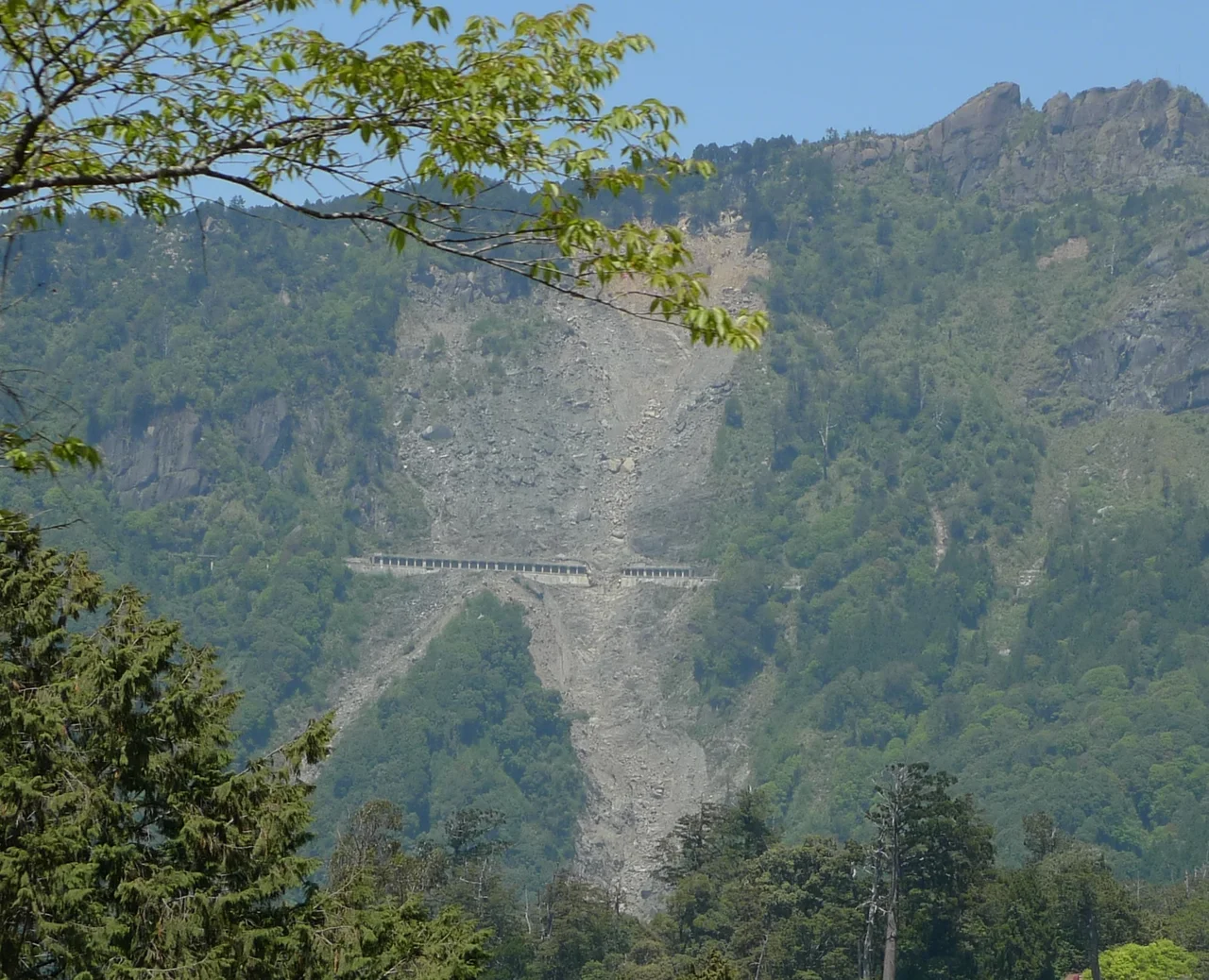
After 1945, diesel railcars replaced the steam Shays, and in the 1980s Hitachi-built diesel-hydraulic locomotives arrived. But the railway's real rival was asphalt: the completion of the Alishan Highway in 1982 offered faster, cheaper bus service, and the train became primarily a tourist attraction. Nature has been equally unkind. Typhoon Morakot devastated sections of the line in 2009, and Typhoon Dujuan damaged it again in 2015. The main line was partially closed for years, reopening in stages -- to Fenqihu in 2014, to Shizilu in 2017 -- before the full route between Chiayi and Zhushan finally reopened in July 2024, following the completion of the reconstructed Tunnel 42 in April of that year. A 2011 derailment killed five tourists and injured 113, underscoring the risks of operating narrow-gauge trains on steep mountain terrain.
Sister Railways and Sacred Trees
Taiwan's Ministry of Culture has listed the Alishan Forest Railway as a potential World Heritage Site, recognizing both its engineering significance and its cultural weight. Since 2016, the railway has established sister-railway partnerships with mountain railways around the world, including the Darjeeling Himalayan Railway in India, the Matterhorn Gotthard Bahn in Switzerland, and the Cierny Hron Railway in Slovakia -- ten partners across six countries. On March 10, 2018, Google celebrated the railway with a Google Doodle. Today the system is managed by the Alishan Forest Railway and Cultural Heritage Office, and while diesel locomotives handle daily service, occasional special runs fire up the original Shay steam engines, sending plumes of white smoke curling through the cypress groves that the railway was built to destroy but instead helped make famous.
From the Air
Coordinates: 23.51N, 120.80E. The Alishan Forest Railway runs from Chiayi City (elevation 30 m) on Taiwan's western plain up into the Alishan mountain range (elevation 2,216 m at Alishan station). From the air, look for the narrow-gauge track threading through dense forest, with the Dulishan Spiral switchbacks visible as a zigzag pattern on the mountainside. Over 50 tunnels and 77 wooden bridges punctuate the route. Nearest airports: Chiayi Airport (RCKU) near the lowland terminus. Recommended viewing altitude: 5,000-8,000 ft for mountain terrain; the route's full extent from plains to alpine is best appreciated at higher altitudes.
Nearby Stories
- Dutch Pacification Campaign on Formosa 2.6 km away
- Ruisui Tropic of Cancer Marker 7 km away
- Chelungpu Fault Preservation Park 8.8 km away
- Chenggong, Taitung 12 km away
- Baolai Spring Park 12 km away
- High-Heel Wedding Church 13 km away
- 2024 Hualien Earthquake 30 km away
- China Airlines Flight 611 63 km away