Aliwal Shoal
The first thing you notice about the ragged tooth sharks at Aliwal Shoal is their teeth -- rows of them, thin and jagged, protruding from the jaw at odd angles like a mouth full of broken glass. The second thing you notice is that they do not care about you at all. Between July and November, up to sixty of these sharks congregate at the reef five kilometers off the KwaZulu-Natal coast near the town of Umkomaas, drawn here to mate in waters where a fossilized sand dune creates an underwater landscape of caves, overhangs, and cathedral-like arches. Divers come from around the world to float among them, close enough to count the scars on their hides. The sharks, known locally as "raggies," have been doing this far longer than anyone has been watching.
A Dune Turned to Stone
Aliwal Shoal is not a coral reef in the tropical sense. It is the fossilized remains of an ancient coastal sand dune, now submerged and colonized by marine life over thousands of years. The reef stretches roughly five kilometers along the coast, its structure riddled with gullies, caves, and pinnacles that rise to within five meters of the surface at their shallowest. Algae and sponges dominate the rocky surfaces, but hard and soft corals have established themselves across the structure, along with echinoderms and sea squirts. The warm Agulhas Current sweeps past the outer edge of the shoal, bringing nutrients and larvae from the tropics. This mixing of temperate and subtropical waters gives Aliwal Shoal an unusual diversity: potato bass and brindle bass patrol the deeper ledges, while tropical fish dart through the shallower corals. Tiger sharks, hammerheads, and the occasional whale shark pass through seasonally. It is a reef built by geology and maintained by current.
The Ship That Named It
The shoal takes its name from a near-disaster. In 1849, the three-masted vessel Aliwal, captained by James Anderson, almost sank when she struck the submerged reef. Anderson survived, and the reef acquired his ship's name -- a fitting origin for a place that would go on to claim a more dramatic victim. On 11 August 1974, the MV Produce, a 176-meter Norwegian bulk carrier weighing approximately 13,000 tons, was heading south from Durban loaded with molasses when she struck the northern pinnacles of the shoal in rough seas. The impact ripped open her hull. Local fishermen launched a rescue in treacherous conditions and pulled every crew member to safety -- not a single life was lost. The Produce split in two and settled on her starboard side about five hundred meters north of the reef, her bridge section resting just fourteen meters below the surface. Today she is one of South Africa's most popular wreck dives, her rusting corridors draped in soft coral and patrolled by schools of fish that have made the hull their home.
Cathedral and Raggie Cave
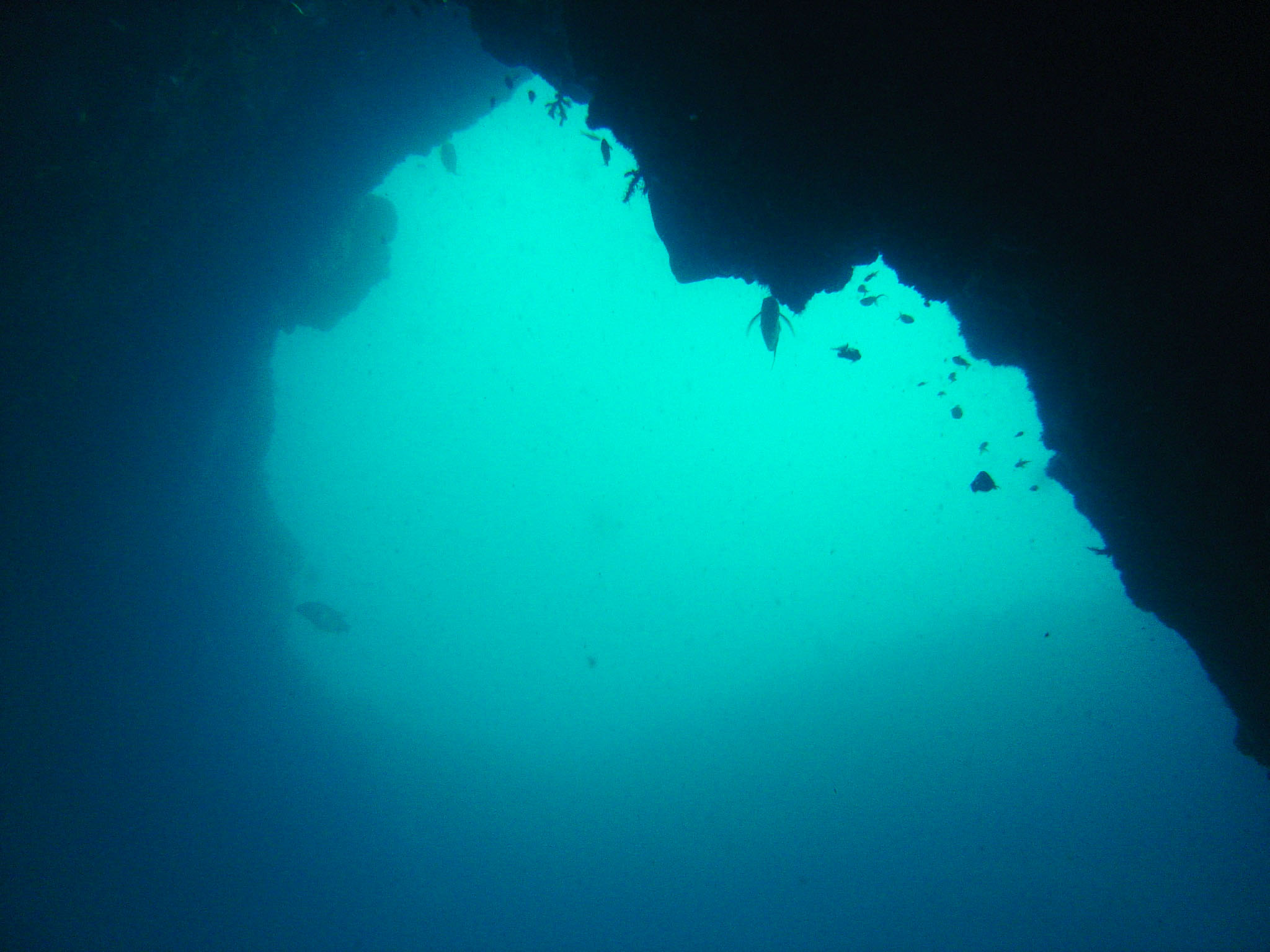
The dive sites at Aliwal Shoal read like a guidebook to underwater architecture. Cathedral, the reef's most famous formation, features a dramatic stone arch framing blue water beyond -- the kind of image that sells dive magazines. Raggie Cave is where the ragged tooth sharks gather in winter, hovering motionless in the current with their mouths agape, filtering oxygen through those fearsome-looking teeth. Despite their appearance, raggies are docile animals, content to share their space with divers who keep a respectful distance. The shoal also hosts the SS Nebo, a steamship that sank in 1884, offering a second wreck dive in shallower water. Between the wrecks, the reef formations, and the shark aggregations, a diver could spend a week at Aliwal Shoal and never repeat a dive. Most launch from Umkomaas, a quiet coastal town that belies the underwater spectacle just offshore.
Guarded Waters
Aliwal Shoal has been a Marine Protected Area since 1991, when the original 126-square-kilometer zone was established to safeguard its biodiversity. In 2019, the protection was dramatically expanded with the addition of the Aliwal Shoal Offshore MPA, bringing the total protected area to 670 square kilometers stretching eighteen kilometers along the coast between the Mzimayi and Umkomaas river mouths and extending seven kilometers out to sea. The protections regulate fishing and restrict certain activities to preserve the reef's ecological balance. For the ragged tooth sharks, the MPA designation is particularly significant -- these slow-growing animals are vulnerable to overfishing and habitat disturbance, and the shoal is one of their critical mating aggregation sites along the South African coast. The reef that almost sank a ship in 1849 now stands as one of the country's most carefully protected marine environments.
From the Air
Aliwal Shoal lies approximately 5 km offshore at 30.27S, 30.89E, off the town of Umkomaas on the KwaZulu-Natal south coast, South Africa. From the air, the reef is occasionally visible as a darker patch in the ocean, particularly in calm conditions at lower altitudes. The small town of Umkomaas is visible on the coast, with the Umkomaas River mouth as a landmark. Dive boats launching from the beach are often visible. The nearest major airport is King Shaka International Airport (FALE) in Durban, approximately 60 km to the northeast. Virginia Airport (FAVG) in Durban is closer at about 45 km. Best viewed at 2,000-3,000 ft AGL to spot the reef outline and coastal geography.