Allans Beach
You have to earn Allans Beach. There is no car park at the sand's edge, no ice cream stand, no lifeguard tower. The road ends at a farm gate, and from there a walking track crosses open pasture before the dunes reveal themselves and the Pacific opens up -- 1.9 kilometres of white sand curving toward Cape Saunders, with nothing between you and Antarctica but cold water and wind. Twenty-five kilometres from Dunedin's city centre and six from the tiny settlement of Portobello, this is a beach that filters for commitment. The people who come here -- trampers, surfers, the occasional naturist -- are the kind who prefer their coastline unmanicured.
The Spit and the Inlet
Allans Beach sits on the seaward face of a large sand spit that narrows the mouth of Hoopers Inlet to a channel barely 170 metres across. Behind the beach, dunes rise and fall, blanketed in pikao sedge -- the golden sand-binder native to New Zealand's coasts. Behind those dunes, the landscape shifts dramatically: Hoopers Inlet Swamp steps down through freshwater marsh to salt marsh, a gradient of ecosystems compressed into a narrow strip. The Allans Beach Wildlife Management Reserve protects the inlet side, while the beach itself belongs to the Allans Beach Recreation Reserve. To the northeast, the land climbs toward Mount Charles. Eastward, the coast turns rugged as volcanic slopes drop straight to the sea, forming the headlands of Matakitaki and Cape Saunders.
Southern Ocean Muscle
The surf at Allans Beach does not play gently. Facing south-southeast, the beach catches swells that have built across thousands of kilometres of open Southern Ocean, and in winter those waves arrive with serious power. This is not a swimming beach in any casual sense -- the currents are strong, the water is cold, and there are no safety patrols. Surfers come for the quality of the break, and they come knowing the risks. Periodically, natural sediment movement blocks the Hoopers Inlet channel entirely, as happened most recently in 2012. When the channel closes, the tidal exchange that normally flushes the inlet ceases, and what was a dynamic coastal system becomes temporarily sealed. The blockages eventually clear, but while they last, they reshape the ecology and accessibility of the entire spit.
Penguins, Seals, and the Rules of Coexistence
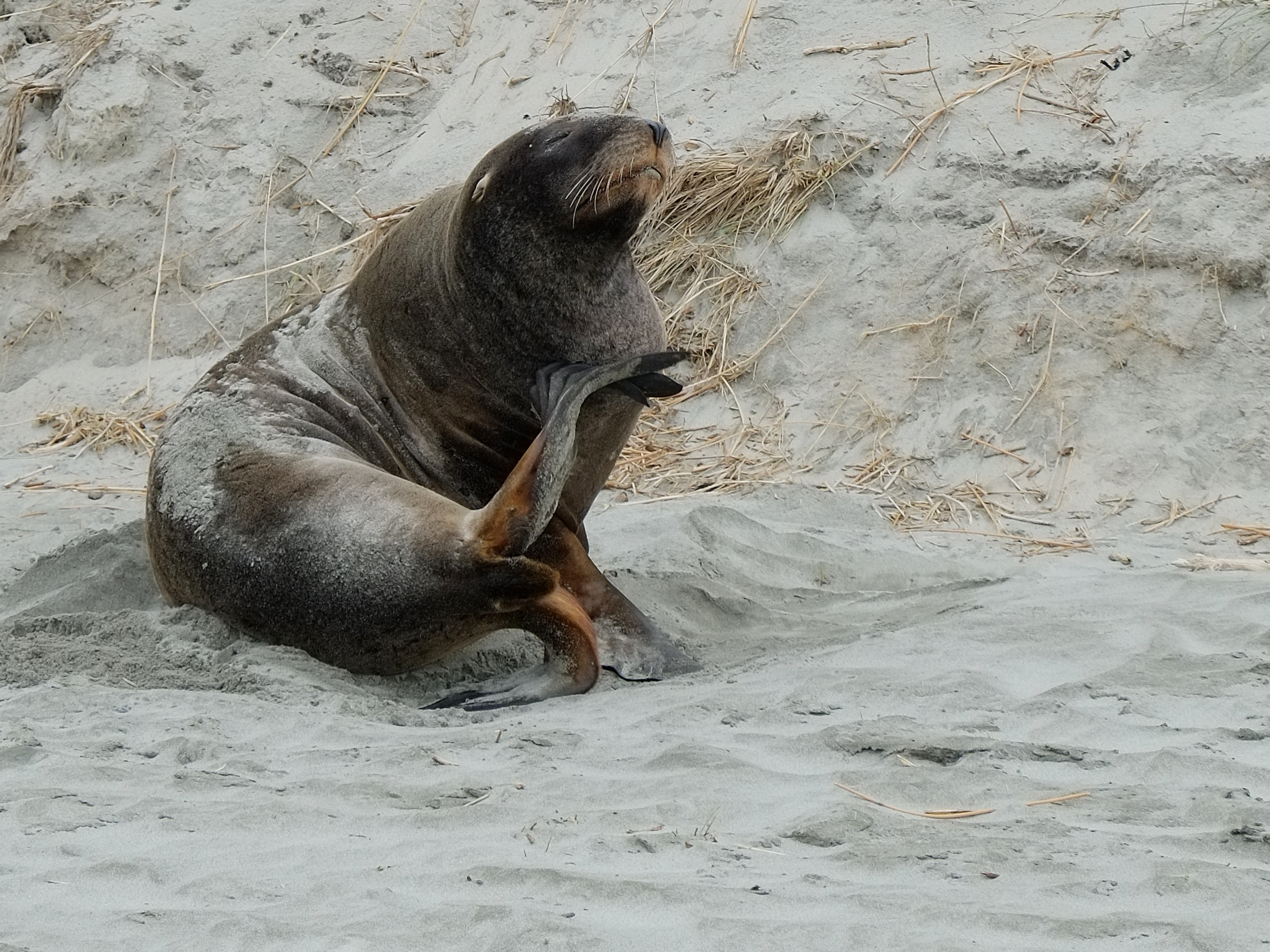
Allans Beach belongs to more species than just humans. New Zealand fur seals haul out on the rocks. New Zealand sea lions -- one of the world's rarest pinniped species -- rest on the sand. And yellow-eyed penguins, the hoiho, waddle up the beach at dusk to reach their nesting sites in the vegetation behind the dunes. Visitors who encounter the penguins are asked to crouch low and remain still, because these birds are easily disturbed and their population is fragile. The nearest nesting colony sits on the Sandymount side of the Hoopers Inlet channel, which means that when sediment closes the channel, foot traffic can reach the colony from the beach -- exposing the penguins to interference from people and their dogs. It is a tension between access and protection that the beach constantly negotiates.
A Beach That Keeps Its Distance
Allans Beach sees relatively few visitors, and its management reflects that quiet character. Dogs are allowed on leash at the western end but banned entirely from the eastern end, where the wildlife concentrates. There are no facilities at the beach itself -- no toilets, no shelter, no fresh water. The walk in takes about twenty minutes through open farmland, exposed to whatever weather the peninsula is serving up. This deliberate lack of infrastructure is part of what preserves the place. Allans Beach has appeared on international lists of the world's best beaches, not for its amenities but for its raw, unmediated beauty -- the white sand against the dark volcanic headlands, the fur seals sleeping in the surf line, the enormous Southern Ocean sky. It is a beach that asks nothing of you except that you leave it as you found it.
From the Air
Located at 45.88°S, 170.69°E on the southeastern coast of the Otago Peninsula. The beach is clearly visible from the air as a white sand arc between the dark headlands of Mount Charles and Cape Saunders, with the narrowing channel of Hoopers Inlet behind it. Best viewed at 1,500-3,000 feet. The Otago Peninsula's volcanic ridgeline and Portobello village are useful landmarks. Nearest airport: NZDN (Dunedin International), approximately 35 km to the southwest.