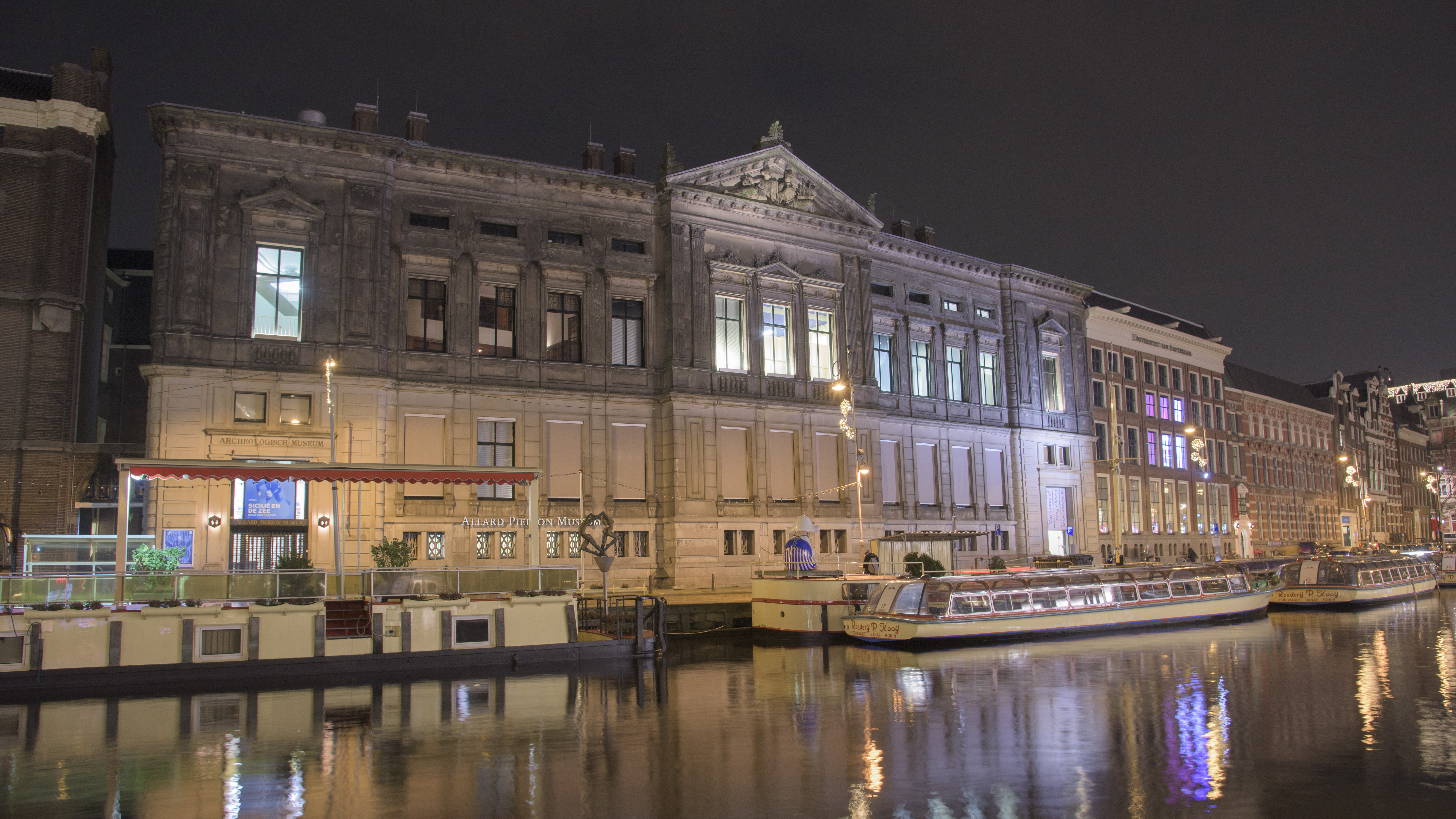
Allard Pierson Museum
A clergyman walks the dust of the Mediterranean in 1877 and comes home obsessed. He cannot bring the temples back to Amsterdam, but he can bring their shadows. For nearly two decades, Allard Pierson assembled plaster casts of statues he had stood beside in Athens, Rome, and the Aegean - a ghost museum of a teaching collection, gathered by a former preacher who had traded the pulpit for the lecture hall. Today his name hangs above the door of a building that used to be a bank. The Nederlandse Bank vacated its offices at the Oude Turfmarkt in 1976, and the antiquities moved in. Behind those neoclassical walls, sarcophagi sit where vault doors once did, and 4,000 BC meets the canals.
The Preacher's Inheritance
Allard Pierson never set out to be a museum's namesake. Born in 1831, he was a clergyman first, then the University of Amsterdam's first professor of Aesthetics, Art History, and Modern Languages, appointed in 1877 when the university was newly founded. His travels through the Mediterranean filled him with a passion he could not put down. Between 1877 and 1895 he built his collection of plaster casts, the kind of teaching tool every nineteenth-century classics department wanted: replicas of Greek and Roman statuary that students could circle and sketch. After Pierson's death in 1896, the collection passed forward. In 1932 his son Jan Lodewijk founded the Allard Pierson Foundation so the antiquities could keep teaching. The first museum opened on 12 November 1934 in a building on Sarphatistraat, the top floor doubling as exhibition space. The collection has been outgrowing its rooms ever since.
Four Thousand Years in Glass Cases
The museum's range stretches from 4000 BC to 500 AD, which is the kind of span that turns a casual visit into a quiet form of vertigo. Egypt fills one wing, with mummies and sarcophagi and a film walking visitors through the mummification process. The Greek pottery rooms hold black-figure and red-figure vessels from the fifth and sixth centuries BC - the period when Athenian potters were inventing the visual vocabulary that European art would borrow from for the next two thousand years. A Roman sarcophagus carved partly into the shape of the man buried inside it dates from around 150 AD. And then there is the Gipsengalerij, the plaster-cast attic open only by guided tour, where Pierson's nineteenth-century shadows of Mediterranean statues stand in rows. It is the museum within the museum - the original collection, kept the way collections were once kept.
Gold That Could Not Go Home
In February 2014, the museum opened an exhibition called "Crimea - Gold and Secrets of the Black Sea." The loans came from five Ukrainian museums - four of them on the Crimean peninsula, one in Kyiv. Then, in March of that same year, Russia annexed Crimea, and the gold became a question with no easy answer. Did it belong to the museums that had loaned it? To Ukraine, the country those museums had stood in when the boxes were sealed? To the territory the boxes were stamped from, now under different control? Dutch courts spent nearly a decade deciding. Ruling after ruling went in Ukraine's favor. On 22 November 2023, Ukrainian Culture Minister Rostyslav Karandieiev signed the agreement to bring the Scythian artifacts to Kyiv, and on 27 November the transfer was complete. The objects are now held at the National Museum of the History of Ukraine in the Kyiv Pechersk Lavra. Director Els van der Plas called it "a special case, in which cultural heritage became a victim of geopolitical developments."
Inside a Bank Vault
The building is its own artifact. The Nederlandse Bank built the Oude Turfmarkt offices in the nineteenth century as a place to keep money safe. Its walls were thick. Its rooms were dignified. When the bank moved out in 1976, the museum moved in, and Princess Beatrix presided over the re-opening on 6 October that year. The decision to put antiquities into a former bank has a quiet logic. Vaults are designed to hold things still and protect them from time, which is also what a museum does. The collections of Egypt and the Near East, the Greek world and Etruria and Rome, all share the same purposeful hush. A Society of Friends established in 1969 still keeps the museum company - around 1,500 members at last count, paying their dues so that 4,000-year-old utensils have a place to be looked at.
From the Air
Located at 52.369 N, 4.893 E in central Amsterdam, on the Oude Turfmarkt along the Rokin. Geohash u173z. The museum building is part of the neoclassical row across from the University of Amsterdam's main complex - identifiable from above by its proximity to the Munttoren and the Rokin canal. Schiphol Airport (EHAM) lies 14 km southwest, with the museum sitting almost directly under the standard approach corridor. Lower altitudes (under 2,000 ft) offer the clearest view of the canal grid below.