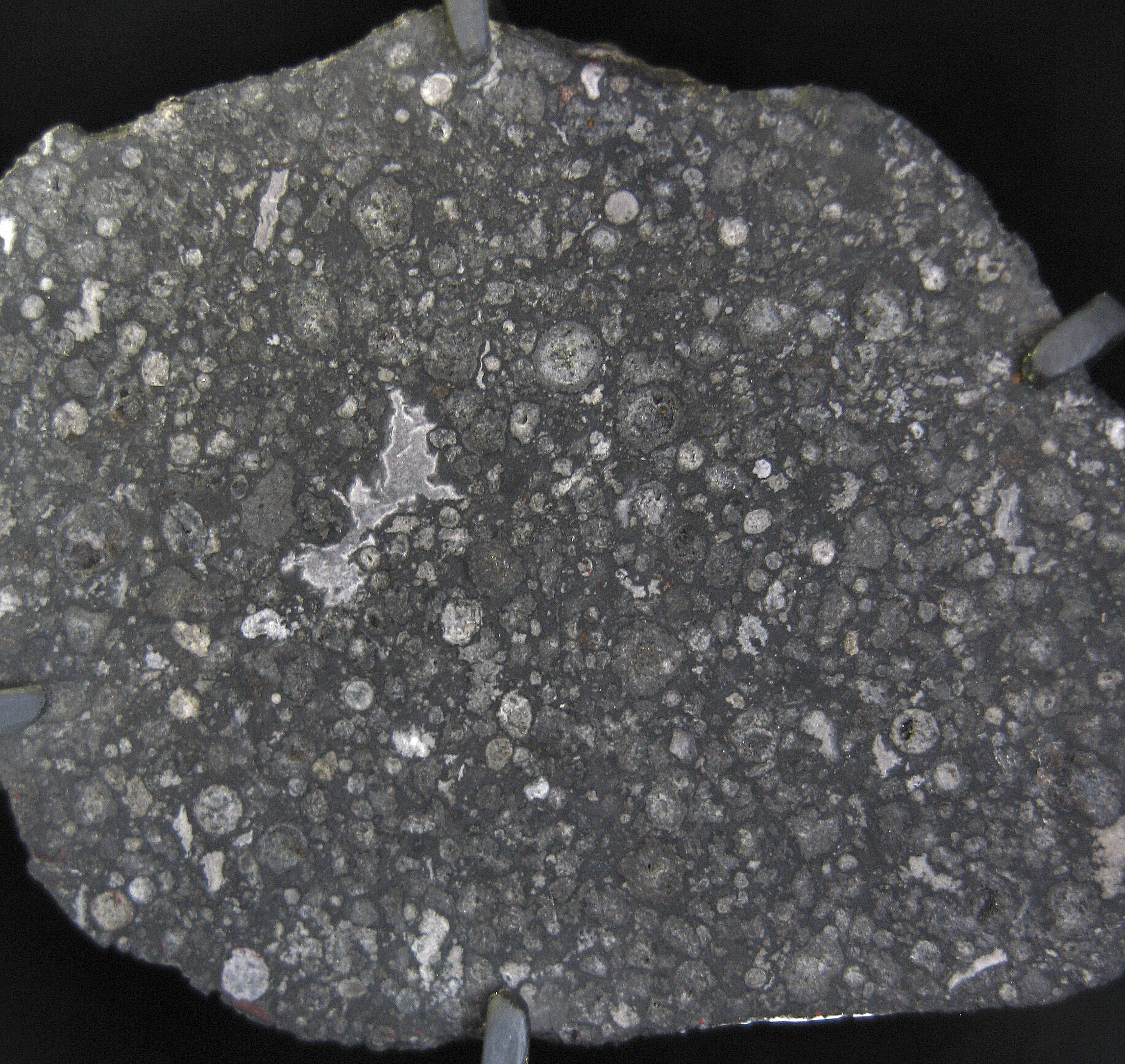
Allende Meteorite
The timing was almost too perfect. In early 1969, NASA's lunar laboratories were humming with preparation, new instruments were being calibrated, and planetary scientists were gearing up for the Apollo missions that would bring back the first Moon rocks. Then, just months before those samples arrived, the sky over northern Mexico delivered a gift of its own. At 1:05 AM on February 8, a fireball approached from the southwest, lit the sky and ground for hundreds of miles, and exploded over the village of Pueblito de Allende in the state of Chihuahua. Thousands of black, fusion-crusted fragments rained across the desert. The scientific community was ready. They had the tools, the funding, and the hunger. What they received was the largest carbonaceous chondrite ever found on Earth -- and a window into the first moments of the Solar System.
A Rock the Size of a Car
The original stone is believed to have been roughly the size of an automobile, hurtling toward Earth at more than 16 kilometers per second. When it hit the atmosphere, air resistance braked it so violently that it shattered into thousands of pieces, each one developing a glassy black fusion crust as its exterior melted during the descent. The fragments scattered across one of the largest meteorite strewnfields ever documented -- a flat, sparsely vegetated desert where the dark stones stood out against pale soil. Hundreds of pieces were collected in the days after the fall. Over the following 25 years, between two and three tonnes of specimens were recovered, with individual fragments ranging from one gram to 110 kilograms. More than fifty years later, pieces are still occasionally found.
Older Than the Earth Itself
Carbonaceous chondrites make up only about four percent of observed meteorite falls, and before 1969 the class was poorly understood. Allende changed that overnight. Sliced open and polished, the meteorite reveals a dark matrix embedded with millimeter-sized chondrules -- tiny stony spherules found only in meteorites -- and larger white blobs called calcium-aluminium-rich inclusions, or CAIs. These inclusions are the reason Allende rewrote textbooks. Dating reveals the CAIs to be 4.567 billion years old, the oldest known solids to have formed in our Solar System. They are 30 million years older than the Earth and 193 million years older than the oldest rock found on our planet's surface. Carbonaceous chondrites like Allende have undergone the least mixing and remelting of any meteorite class since the Solar System's formation. Their age is frequently taken as the age of the Solar System itself.
Stardust and Supernovae
The deeper scientists looked, the stranger Allende became. A 1977 analysis at the California Institute of Technology found that isotopes of calcium, barium, and neodymium in the meteorite did not match anything from our Solar System -- they had originated in other stars entirely. This supported the theory that a supernova's shockwave may have triggered the formation of our Solar System. The Caltech team identified aluminum-26, a short-lived isotope that acts as a clock, dating that supernova to within two million years before the Solar System coalesced. Subsequent studies found alien isotopic ratios of krypton, xenon, and nitrogen. The conclusion: the presolar disc that became our Solar System was salted with fine dust from nearby novas, supernovae, and red giants. These specks persist in Allende as presolar grains -- particles older than the Sun, surviving inside a rock that fell on a Mexican desert in 1969. In June 2012, researchers discovered panguite, a type of titanium dioxide mineral previously unknown to science, embedded in the meteorite.
The Best-Studied Meteorite in History
Allende earned its reputation through sheer accessibility. The Smithsonian Institution and other museums launched immediate expeditions to collect samples, gathering hundreds of kilograms of material. Because the fall coincided with the buildup to Apollo 11, the scientific infrastructure was already in place -- laboratories were being upgraded, funding was flowing, and a generation of planetary scientists was eager for material to study. Allende provided far more than all previously known carbonaceous chondrite falls combined. Among its discoveries: trace amounts of carbon including graphite and diamond, organic compounds including amino acids not found on Earth, and in 2020, the purported identification of hemolithin -- an iron and lithium-containing protein of possible extraterrestrial origin. The desert around Pueblito de Allende holds no monument to the event. The strewnfield is just flat scrubland, unremarkable to the eye. But scattered beneath its surface are fragments of a rock that carries the memory of stars that died before our Sun was born.
From the Air
Located at 26.97N, 105.32W near the village of Pueblito de Allende, Chihuahua, Mexico. The strewnfield covers a large area of flat, sparsely vegetated Chihuahuan desert terrain. Nearest major airport is General Roberto Fierro Villalobos International Airport (MMCU/CUU) at Chihuahua city, approximately 200 km northwest. The city of Parral (MMPR) is closer, roughly 30 km south. The terrain is flat desert with sparse vegetation, excellent visibility in clear conditions.