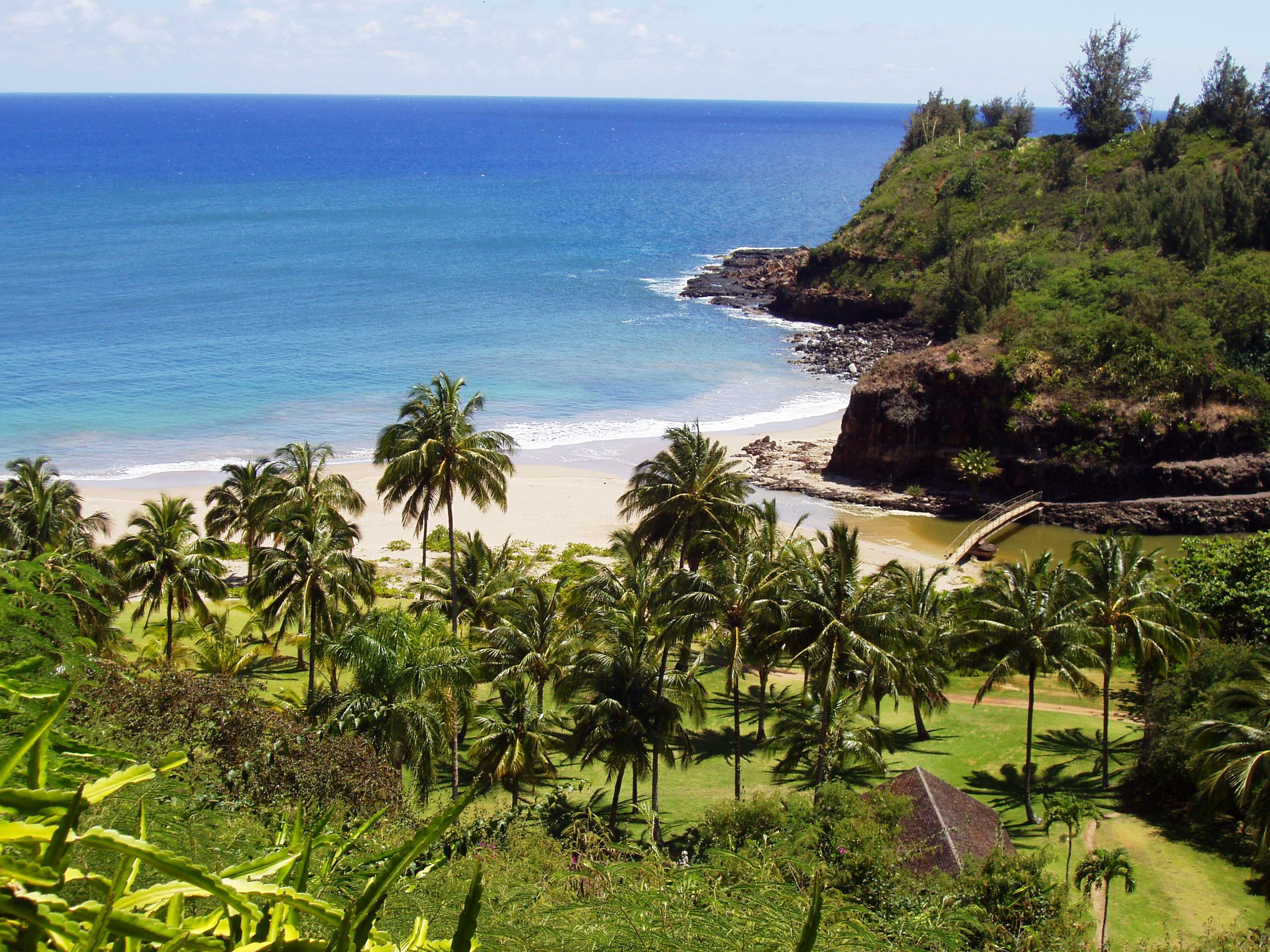
Allerton Garden
If the giant Moreton Bay fig trees look familiar, there is a good reason. Their massive root systems doubled as dinosaur cages in Jurassic Park, and their canopy has appeared in Pirates of the Caribbean, South Pacific, and half a dozen other productions drawn to this valley on Kauai's south shore. But Allerton Garden was never designed for cameras. It was designed by a father and son who spent decades turning eighty acres of former sugarcane plantation into one of the most carefully composed tropical gardens in America.
A Queen's Valley
Long before the Allertons arrived, this valley beside Lawai Bay had royal connections. Queen Emma of Hawaii resided above it for a time, and a modest house believed to have been her residence was later moved to the valley floor and renovated. In the late nineteenth century, the McBryde family purchased the entire valley for a sugarcane plantation, and for decades the land served the industry that would come to dominate Hawaiian economics. The valley's deep cut along the Lawai Stream and its sheltered position made it fertile ground, but it took a different kind of vision to see it as anything other than an agricultural asset.
The Allertons' Grand Experiment
Robert Allerton had already proven his eye for landscape design at "The Farms," his estate in Monticello, Illinois, now preserved as Robert Allerton Park. His adopted son John Gregg Allerton had studied architecture at the University of Illinois in the 1920s, and together they shared a passion for the interplay of sculpture and living plants. In 1938 they came to Hawaii and purchased a portion of the old plantation for a residence and gardens. What followed was decades of patient design: garden rooms enclosed by walls of tropical foliage, pools fed by the Lawai Stream, miniature waterfalls and fountains placed to catch the light, and sculptures transported from their Illinois estate. They gathered plants from across tropical Asia and the Pacific Islands, weaving Hawaiian species together with exotic introductions in compositions that balanced formality with wildness.
From Private Eden to Public Trust
Robert Allerton's ambitions extended beyond his own garden walls. He joined a coalition of individuals and organizations pushing for the establishment of a tropical botanical garden on American soil. In the final year of his life, Allerton witnessed the charter being granted for the Pacific Tropical Botanical Garden, now known as the National Tropical Botanical Garden. John Gregg Allerton continued to maintain and develop the garden until his death in 1986, when he left it in trust. By the early 1990s, the National Tropical Botanical Garden assumed management and named the garden after both father and son. Today it operates as one of the five gardens in the NTBG system, with guided tours that wind through the garden rooms, past the Mermaid Fountain and Diana Waterfall, and beneath the towering canopies that have made this valley one of the most filmed locations in Hawaii.
Where Art Meets Jungle
Walking through Allerton Garden feels less like visiting a botanical collection and more like moving through a series of outdoor galleries. Each garden room has its own mood, framed by hedges of tropical plants and anchored by a piece of sculpture or a water feature. The formality is deliberate but never sterile: the tropics push back constantly, and the gardeners work within that tension rather than against it. Vines climb the statues, moss softens the stonework, and the Lawai Stream provides a constant, low soundtrack. The effect is of a place where human intention and natural exuberance have reached a truce, each making the other more interesting.
From the Air
Located at 21.886N, 159.493W on Kauai's south shore, in a valley opening to Lawai Bay. Best viewed at 1,000-2,000 feet AGL. Lihue Airport (PHLI) is approximately 10 nautical miles east. The garden occupies a valley cut along the Lawai Stream, adjacent to McBryde Garden. The tree canopy and bay entrance are identifiable from the air in clear conditions.