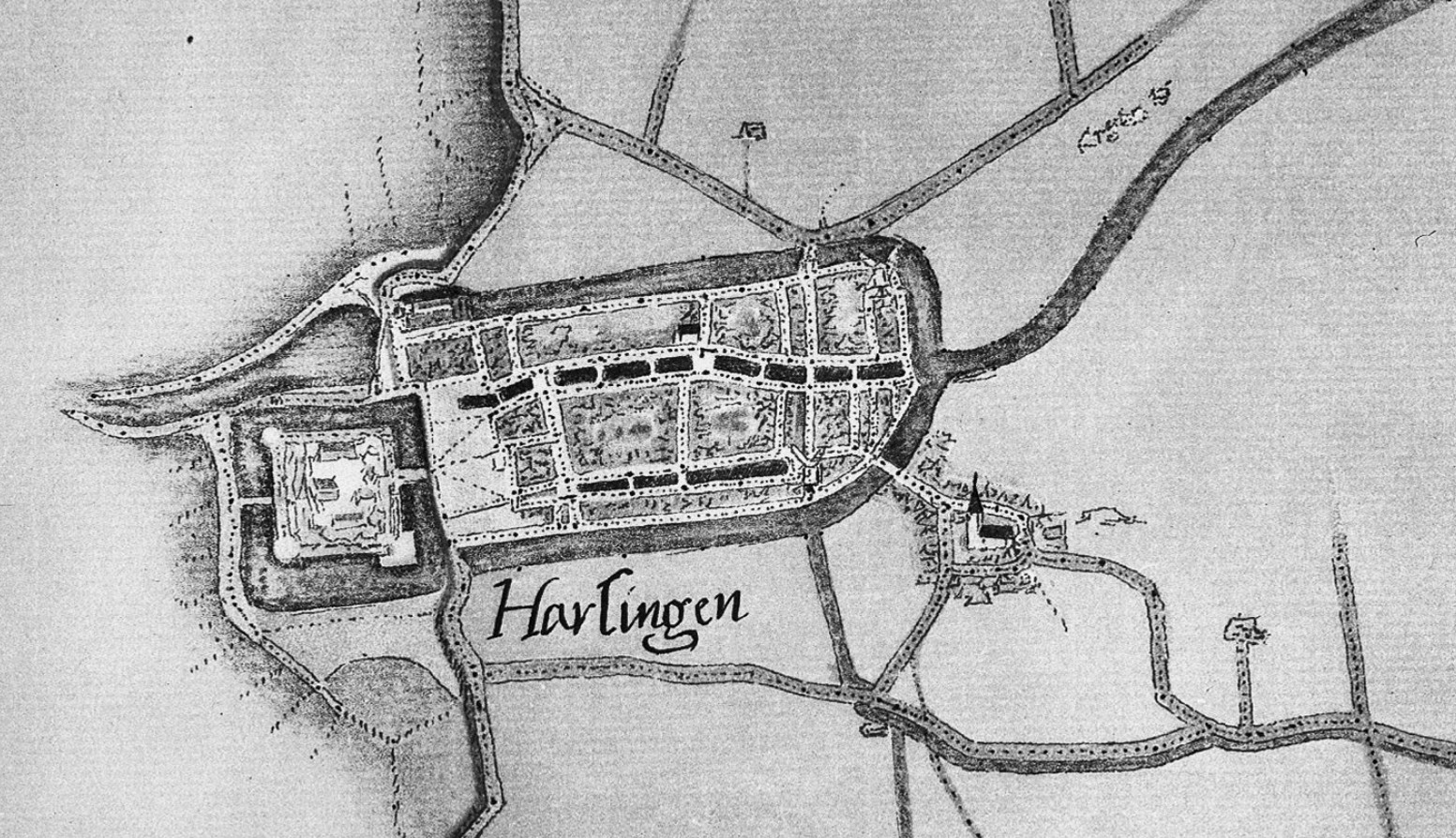
Almenum
On Easter Sunday in 1064, two Frisian noblemen argued about who would be first to drop a coin in the poor box. The argument ended with Ruurd Jans Harliga killing Sasker Harns inside the church at Almenum. That single moment of pride lit a fuse that burned for the better part of a century - three families killing each other in waves until a 1133 pitchfork murder finally split the country in two. Almenum no longer exists as a separate place. Harlingen ate it. But the terp, the five-meter mound of earth where Saint Boniface is said to have raised the first Christian church in Friesland in 754, is still there beneath the Grote Kerk.
The Terp and the Saint
A terp is what the Frisians built before they trusted dikes - an artificial hill of clay and dung and household refuse, piled up over generations until it stood high enough to keep the sea out of the bedrooms. The terp at Almenum rises about five meters above the surrounding pastures. On top of it, according to tradition, Saint Boniface placed a thatched wooden church in 754, dedicating it to the archangel Michael. It was the first Christian church in Friesland. The name Almenum probably comes from a man called Allaman whose home stood here, the -um suffix derived from West Frisian hiem, meaning home. An alternate theory holds that the name once meant common grazing land, the kind Icelandic still calls almenningurheim. Either way, somebody's house, or everybody's pasture - the terp came first.
A Flag, A Charter, A Legend
Almenum collected legends the way old churches collect dust. One concerned a miraculous red banner called the Magnusvaan, said to have belonged to Friso, the mythical founder of the Frisian people. The flag could supposedly avert lightning, repel evil spirits, and make its bearer invincible. Friso was buried with it. Then Willibrord, apostle to the Frisians, dreamed that an angel pointed to where the banner lay. He dug it up and gave it to Magnus Forteman, who reportedly carried it when he conquered Rome. Afterward the flag was hidden in the wall of the church at Almenum. Another tradition claimed Magnus hung a charter there from Pope Leo III and Emperor Charlemagne - the Magnuskeren - recording seven keren and seventeen statutes and twenty-four land laws. Almenum mattered, the stories insisted, because almost nowhere else in Frisia did.
The Hundred-Year Feud
The Easter killing of 1064 set off something the Frisians took seriously. The Harns, Harliga, Gratinga, and Gerbranda families slaughtered each other for generations. The escalation finally came in 1133, when Douwe Harns met Sikke Gratinga's son crossing Harns land on his way to the Gratinga estate and ran him through with a pitchfork. The country split into two opposed factions. The Harns stins - the small Frisian stone tower house that doubled as a fortress - was besieged, taken, and razed. In 1148 the parties signed what they called a covenant of satisfaction. By every account the satisfaction was theatrical. Beneath the treaty, the resentment kept simmering. Almenum had been a battleground for ego, then for memory, and neither side ever really stopped keeping score.
The Sea Makes a Port
On 14 December 1287, the St. Lucia's flood broke through the Frisian coast and rearranged the map. The Zuiderzee opened. The Wadden Sea pushed in to meet Harlingen. Nearby villages - Berdingadorp, Medumwart, Dikesherna, parts of the Gerbranda lands - simply disappeared beneath the water. The church at Berdingadorp was folded into the church at Almenum. The disaster was also the making of Harlingen, which suddenly had a coastline and could become a seaport. Almenum, sitting just inland on its terp, found itself adjacent to a town with ambitions. The monks at Ludingakerke, the monastery founded here in 1157 by Eilwardus Ludinga, had already dug canals out past Vlieland and Texel. Now those canals connected to a real harbor, and the harbor was not in Almenum.
Eaten by the Neighbor
For centuries Almenum's church kept its strange double identity - the parish church of a village that was being slowly absorbed by the city next door. Harlingen's 1579 expansion swept Almenum inside the new city walls. The question of which town the church belonged to wasn't resolved until 1684, when Henry Casimir II of Nassau-Dietz declared it Harlingen's. In 1771 the old St. Michaelsdom was pulled down and replaced by a cross-shaped building called the Grote Kerk, opened New Year's Day 1775 with a reading from John 10:22. The tower of the old church was kept, refaced with new stone. From 1812 to 1816, under Napoleonic France, Almenum briefly existed again as a canton. Today the name survives on a retirement home across the van Harinxmakanaal, a hotel in Harlingen, a forgotten white-flowered flax variety, and a small bulk freighter.
From the Air
Almenum sits at 53.18°N, 5.43°E, now absorbed into the eastern edge of Harlingen on the Friesland coast. The Grote Kerk's tower - the surviving stub of the old St. Michaelsdom - is the visible landmark, just inland from Harlingen's harbor on the Wadden Sea. Nearest airport is Leeuwarden Air Base (EHLW), about 25 km east. Cruising altitudes of 3,000-5,000 feet AGL give a good view of the geometric old fortifications around Harlingen and the dike-and-polder grid of Friesland stretching east toward Franeker.