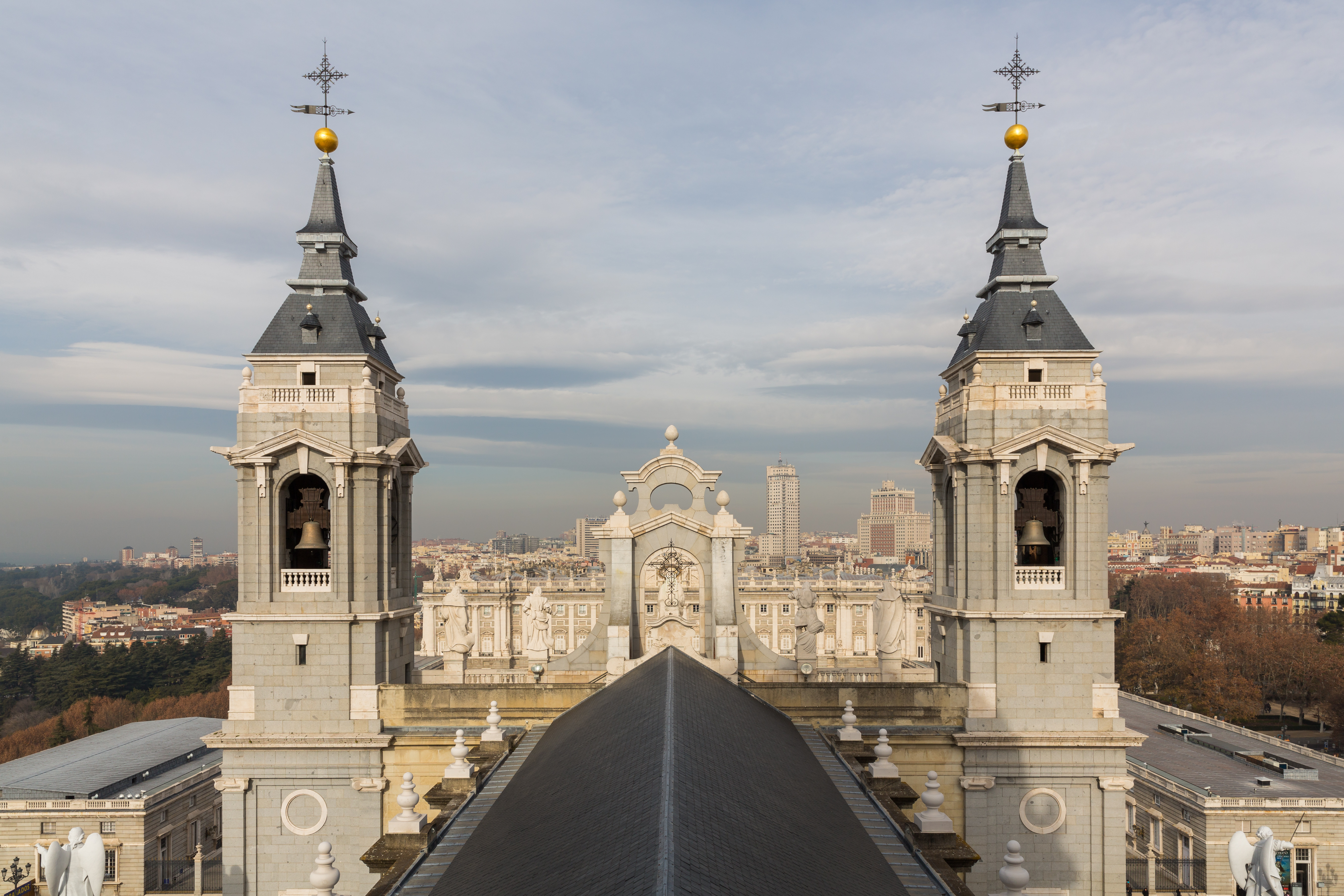
Almudena Cathedral
Most great cathedrals are old. The Almudena is not. Construction began in 1883 and did not finish until 1993, making it one of Europe's youngest cathedrals and one of its most stubbornly complicated. Over that 110-year span, Spain fought a civil war, abandoned the project entirely, redesigned it from Neo-Gothic to Baroque, and watched three generations of architects wrestle with a single impossible constraint: the finished building had to look good standing directly across from the Royal Palace.
A Cathedral That Refused to Be Easy
Madrid was, for centuries, a capital without a cathedral. The city had been the seat of the Spanish court since Philip II moved it here in 1561, yet it fell under the Archdiocese of Toledo rather than having its own. When plans finally materialized in the 1870s, architect Francisco de Cubas designed a grand Neo-Gothic structure to honor the Virgen de la Almudena, the city's patron. Ground was broken in 1883. Then came complications. The Spanish Civil War halted everything in 1936, and the half-built site sat abandoned for fourteen years. When work resumed in 1950, a fundamental decision changed the cathedral's character: the exterior would be redesigned in a Baroque style, with grey and white stone, to harmonize with the Palacio Real standing directly opposite across the Plaza de la Armeria.
Where Pop Art Meets the Sacred
Step inside the Almudena and the Neo-Gothic bones of the original design reassert themselves, but with an unexpected twist. Where medieval cathedrals gather darkness and centuries of grime, the Almudena's interior is bright, almost startlingly modern. Chapels contain statues by contemporary artists in styles that range from historical revivals to what some visitors describe as pop-art decor. The Blessed Sacrament Chapel features mosaics by Father Marko Ivan Rupnik, while the apse icons were painted by Kiko Arguello, founder of the Neocatechumenal Way. The effect is polarizing. Some worshippers find the contemporary aesthetic jarring; others see it as an honest reflection of a cathedral that belongs to the twentieth century rather than pretending otherwise.
Beneath the Nave
Below the main cathedral lies a Neo-Romanesque crypt that holds one of Madrid's most venerated objects: a 16th-century image of the Virgen de la Almudena. According to tradition, the original image was hidden in a city wall during the Moorish occupation and rediscovered centuries later, still intact. The name Almudena itself derives from the Arabic al-mudayna, meaning 'the citadel.' Along the nearby Calle Mayor, archaeologists have unearthed remnants of those very Moorish and medieval walls, a reminder that Madrid's Christian identity was built quite literally on top of its Islamic foundations.
Royal Ceremonies and Resting Places
On May 22, 2004, the Almudena hosted the wedding of Crown Prince Felipe and Letizia Ortiz Rocasolano, the first royal wedding held in the cathedral and a moment that brought global attention to a building most tourists overlooked in favor of the Prado or the Royal Palace nearby. The cathedral also serves as a final resting place for members of Spain's aristocracy and royal family, including Queen Mercedes of Orleans, who died at just seventeen in 1878, and Carmen Franco, the daughter of the dictator, who was interred here in 2017. Pope John Paul II consecrated the building on June 15, 1993, making official what had taken more than a century of political upheaval, architectural compromise, and sheer persistence to complete.
The Palace's Mirror
Seen from the air, the Almudena and the Royal Palace form a striking pair across the plaza, their facades answering each other in matching grey and white stone. The cathedral's dome and twin bell towers break Madrid's relatively flat central skyline. From the ground, the relationship is even more theatrical: the palace's neoclassical grandeur demands a counterpart, and the Almudena provides one, even if achieving that visual harmony required scrapping a century of earlier plans. It is a building defined less by a single vision than by the accumulated compromises of generations who refused to give up on it.
From the Air
Located at 40.4156N, 3.7144W, directly adjacent to the Royal Palace of Madrid. The cathedral dome and twin bell towers are identifiable from moderate altitude. Best viewed from the west to appreciate the palace-cathedral axis. Nearest airport: Madrid-Barajas Adolfo Suarez (LEMD), approximately 13 km northeast. Recommended viewing altitude: 2,000-3,000 feet AGL.