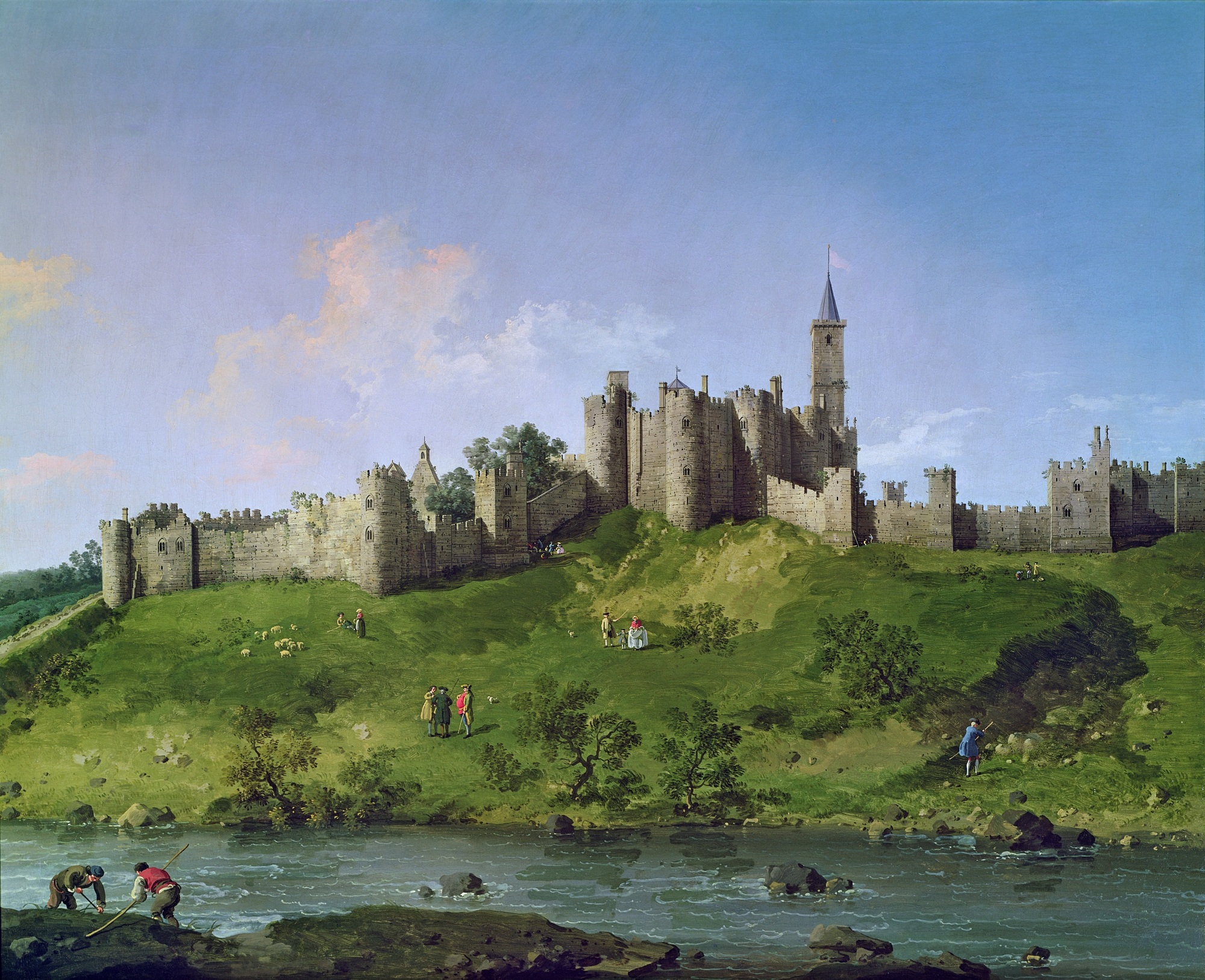
Alnwick Castle
A generation of children knows Alnwick Castle as the place where Harry Potter learned to fly a broomstick. Millions have seen its towers and courtyards on screen, doubling as Hogwarts in the first two Harry Potter films. But the real castle has seven centuries of drama that no screenwriter could improve upon -- a history of rebellion, siege, execution, and the relentless ambition of one of England's most powerful families.
The Norman Fortress
Ivo de Vesci, a Norman nobleman from Vassy in Calvados, erected the first parts of the castle around 1096 to guard a road crossing the River Aln. By 1136 it was described as "very strong" when King David I of Scotland captured it. The castle passed through the de Vesci family until their property was sold to the Percys, and from that moment -- in 1309, when Henry Percy purchased it from the Bishop of Durham -- the fortunes of Alnwick and the Percy family became inseparable. Henry Percy bought what was then a modest stone castle and immediately began transforming it into a major fortress on the Anglo-Scottish border. He did not live to see the work completed, but his son continued building. The Abbot's Tower, the Middle Gateway, and the Constable's Tower survive from this period, remnants of the construction programme that turned Alnwick into one of the most formidable castles in northern England.
Hotspur's Rebellion
The Percys were not merely landowners. They were political operators who shaped the fate of kings. Henry Percy, 1st Earl of Northumberland, helped dethrone Richard II in 1399, only to rebel against the man he had helped put on the throne, Henry IV. The earl's son, the legendary Harry Hotspur -- immortalised by Shakespeare -- was killed at the Battle of Shrewsbury in 1403. The king pursued the earl northward, and Alnwick Castle surrendered under the threat of bombardment. It was the first of many times the castle would change hands in the violent politics of fifteenth-century England.
The Wars of the Roses at Alnwick
During the Wars of the Roses, Alnwick was one of three Northumberland castles held by Lancastrian forces, and it saw some of the only significant castle warfare of the conflict. Between 1461 and 1464, Alnwick was captured, surrendered, betrayed, recaptured, and surrendered again in a dizzying sequence. At one point Sir Ralph Grey tricked the Yorkist commander Sir John Astley and handed the castle to the Lancastrians for the third time since the Battle of Towton. It was not until the Earl of Warwick received the castle's final surrender on 24 June 1464, after the Yorkist victories at Hedgeley Moor and Hexham, that Alnwick came definitively into Yorkist hands. Military historian D. J. Cathcart King called the defence of Alnwick the "only practical defence of a private castle" during the entire conflict.
Italian Rooms and Poison Gardens
After the execution of Thomas Percy, 7th Earl of Northumberland, in 1572, the castle fell into neglect. Revival came in the eighteenth century when the interiors were remodelled, and again in the Victorian era when the principal rooms were redecorated in an opulent Italianate style by the architect Luigi Canina. Today the castle is the home of Ralph Percy, 12th Duke of Northumberland, and his family, who occupy part of the building while the rest is open to visitors. Adjacent to the castle, the Duchess of Northumberland created the Alnwick Garden, a formal garden with cascading fountains, one of the world's largest treehouses, and a Poison Garden where plants like cannabis and opium poppy grow behind locked gates. The garden cost forty-two million pounds to develop.
Still a Working Castle
Alnwick is the second-largest inhabited castle in England after Windsor, and it carries its dual identity -- family home and public attraction -- with surprising ease. Exhibitions fill three perimeter towers: the Postern Tower houses frescoes from Pompeii and relics from ancient Egypt, Constable's Tower displays the Percy Tenantry Volunteers raised to repel Napoleon, and the Abbot's Tower is home to the Regimental Museum of the Royal Northumberland Fusiliers. During World War II, the Newcastle Church High School for Girls was evacuated here. Since 1981, St. Cloud State University of Minnesota has maintained a branch campus inside the castle walls. The Harry Potter connection has driven visitor numbers above 600,000 per year when combined with the garden, but the castle itself seems serenely indifferent to celebrity, as befits a place that has housed the same family through the reigns of thirty monarchs.
From the Air
Alnwick Castle is at 55.416N, 1.706W, overlooking the River Aln in the market town of Alnwick, Northumberland. The castle's bailey, towers, and adjacent Alnwick Garden are clearly visible from the air. A deep ravine separates the castle from the town to the south and east. Best viewed at 1,500-3,000 ft AGL. Nearest ICAO: EGNT (Newcastle) approximately 28nm south.