Aloha Airlines Flight 243
Passenger Gayle Yamamoto noticed a crack in the fuselage as she boarded. She said nothing. On April 28, 1988, Aloha Airlines Flight 243 -- a routine hop between Hilo and Honolulu aboard a Boeing 737-297 built in 1969 -- was cruising at altitude when roughly 18 feet of the cabin roof ripped away in an explosive decompression. The sky opened above rows of passengers still buckled into their seats. Flight attendant Clarabelle "C.B." Lansing was swept out of the aircraft. Sixty-five passengers and crew were injured, eight of them seriously. But the airplane did not crash. What happened next became one of the most studied events in aviation history.
Nineteen Years of Salt Air
The Boeing 737 registered as N73711 had been flying Hawaiian inter-island routes for nineteen years, accumulating 35,496 flight hours and an extraordinary 89,680 flight cycles -- takeoffs and landings. Most jets fly longer routes and pressurize fewer times; this aircraft's life consisted of short hops in a coastal environment saturated with salt and humidity. The combination of frequent pressurization cycles and corrosive marine air attacked the aircraft's lap joints, the overlapping seams where sheets of fuselage skin are riveted together. Metal fatigue cracked the cold bond adhesive, and crevice corrosion ate at the aluminum beneath. The airplane was, in engineering terms, an aging aircraft whose inspection regime had failed to catch the deterioration accumulating flight by flight, cycle by cycle, in the tropical air between islands.
The Roof Opens
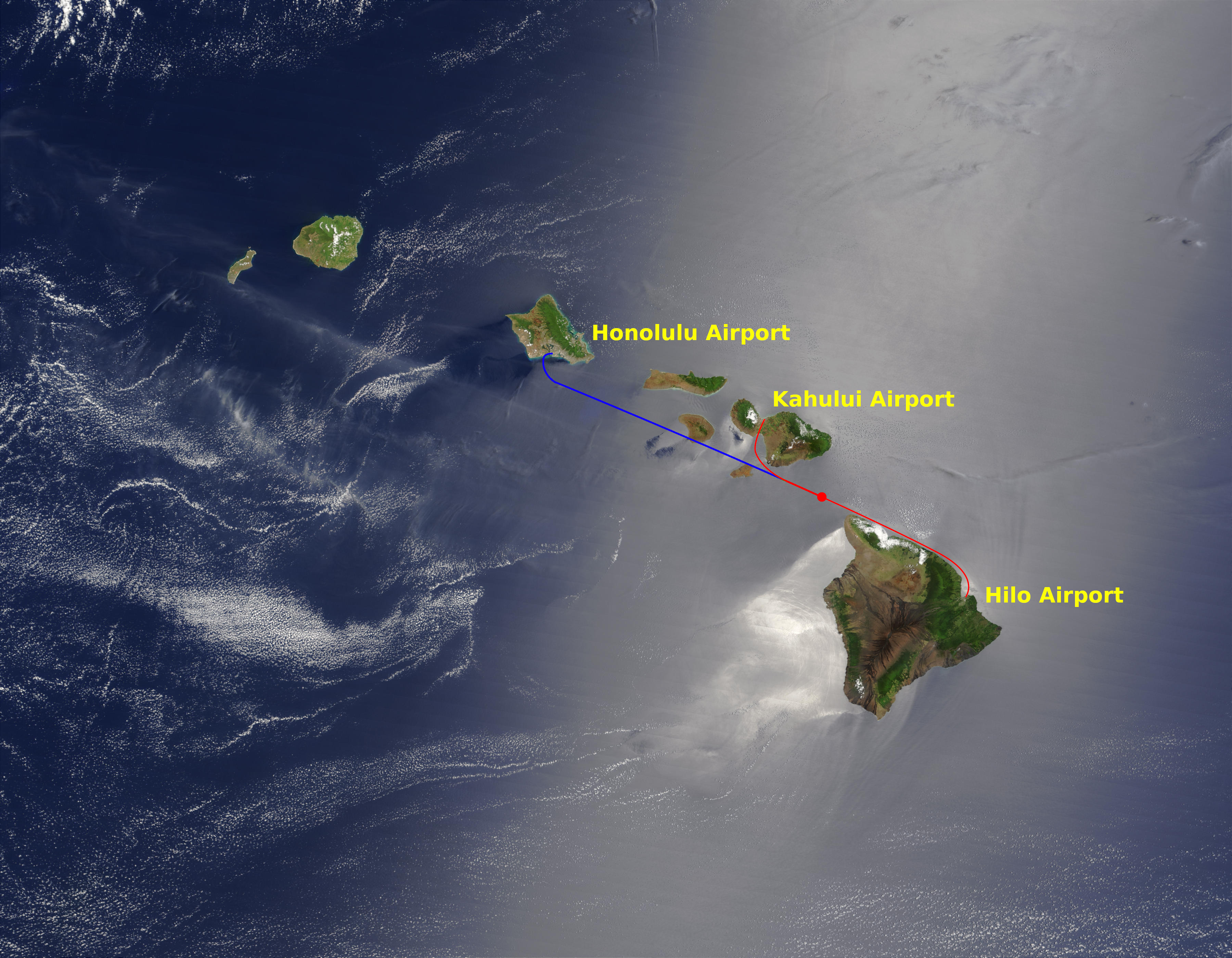
First Officer Madeline "Mimi" Tompkins was flying when the decompression struck. Captain Robert Schornstheimer immediately took the controls and began an emergency descent toward the nearest runway: Kahului Airport on Maui. The cockpit door had been torn away, and Schornstheimer could see daylight where the first-class cabin ceiling should have been. Wind noise was so intense that the crew communicated largely by hand signals. One of the 737's two engines had failed, ingesting debris. Despite the catastrophic structural damage -- the fuselage had peeled open like a tin can, leaving passengers exposed to the slipstream -- the aircraft held together long enough to reach Maui. Schornstheimer landed safely at Kahului. There was one death: C.B. Lansing, a veteran flight attendant who had been working in the first-class cabin when the roof separated.
An Island Unprepared
Maui in 1988 had no emergency plan for a disaster of this scale. The island possessed exactly two ambulances. When the crippled 737 rolled to a stop at Kahului, air traffic control radioed Akamai Tours, a local van company based three miles from the airport, and asked for as many of their 15-passenger vans as they could spare. Office personnel and mechanics drove to the runway. Two of the Akamai drivers happened to be former paramedics; they set up a triage area on the tarmac, sorting the injured passengers and crew while the vans shuttled them to the hospital. The improvised response -- a tour company performing the work of an emergency medical service -- underscored how far the reality of disaster preparedness lagged behind the risks of commercial aviation, even in a state built on air travel.
What Flight 243 Changed
The National Transportation Safety Board concluded that metal fatigue, exacerbated by crevice corrosion, had caused the fuselage failure. The investigation revealed that the aircraft's cold bond lap joints -- a construction method used on early 737s -- were particularly vulnerable to the kind of cyclical stress and corrosion that inter-island flying imposed. All 737s produced after line number 292 had already incorporated an additional doubler sheet at the lap joints, but hundreds of older aircraft were still in service worldwide. Flight 243 forced a fundamental rethinking of how the industry monitored aging aircraft. The FAA tightened inspection requirements, airlines accelerated retirement of high-cycle airframes, and the concept of "aging aircraft" entered the regulatory vocabulary as a distinct safety category. A memorial garden honoring C.B. Lansing opened at Honolulu International Airport in 1995. The accident was dramatized in the 1990 television movie Miracle Landing and featured in multiple aviation documentary series.
From the Air
The accident occurred during a flight from Hilo International (PHTO) to Honolulu International (PHNL). The emergency landing took place at Kahului Airport (PHOG) on Maui, approximately 20.54°N, 156.28°W. The flight path crossed over the Alenuihaha Channel between the Big Island and Maui. From the air, Kahului Airport is clearly visible on Maui's central isthmus between Haleakala and the West Maui Mountains. The inter-island route is one of the most heavily flown corridors in the United States.