Aloha Tower
Every arriving ship saw it first. From 1926 until Honolulu's skyline finally outgrew it, the Aloha Tower was the tallest structure in Hawaiʻi — ten stories and 184 feet of concrete and steel, topped by a 40-foot flagpole, standing at Pier 9 of Honolulu Harbor with the word "ALOHA" spelled out on all four sides. It was a lighthouse, a clock tower, a harbor control center, and a declaration of welcome, all at once. What the Statue of Liberty was to immigrants entering New York Harbor, the Aloha Tower was to the hundreds of thousands who arrived by sea to begin new lives in the Hawaiian Islands.
Boat Days at Pier 9
The tower opened on September 11, 1926, at a cost of $160,000 — a substantial investment for territorial Hawaiʻi. In the decades before commercial aviation, Honolulu Harbor was the islands' front door, and arrival by steamship was an event. "Boat Days" brought crowds to the waterfront: lei sellers, musicians, families waving from the pier, the Royal Hawaiian Band playing as passengers disembarked. The Aloha Tower presided over all of it, its observation deck offering new arrivals their first elevated view of Honolulu and the Koʻolau mountains beyond. For immigrants from Japan, China, the Philippines, Portugal, and elsewhere, that first glimpse from the pier became a founding memory of island life.
A Tower That Outlasted Its Era
By the 1960s, the jet age had made ocean liners obsolete as the primary route to Hawaiʻi. The tower's role as the gateway to the islands faded as Daniel K. Inouye International Airport absorbed the steady flow of arrivals. But the Aloha Tower endured. It remained a working lighthouse and harbor control point, even as Honolulu's skyline grew tall around it. After the September 11, 2001 attacks, security concerns closed the observation deck to the public for several years, though it has since reopened. The tower's persistence is stubborn — it has weathered economic shifts, changing security landscapes, and the constant churn of waterfront redevelopment proposals, refusing to become irrelevant.
From Marketplace to Campus
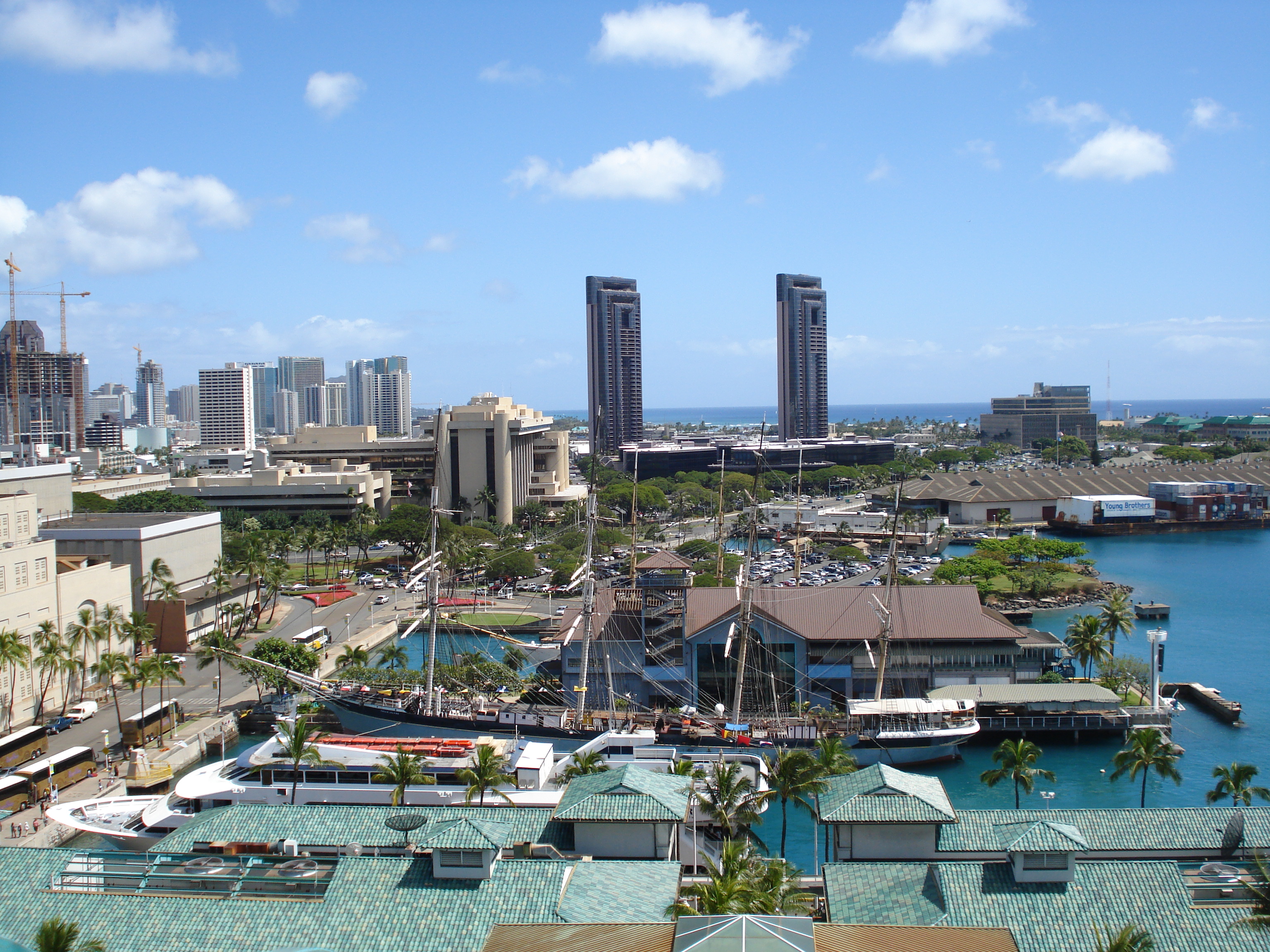
In the 1990s, the Aloha Tower Marketplace transformed the surrounding pier area into a shopping and entertainment complex, attempting to draw tourists and locals back to the waterfront. The marketplace struggled commercially over the years. In 2015, Hawaiʻi Pacific University took over the facility and converted it into an expansion of its campus, adding 78 student housing units for 278 students. The transformation was fitting: a building that once welcomed newcomers to the islands now houses students from around the world arriving to study in Honolulu. The adjacent historic vessel Falls of Clyde, an iron-hulled four-masted ship that had been docked at the royal pier for decades, was scuttled in 2025 after years of deterioration and delisting from the historic register.
The Next Chapter at the Waterfront
Honolulu's waterfront is changing again. The city's Skyline rail project will bring a downtown station near the Aloha Tower, expected to open by 2031. As part of the transit-oriented development plan, the parking lot in front of the tower and a decommissioned Hawaiian Electric power plant nearby are slated for demolition to make way for mixed-use developments. Surrounding commercial offices are being converted into residential condominiums. The Aloha Tower itself stands protected by its listing on the National Register of Historic Places, a ten-story anchor of continuity amid the construction cranes and concrete pours that are reshaping the harbor district. A century after it opened, it remains what it has always been: a fixed point of welcome at the water's edge, greeting whoever arrives next.
From the Air
Aloha Tower is located at 21.307°N, 157.866°W at Pier 9 of Honolulu Harbor on Oʻahu. The distinctive clock tower is identifiable from the air by its position at the harbor's edge and the large "ALOHA" lettering on its four faces. Best viewed at 1,000–2,000 ft AGL. Nearest airport: Daniel K. Inouye International (PHNL), approximately 5 nm northwest. The harbor and downtown Honolulu waterfront provide clear visual references. Trade winds typically produce clear morning conditions.