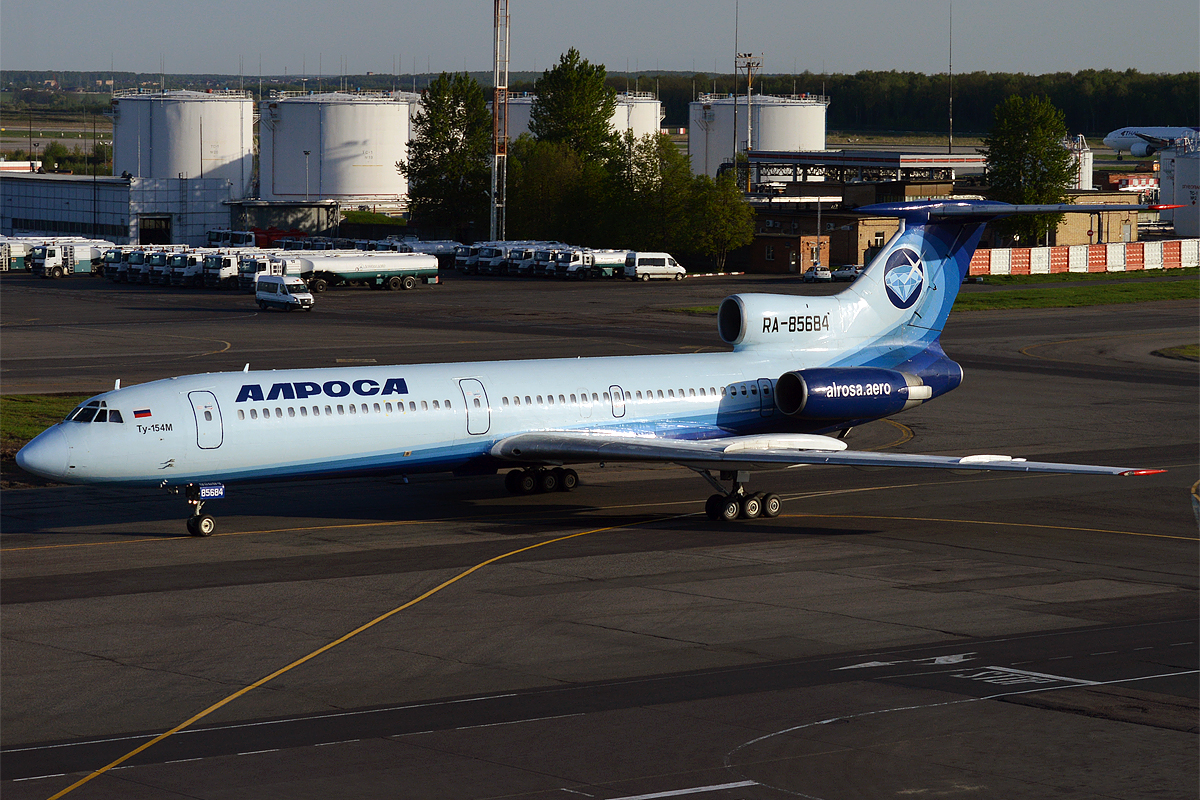
Alrosa Flight 514
At some point over Usinsk on the morning of September 7, 2010, every electrical system on Alrosa Flight 514 stopped working. The fuel pumps that transferred fuel from the wing tanks to the engine supply tank in the fuselage went silent. The navigation equipment went dark. The radio died. The flaps, which required electrical switches to operate despite being hydraulically powered, would not move. The crew of the Tupolev Tu-154, carrying 72 passengers and 9 crew members, were suddenly flying a 100-ton aircraft over the subarctic taiga of the Komi Republic with no instruments, no radio, no flaps, and nowhere obvious to land.
The Decision
Captain Novoselov and First Officer Lamanov had limited options. Without the ability to transfer fuel, the aircraft could not reach Moscow. Without radio, they could not call for help through normal channels. The crew identified Izhma Airport — a former airfield now used only for helicopter operations — as the closest strip. The runway there had not been maintained for jet operations; it was shorter than the 2,500 meters the Tu-154 typically requires. Emergency authorities at Izhma were somehow informed by 07:47 local time that an aircraft might be attempting to land. Eight minutes later, at 07:55, the Tu-154 touched down — faster than normal at around 350 kilometers per hour because the absence of flaps meant the minimum landing speed was higher than it should have been. The aircraft overran the end of the runway and came to rest in the vegetation beyond it, on its landing gear, damaged but intact.
All 81 Survived
Every person on board walked away. The passengers were later flown by Mil Mi-8 helicopter to Ukhta Airport, where a replacement Tu-154 continued their journey to Moscow. Two passengers, apparently having had enough of aircraft for one day, chose to continue by rail instead. Russian aviation experts called what happened a miracle. The crew called it their job, though what they had done was by any measure extraordinary: a controlled landing on a too-short strip, without instruments, flaps, or radio, in a remote region of Russia's north, without a single fatality. President Dmitry Medvedev signed an order awarding the captain and first officer the title Hero of the Russian Federation. The other seven crew members received the Order of Courage.
Getting the Plane Out
The aircraft, registered RA-85684, sat at Izhma for six months while engineers debated how to extract it. The runway was too short for a standard Tu-154 takeoff. But the alternative — dismantling the aircraft on site — was expensive and final. On March 24, 2011, test pilots managed to take off from Izhma, flying the damaged aircraft 160 kilometers to Ukhta Airport for refueling and inspection, then on to Samara Airport for full repairs. The mechanics of how they achieved a takeoff in roughly half the required runway length — on an airstrip that had been cut back from vegetation by a local maintenance worker named Sergei Sotnikov, who reportedly tended the abandoned strip for years on his own initiative — added another chapter to an already improbable story.
The Plane Named Izhma
Repairs were completed in June 2011. The aircraft was given the name Izhma and returned to regular service with Alrosa. It flew for another seven years before its certificate of airworthiness expired in September 2018 and the airline judged renewal uneconomical. On September 29, 2018, Lamanov — the first officer from the accident flight, now serving as pilot in command — flew Izhma one final time, from Mirny Airport to Novosibirsk Tolmachevo Airport, where it became part of the local aviation museum's collection. Captain Novoselov was waiting on the ground when it landed. Some aircraft earn their names. Izhma earned its.
From the Air
The emergency landing occurred at Izhma Airport, located at approximately 65.03°N, 53.97°E near the town of Izhma in the Komi Republic, Russia. The airstrip sits in the taiga south of the Izhma River. Ukhta Airport (UUYW), where survivors were subsequently flown, is approximately 60 km to the south-southwest. From cruising altitude, the region appears as an unbroken expanse of boreal forest with occasional river valleys. The scale of the terrain — and the isolation of Izhma Airport within it — makes clear why landing at this strip was considered a miracle.