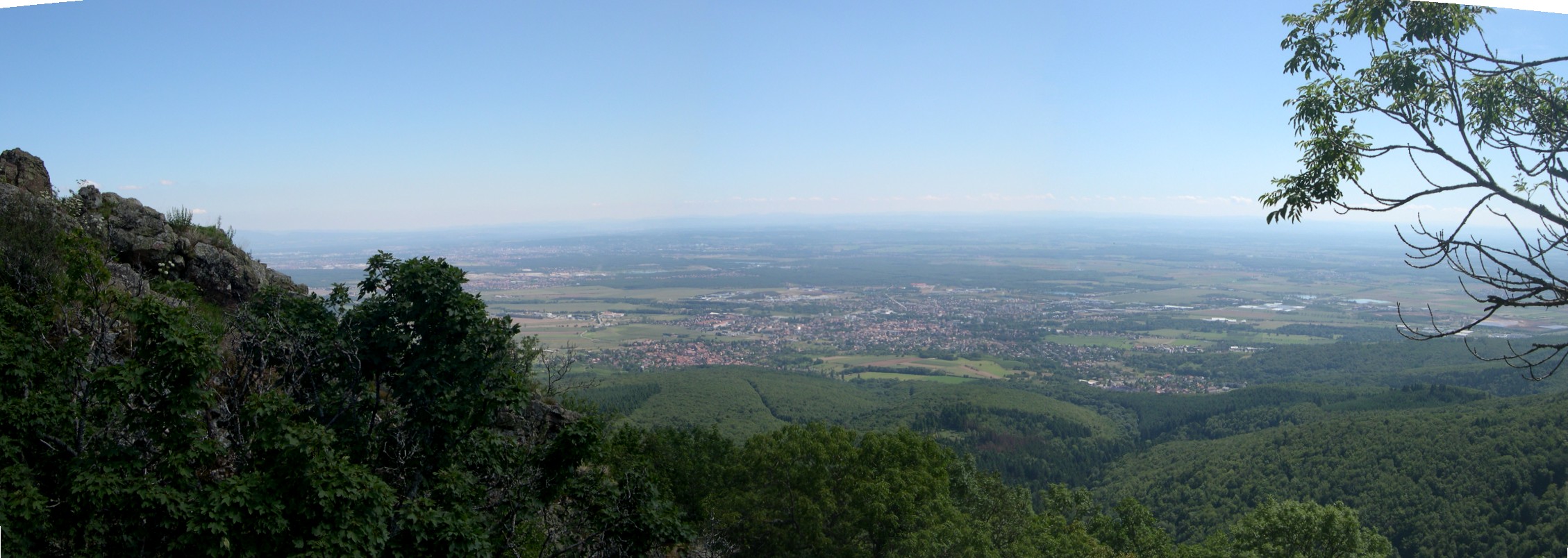
Alsace
Strasbourg's cathedral rises in pink sandstone, a single Gothic tower reaching toward clouds that might bring French rain or German snow depending on the century. Alsace has changed hands between France and Germany so many times that the locals eventually stopped seeing the irony: they fly more French flags than any other inland region, precisely because their French identity has been questioned so often. The land itself is caught between geographies - the Vosges mountains on the west, the Rhine on the east, a strip of vineyard-covered foothills running north to south with half-timbered villages tucked into every fold of the terrain. Drive the Wine Road from Marlenheim to Thann and you'll pass through a landscape that looks like a fairy tale illustration: storks nesting on church towers, geraniums spilling from window boxes, castle ruins crowning every prominent hill. But the fairy tale has a hard history beneath it, and the distinctive culture that emerged - not quite French, not quite German, stubbornly both and neither - is the real treasure of this contested corner of Europe.
The Cathedral and the Clock
Strasbourg Cathedral was the world's tallest building for 227 years. That fact seems impossible when you stand beneath it - surely something taller must have existed somewhere - but from 1647 to 1874, nothing exceeded its 142-meter spire. The building itself is an education in medieval engineering and aesthetics: Romanesque foundations supporting Gothic heights, the pink Vosges sandstone giving the whole structure a warmth that grey limestone cathedrals lack.
Inside, the astronomical clock performs its mechanical miracle at 12:30 each day. Apostles parade, angels chime bells, a rooster flaps and crows three times. The current mechanism dates to the 19th century but incorporates elements from clocks dating back to 1352. It calculates leap years, moveable feasts, and the precise moment of solar noon - a different time each day, displayed alongside the civil time that governs ordinary life. Four million visitors come annually to see the cathedral. Most crowd around the clock at noon, waiting for carved figures to emerge from doors that have opened daily for over 500 years.
The Wine Road
The Route des Vins d'Alsace runs 170 kilometers from Marlenheim near Strasbourg to Thann near Mulhouse, threading through villages whose names grace wine labels worldwide: Riquewihr, Ribeauvillé, Eguisheim, Kaysersberg. The vines climb the lower slopes of the Vosges, benefiting from the microclimate created by the mountains' rain shadow - Colmar is one of the driest cities in France, receiving only 95 days of precipitation annually.
The wines are almost entirely white: Riesling, Gewurztraminer, Pinot Gris, Muscat, Pinot Blanc. They're made in a style that owes more to Germany than to the rest of France - aromatic, often off-dry, meant for food that straddles the same cultural divide. The wine villages compete for visitors with flower-bedecked half-timbered houses, wine cellars offering tastings, and restaurants serving the local specialties. A day on the wine road is a rolling immersion in everything Alsace does best: beauty, history, and the intersection of two culinary traditions.
The Castles on the Hills
Ruined castles crown the Vosges peaks like stone sentinels watching the Rhine. Some have been restored - Haut-Koenigsbourg near Séléstat is a 20th-century reconstruction of a 12th-century fortress, now a major tourist attraction. Others remain romantic ruins: Fleckenstein carved into living rock, the three castles of Ribeauvillé visible from miles around, the Haut-Barr overlooking Saverne from its clifftop perch.
The castles date mostly from the 11th to 13th centuries, when the Alsatian nobility built fortifications to control the trade routes through the Rhine valley. Sieges, fires, and centuries of neglect reduced most to ruins. The French Revolution finished off whatever the wars had spared. What remains is a landscape dotted with medieval fragments - towers visible from vineyard to vineyard, walls crumbling back into the forest, and a few reconstructed examples showing what the originals might have looked like in their prime.
The Cuisine Between
Alsatian food is German in substance and French in execution. Choucroute - sauerkraut - is claimed as a local invention, piled with sausages and pork in a dish that could have come from Bavaria. Tarte flambée, the Alsatian pizza of crème fraîche, onions, and bacon, has a German name (Flammkuchen) and a French refinement. Baeckeoffe, a casserole of marinated meats and potatoes, was traditionally prepared by housewives who dropped their dishes at the baker's oven while they did laundry.
Yet Alsace has more five-star Michelin chefs per capita than any other region in France. The cuisine occupies both ends of the spectrum simultaneously: hearty, rustic, German-influenced comfort food in the winstubs and cafes; elaborate, technically perfect French gastronomy in the starred restaurants. Both streams draw from the same ingredients - the wines, the pork, the Munster cheese that's best not transported too far, the local eaux-de-vie distilled from every fruit that grows on the eastern slopes.
The Malgré-Nous
Alsace's flags fly so proudly because the region knows what it means to have its identity stolen. In World War I, Alsatian men under German rule were sent to the Russian front - far from France, where they might have been tempted to defect. In World War II, after Germany annexed Alsace again, 130,000 Alsatian men were forcibly conscripted into the Wehrmacht. They called themselves malgré-nous - 'against our will' - and many died fighting for a country they didn't choose, against the France they considered home.
The postwar years saw deliberate Frenchification: the Alsatian dialect was discouraged, sometimes punished in schools. A generation grew up speaking French that their parents had never learned. Now the dialect is reviving, street signs are bilingual, and Alsace is comfortable enough in its French identity to acknowledge its German heritage. The Christmas markets that draw millions each winter are German in origin. The storks that nest on church towers are symbols of Alsace that neither country claims exclusively. The wine is French, the cuisine is both, and the people are simply Alsatian - shaped by a history of changing borders into something that belongs entirely to itself.
From the Air
Located at 48.50°N, 7.50°E in northeastern France, Alsace occupies the Rhine plain between the Vosges mountains (west) and the German border (east, marked by the Rhine River). Strasbourg (SXB) is the main airport with excellent international connections; the city is also a major TGV hub (Paris 1h50). The region stretches roughly 190km north-south, never more than 50km wide. From altitude: the Vosges form a distinct forested ridge (highest point Grand Ballon, 1,424m), the Rhine plain is a patchwork of vineyards and villages, and the Rhine itself forms a clear boundary with Germany. The Wine Road villages are visible as clusters of half-timbered buildings on the vineyard slopes. Mulhouse (MLH, actually EuroAirport serving Basel and Freiburg too) is the southern gateway. Colmar, midway along the region, is the wine capital but has no airport. The climate features cold winters and warm, dry summers. Cross-border traffic is heavy; Kehl (Germany) connects to Strasbourg by tram.