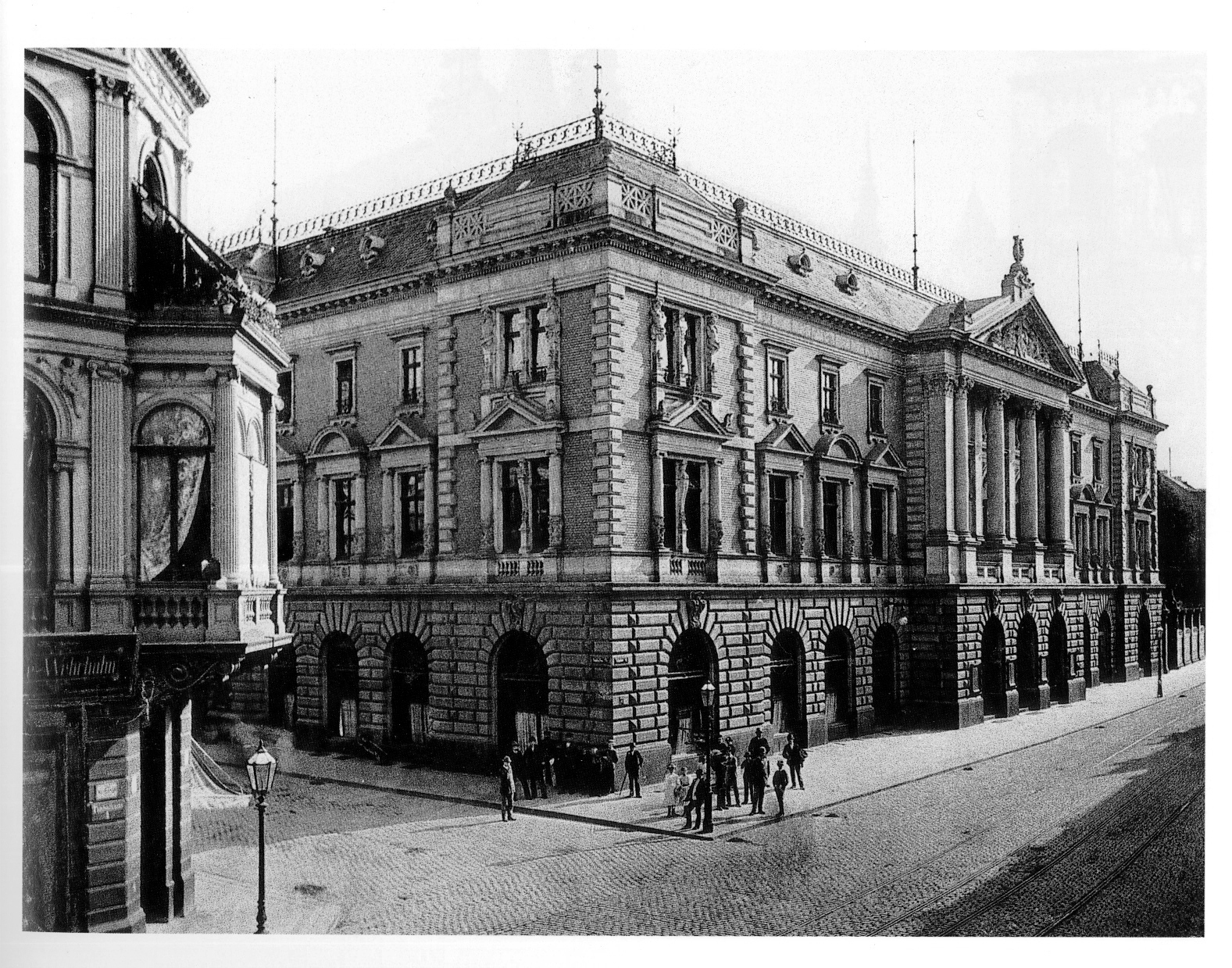
Alte Tonhalle
On the eleventh of December, 1912, the Kaisersaal in Düsseldorf's municipal Tonhalle held a thousand performers. Mahler had been dead for nineteen months. His Eighth Symphony — the Symphony of a Thousand — had received its world premiere in Munich two years before, and this Düsseldorf performance was the second time the colossal work had ever been heard. Photographer Josef Henne captured the moment: tier upon tier of choristers and players packed into a hall named for Kaiser Wilhelm I, beneath ceiling paintings by Hemming & Witte, four columns rising on the main façade outside, a triangular gable above the entrance. Thirty-one years later, the bombs came. Today the address on Schadowstraße holds a Karstadt department store.
From Garden Restaurant to Concert Hall
The Tonhalle did not begin as a concert hall. In 1818, the first Lower Rhenish Music Festival took place in Geisler'sches Lokal, a restaurant with a large wooden hall in Düsseldorf — earlier known as Becker's Gartenlokal, essentially a pub with a garden room. The acoustics were apparently good enough, because by 1830 it had become the gathering place for the city's music lovers, and by 1850 a concert there could draw nearly a thousand people. In 1863 the city of Düsseldorf bought the pub outright; by then it was already called the Tonhalle. Two years later, in 1865, a proper purpose-built concert hall replaced the wooden room. The new building's Kaisersaal — the Emperor's Hall — measured 42.48 meters long by 24.20 meters wide, and with two galleries it could seat 2,820 people. Kaiser Wilhelm I visited in person on the eighteenth of September, 1884, and was given a banquet there by the Rhenish dignitaries. The hall was named in his honor.
The Names on the Programs
Felix Mendelssohn Bartholdy premiered his oratorio Paulus in Düsseldorf in 1836. Robert Schumann, who served as the city's music director, conducted here; in 1849 the audience heard his Der Rose Pilgerfahrt and Requiem für Mignon for the first time. Ferdinand Hiller made music here. So did Ferdinand Ries — Beethoven's pupil — and Norbert Burgmüller and Julius Rietz. Johannes Brahms played in this hall. Franz Liszt played in this hall. The violinist Joseph Joachim performed here; so did the Swedish soprano Jenny Lind, the Nightingale, whose voice was famous enough that P. T. Barnum had paid a fortune to tour her through America. For most of the nineteenth century, if you were a serious composer or performer working in Central Europe, you came through Düsseldorf, and when you came, you played at the Tonhalle. The city had positioned itself as a cultural anchor on the Lower Rhine, and this building was the proof.
The Building Grew Bigger
By 1886 the city wanted something grander, and held a competition for a new building. The winning designs came from the architects Hermann vom Endt and Bruno Schmitz, working in the neo-Renaissance style. The city architects Eberhard Westhofen and Peiffhoven adapted those plans into an extension built between 1889 and 1892. The entrance gained a classicist portico — one column from that section survives today, transplanted to the Malkastenpark as a memorial to Düsseldorf's lost concert culture. The Kaisersaal stayed. So did the Rittersaal — the Knights' Hall — which received its ceiling paintings from Hemming & Witte. In 1901 the alderman Johannes Radke commissioned new stucco work for the Kaisersaal. The complex grew to occupy Schadowstraße 91, adding social rooms, shops, and restaurants alongside the concert spaces. Carnival clubs met here. The artists' association Malkasten held its famous Redoute balls. At a coal industry summit here in 1871, William Thomas Mulvany founded the trade association that helped turn Düsseldorf into what Germans came to call the Schreibtisch des Ruhrgebiets — the writing desk of the Ruhr.
What Bombs Took
In 1943, Allied bombs damaged the building. The Kaisersaal that had held Mahler's Eighth was wounded but not yet destroyed; the city limped the rest of the way through the war with much of the structure intact. After the war, with Düsseldorf rebuilding around the ruined site, the city made a choice that would have been unthinkable in 1912: it sold the Tonhallen site to Karstadt AG. A new department store, designed by the architect Philipp Schaefer, rose on the same address. The original column in the Malkastenpark remains as a small civic apology. The Tonhalle name still belongs to Düsseldorf — but to a different building, a 1926 planetarium on Ehrenhof that was converted into the city's current concert hall in 1978. The original is gone. The names on the programs remain in the archives of the Musikverein Düsseldorf, which still keeps the records of every premiere from 1818 to 1942.
From the Air
The site of the Alte Tonhalle sits at roughly 51.23°N, 6.79°E in central Düsseldorf, on Schadowstraße between the Hofgarten and the modern Altstadt. From altitude the Rhine bend defines the city; the Kö (Königsallee) and the Stadttor make the cleanest landmarks. Düsseldorf International (EDDL/DUS) is 8 km north. The current Tonhalle Düsseldorf — the 1925 planetarium converted into the modern concert hall — stands northwest of the old site at the Ehrenhof on the Rhine bank.