Altes Rathaus (Bonn)
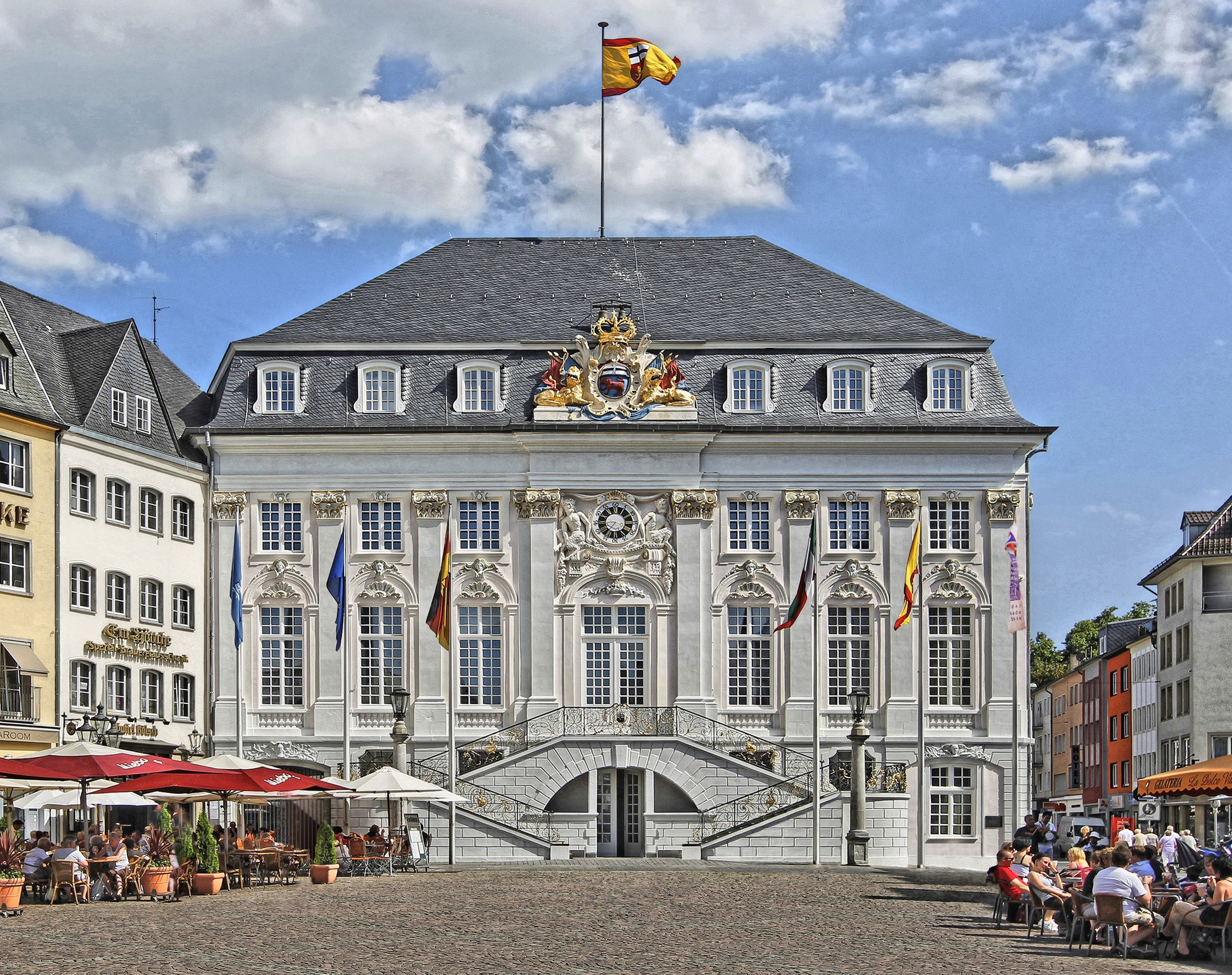
From the Marktplatz looking east, the Altes Rathaus closes the long narrow square like a curtain dropping at the end of a scene. Four stories of pink-painted stucco, white pilasters, gold trim, a steep gambrel roof with dormers, and a sweeping double staircase - the perron - covered in gold leaf. It is small. The whole building has only seven window axes across its front. But it was designed in 1737 to fill the narrow end of the market square completely, and that is exactly what it does. Stand at the western end of the Marktplatz with the Beethoven Monument behind you, and the Altes Rathaus is the building you are looking at.
What Came Before
There had been a town hall on the Marktplatz since at least the fifteenth century - a three-story medieval building of which almost nothing is known, because it was destroyed by artillery fire during the Siege of Bonn in 1689. The siege was part of the Nine Years War, and the surviving town hall was patched up to be functional but never properly rebuilt. By the 1730s the Cologne prince-elector Clemens August of Bavaria - who was responsible for most of the Baroque and Rococo splendor of his residence city - decided Bonn needed a new town hall worthy of its role. The electoral court architect Michael Leveilly drew up plans in the Rococo style. The building went up between 1737 and 1738. The interior decoration and finishing dragged on until around 1780, by which point the original architect had been replaced by Johann Heinrich Roth, who added a three-aisled meat hall on the rear side facing Rathausgasse. The meat hall was rebuilt into simpler shapes in the 1870s and later used by the city treasury and archives.
The Stair Famous for Standing On
The architectural feature that made the Altes Rathaus famous is not its facade or its interior but its exterior staircase. The gilded perron sweeps up to the first-floor balcony in two curving flights, meeting in the middle, with elaborate wrought-iron balustrades and gold-leafed details on the railings. From the top of the perron, anyone speaking has the entire Marktplatz as an audience and the building itself as a backdrop. That feature did not matter much for the first two centuries of the building's existence. Then in 1949, Bonn was chosen as the provisional capital of the Federal Republic of Germany, and the perron became one of the most-photographed pieces of architecture in Europe. On 12 September 1949, Theodor Heuss - who had just been elected the first president of West Germany - appeared on the balcony to greet the people of Bonn. He had to. There was no other building in the new capital with a balcony like this and a square like that one. In 1962, Charles de Gaulle gave his welcoming speech to West Germany from the same perron. In 1963, John F. Kennedy did. On 13 June 1989, Mikhail Gorbachev stood on it to a cheering crowd, six months before the Berlin Wall came down. Every one of those heads of state signed the Golden Book of the City of Bonn, on a desk inside the building. The Golden Book is still kept there.
Not Everyone Was Cheering
On 10 April 1973, the South Vietnamese general and president Nguyen Van Thieu arrived in Bonn for a state visit. The city had opened the Altes Rathaus to the public for the occasion. About sixty hooded members of the Communist Party of Germany, its Marxist-Leninist offshoot, and an associated group stormed the building. They destroyed windows and interior fittings. About two thousand demonstrators outside formed a wall between the police and the building. The damage came to roughly half a million Deutschmarks. The episode does not appear on the tourist plaques. It is one of the more violent moments in the building's history and a reminder that the capital of West Germany was, for forty years, a working political space and not just a backdrop.
Demoted, Not Retired
After the municipal mergers of 1969 - which roughly doubled the city's population by adding Bad Godesberg, Beuel, and the surrounding villages - the Altes Rathaus simply could not hold an expanded city administration. The new Stadthaus, a larger and architecturally undistinguished postwar building further north in Nordstadt, took over as the working seat of municipal government in 1978. The Altes Rathaus lost its administrative function but kept its representational one. The Lord Mayor of Bonn still has offices inside. The executive board departments for Basic Affairs and International Affairs and Representation are housed there. Speeches and ceremonies of importance to the city are still held in the Rococo rooms behind the perron. People still get married in the wedding room. From February 2010 to June 2011 the building underwent a 5.45 million euro renovation - facade, doors, windows, roof, heating, fire protection - funded through the federal economic stimulus package and supplemented by the Verein Altes Rathaus, a preservation association founded in 2009. The pink and gold returned to their original brightness. The perron was regilded. The Altes Rathaus is no longer the building from which the West German president was announced to the Marktplatz, but it still looks like that building. The crowd, when it returns for state occasions, fills the square the same way it did in 1949 and 1963 and 1989.
From the Air
The Altes Rathaus stands at 50.7351 degrees North, 7.1029 degrees East at the eastern end of the Marktplatz in the center of Bonn's old town. From the air, the building is recognizable by its small footprint and steep pink-and-grey gambrel roof closing the narrow end of the market square. Nearest airport is Cologne Bonn (EDDK / CGN), 25 km north. The Beethoven Monument on the Munsterplatz is one block west; the Beethoven House on Bonngasse is two blocks north. The Bonn Minster tower is the most prominent vertical landmark in the immediate area.