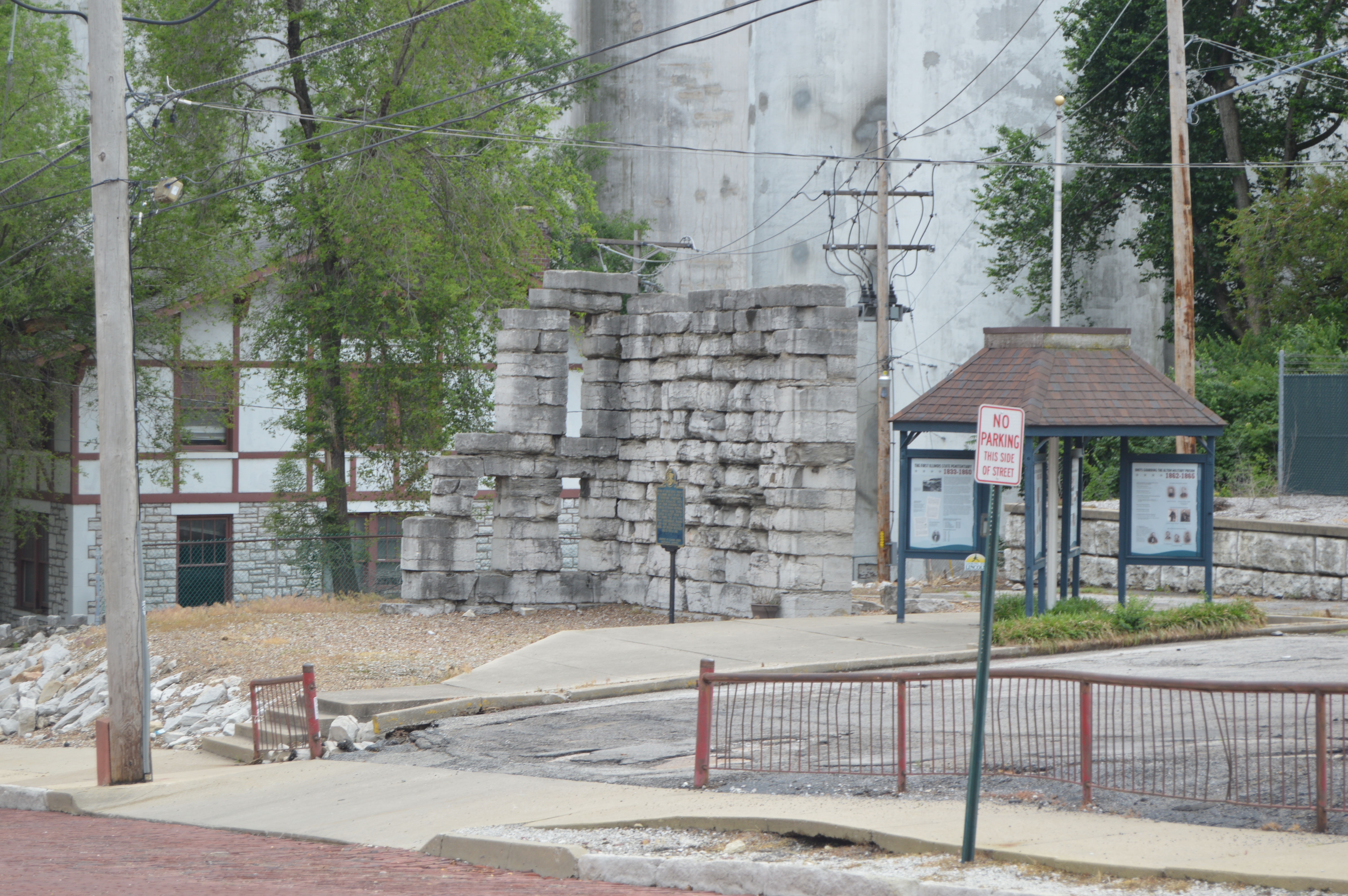
Alton Military Prison
The building was already a ruin when the war began. Illinois had opened its first state penitentiary in Alton in 1833, but by 1860 the prison was so decrepit that the state had abandoned it for a new facility in Joliet. Then the Civil War arrived, the Union suddenly needed places to hold thousands of Confederate prisoners, and the abandoned penitentiary in Alton got a second life that no one would have wished for. Over the next three years, more than 11,000 Confederate soldiers passed through its crumbling walls. At least 1,534 of them died there -- not from battle wounds, but from smallpox, typhoid, dysentery, and pneumonia. Today, only a section of wall remains, standing on the Alton riverfront as a memorial to suffering that happened not on a battlefield but in a building the state had already condemned.
A Prison Already Condemned
When Illinois built its first state penitentiary in Alton in 1833, the Mississippi River town was a logical choice -- accessible by water, close to the growing population centers of the American Bottom. For nearly three decades, the prison held the state's convicted criminals behind limestone walls. But by the late 1850s, the facility had deteriorated beyond repair. Cells were cramped, sanitation was primitive, and the building leaked in every storm. Illinois opened a new state penitentiary in Joliet in 1858 and shuttered the Alton facility. Dorothea Dix, the famous prison reformer, had personally toured the Alton prison and condemned its conditions. When the Union Army requisitioned it as a prisoner-of-war camp in 1862, they were converting a building that the state had already declared unfit for human habitation.
The Smallpox Island
Conditions inside the Alton prison were catastrophic from the start. The facility designed to hold several hundred state prisoners was packed with thousands of Confederate POWs. Overcrowding made disease inevitable, and when smallpox broke out in 1862, it tore through the population with devastating efficiency. The Union Army established a quarantine hospital on a small island in the Mississippi River near the prison, but the isolation came too late for many. Prisoners infected with smallpox were ferried to the island, where many died and were buried in unmarked graves. The epidemic killed hundreds. Combined with typhoid, pneumonia, and dysentery, disease accounted for the vast majority of the 1,534 documented deaths at Alton. The prison became one of the deadliest POW camps in the Civil War, rivaling the more famous horrors of Andersonville in the South.
A War Within the War
The Alton prison held more than just Confederate soldiers. The facility also confined civilian political prisoners, including Confederate sympathizers from Missouri and southern Illinois who were detained without trial under wartime emergency powers. The prison's proximity to the contested Missouri border made it a collection point for a wide range of detainees. Some prisoners attempted escapes; a few succeeded by exploiting the crumbling walls. Guards, too, suffered from the conditions -- many fell ill from the same diseases that ravaged the prisoners. The camp's administration struggled with inadequate supplies, insufficient medical staff, and a building that was literally falling apart around them. Reports of conditions at Alton reached both Union and Confederate authorities, but neither side was willing or able to substantially improve the situation.
One Wall Remaining
When the Civil War ended, the Alton prison was abandoned for a second and final time. The buildings were demolished over the following decades as Alton expanded. Today, only a section of the original limestone wall survives, standing along the riverfront near the intersection of William Street and Broadway. A monument and interpretive markers tell the story of the 11,000 men who passed through and the 1,534 who did not leave. A Confederate cemetery in North Alton holds some of the dead, though many graves remain unmarked. The site is a quiet place now, easy to miss in the small river town. But it stands as a reminder that the Civil War's killing fields extended far beyond the famous battlefields, into cramped and crumbling buildings where disease did what bullets could not.
From the Air
Located at 38.892°N, 90.191°W on the riverfront in Alton, Illinois, approximately 15 nm north of downtown St. Louis along the Mississippi River. The surviving prison wall section is small and difficult to identify from altitude. Alton sits where the Missouri and Mississippi rivers approach their confluence. The Clark Bridge crossing the Mississippi at Alton is a useful visual reference. Nearest airports: KALN (St. Louis Regional Airport/Alton, 3 nm NE), KSTL (St. Louis Lambert International, 15 nm S). The bluffs along the river at Alton are distinctive terrain features.