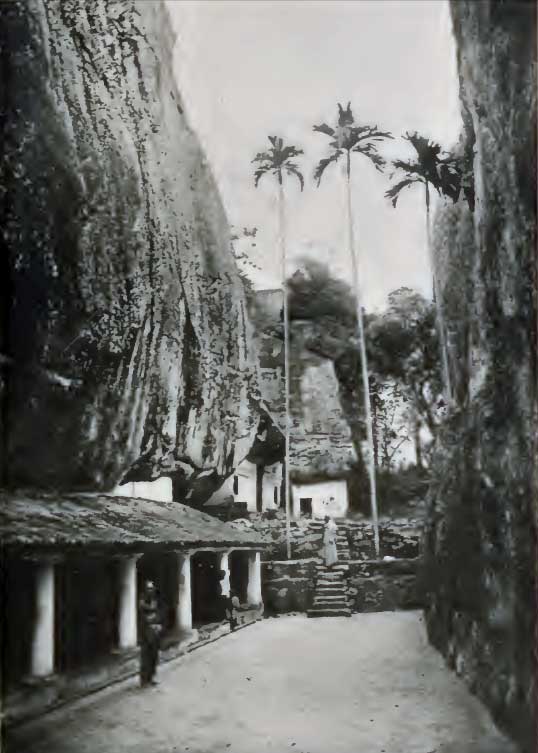
Aluvihare Rock Temple
For centuries, the teachings of the Buddha existed only in the minds of monks who memorized and recited them to one another across generations. Then, around 20 BCE, in a cave temple nestled among the hills of Matale District, 500 monks gathered to do something that had never been done: write it all down. The Aluvihare Rock Temple -- the "Temple of Light," as its Sinhalese name suggests -- became the place where the Pali Canon, the Tipitaka, was first fully transcribed onto palm leaves. What drove the monks to this unprecedented act was not scholarly ambition but fear. The oral tradition was dying, and they knew it.
When Memory Became Fragile
The crisis that led to the transcription was not philosophical but existential. In the first century BCE, during the reign of King Vattagamani Abhaya -- known also as Walagamba -- Sri Lanka was struck simultaneously by famine and invasion. The famine, called Baminithiyasaya, lasted twelve years. South Indian forces invaded, and the king was overthrown. Buddhist monks, who depended on alms from the laity for their survival, found themselves eating yams, roots, and tree leaves to stay alive. About 60 monks retreated to the hilly region of Malaya Rata, surviving on the banks of the Mahaweli River under desperate conditions. The oral chain of transmission -- monk teaching novice, generation after generation, for over four centuries since the Buddha's death -- was fraying. Monks were dying, scattering, or simply too weakened by hunger to maintain the rigorous memorization that the Dhamma required.
Five Hundred Voices, One Text
After King Walagamba regained his throne fourteen years later, the surviving monks returned to Anuradhapura and made a decision that would shape the course of Buddhism. They would write the Tipitaka down. The monks chose Aluvihare as the site -- a secure, secluded cave complex in the Matale hills, 30 kilometers north of Kandy on the road to Dambulla. Approximately 500 scholarly monks assembled there, and the process was meticulous: first, they recited the entirety of the canon aloud, debating and agreeing on an authoritative version before a single character was inscribed. The scribes used metal styluses to etch Pali text onto strips of ola leaf -- the dried, prepared leaves of the palmyra or talipot palm. These palm-leaf manuscripts, called puskola poth, became the first complete written record of Theravada Buddhist scripture. The act preserved a tradition that oral transmission alone could no longer guarantee.
Destroyed, and Written Again
The library at Aluvihare safeguarded those manuscripts for nearly two thousand years. Then, in 1848, the Matale Rebellion -- an uprising against British colonial rule -- swept through the region, and the temple complex was devastated. The old library, with its centuries of accumulated palm-leaf texts, was totally destroyed. The loss was staggering: not just the physical manuscripts but the continuity they represented, a direct line from those 500 monks in the first century BCE to the living temple community. The consequences of the destruction are still visible on the temple grounds today. Recompilation began, but the work was painstaking. Only a few monks at a time could undertake the meticulous task of re-transcribing the three "baskets of the law" that comprise the Tipitaka. The first basket was not completed until 1982 -- more than 130 years after the rebellion.
The Temple of Light
The temple's origins predate the transcription by centuries. Tradition holds that King Devanampiyatissa founded Aluvihare in the third century BCE, building a dagoba and planting a Bo sapling after Buddhism was introduced to Sri Lanka during his reign. The cave complex, carved into and beneath massive boulders, contains ancient inscriptions and frescoes in its monastery caves. The great scholar Buddhaghosa -- regarded as the foremost interpreter of the Pali canonical scriptures -- is said to have spent several years at Aluvihare during the fourth and fifth centuries CE, working on his commentaries. As for the name itself, multiple folk etymologies converge on the same meaning: Aloka Vihara, "temple of light," became Aluvihare because the Pali word aloka was rendered as alu in ancient Sinhalese. Another tradition notes that despite the massive rock formation to the east, sunlight enters the cave unobstructed -- hence Aloka Lena, the "cave with light." Either way, the name endures as a reminder that this place was built to illuminate.
From the Air
Aluvihare Rock Temple is located at 7.50N, 80.62E in the Matale District of central Sri Lanka, 30 km north of Kandy on the Matale-Dambulla road. The temple complex is set among large rock formations and hills, visible as a cluster of structures and boulders amid otherwise green terrain. The rock formations are the most distinctive feature from low altitude. Nearest airport: Colombo Bandaranaike International (VCBI) approximately 120 km west-northwest. The nearby city of Kandy can be identified by Kandy Lake. Best viewed at 2,000-4,000 feet AGL in clear conditions.