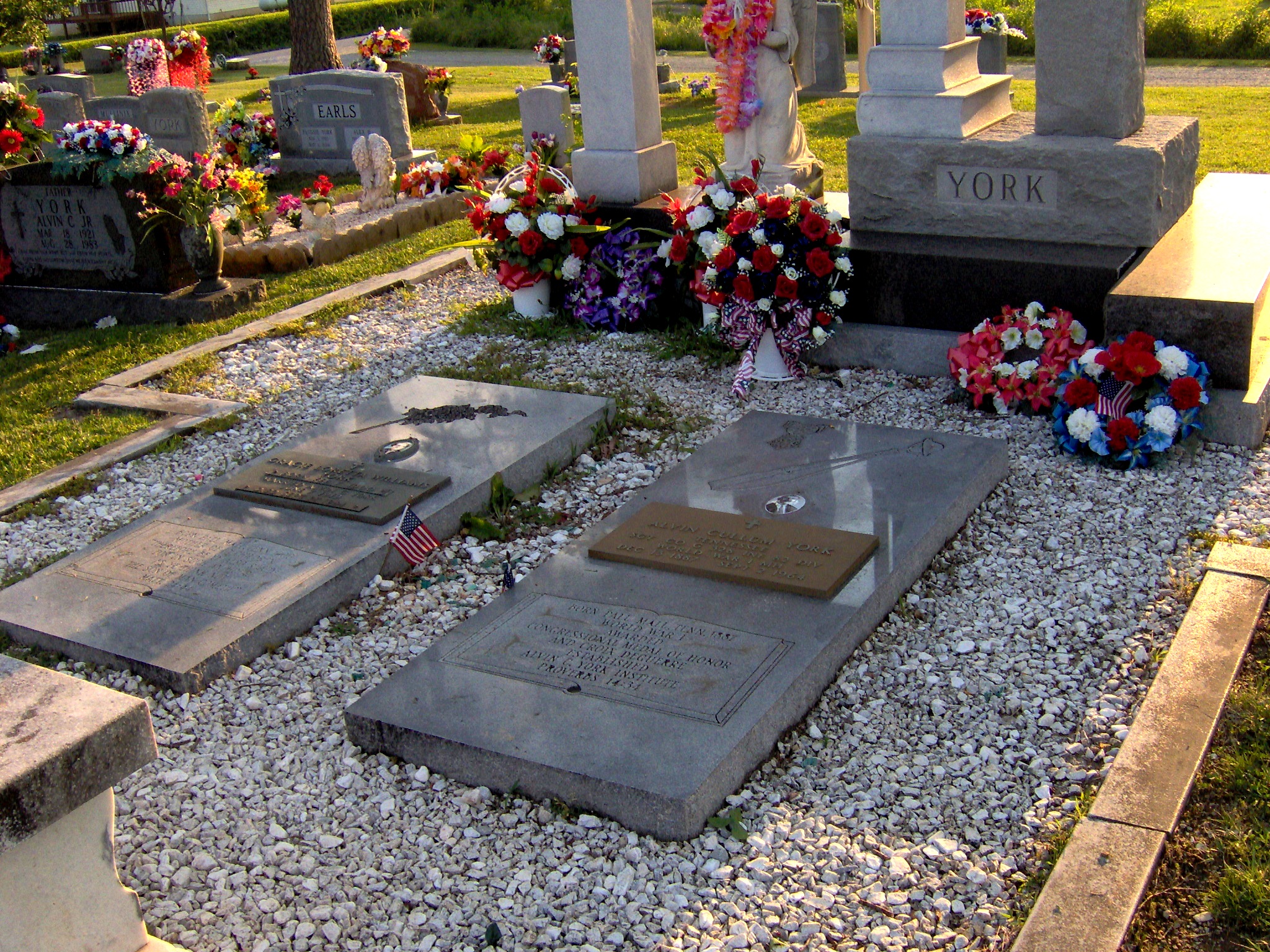
Alvin York
"Well York, I hear you have captured the whole German army." Brigadier General Julian Robert Lindsey was half-joking when Corporal Alvin York marched back to American lines near Chatel-Chehery, France, on October 8, 1918. York's reply was characteristically understated: "No sir. I got only 132." The red-haired giant from Pall Mall, Tennessee -- a man who had filed for conscientious objector status on religious grounds before being talked into serving -- had just silenced an entire battalion of German machine guns, killed at least 25 enemy soldiers, and personally accepted the surrender of 132 prisoners. He did it with a rifle, a pistol, and seven surviving men from his patrol. By the time the Saturday Evening Post told his story to two million readers the following spring, Sergeant York had become the most famous soldier in America. What he did with that fame surprised everyone.
The Argonne and the Impossible Morning
The Meuse-Argonne offensive was one of the bloodiest campaigns of World War I, and on the morning of October 8, 1918, York's unit -- the 328th Infantry Regiment of the 82nd Division -- pushed into the Argonne Forest. German machine guns commanded the hillsides. When York's patrol of seventeen men attempted to flank the guns by working behind the ridge, they stumbled into a German headquarters and captured a group of soldiers. Then the machine guns on the hill above opened fire on the Americans, killing six of York's comrades. York, now the senior man still in action, took cover and began picking off German gunners one by one. When six Germans charged him with bayonets, he dropped all six with his pistol, shooting from back to front so the men behind would not see those ahead falling. German First Lieutenant Paul Jurgen Vollmer, commanding the 1st Battalion of the 120th Reserve Infantry Regiment, emptied his own pistol trying to kill York. When every round missed, Vollmer offered in English to surrender. York accepted.
A Hero Who Wanted No Part of It
York arrived in Hoboken, New Jersey, on May 22, 1919, to celebrations arranged by the Tennessee Society in New York City. He stayed at the Waldorf Astoria, toured the subway in a special car, received a standing ovation from the House of Representatives, and met Secretary of War Newton D. Baker. Then he went home to Pall Mall and married Gracie Loretta Williams, with Tennessee Governor Albert H. Roberts performing the ceremony. Offers poured in -- thousands of dollars for appearances, endorsements, newspaper articles, movie rights. York turned them all down. "I occupied one space in a 50-mile front," he told audiences who wanted war stories. "I saw so little it hardly seems worthwhile discussing it. I'm trying to forget the war in the interest of the mountain boys and girls that I grew up among." When he finally relented and allowed the 1941 film Sergeant York -- directed by Howard Hawks, starring Gary Cooper -- it was only to raise money for a Bible school. Cooper won the Academy Award for Best Actor. The film became the highest-grossing picture of 1941.
Schools Over Glory
In the 1920s, York formed the Alvin C. York Foundation to build educational opportunities in Fentress County. Board members included Congressman Cordell Hull, who later became Franklin Roosevelt's Secretary of State, and Secretary of the Treasury William G. McAdoo. York fought for state and county funding, battled local leaders over the school's location, resigned, started a rival school, won control through lawsuits, and opened the York Agricultural Institute in December 1929. When the Great Depression dried up state funding, he mortgaged his own farm to pay for student bus transportation. Even after political rivals ousted him as president in 1936, he kept donating. The Alvin C. York Institute still operates today as Jamestown's high school. Meanwhile, York oversaw the creation of Cumberland Mountain State Park's Byrd Lake as a Civilian Conservation Corps superintendent -- one of the largest masonry projects the CCC ever undertook.
The Long Twilight
York's later years were marked by physical decline and financial struggle. The farm given to him by Nashville's Rotary Club through public subscription came unequipped, forcing him to borrow money to stock it. Farming depression, unpaid installments, and a decade-long battle with the IRS over his film earnings compounded the hardship. "I could get used to most any kind of hardship," he said, "but I'm not fitted for the hardship of owing money." Described in 1919 as standing over six feet tall and weighing more than 200 pounds, by 1948 he had suffered a stroke. More strokes followed, and from 1954 he was confined to bed with failing eyesight. He died at the Veterans Hospital in Nashville on September 2, 1964, at age 76. General Matthew Ridgway represented President Lyndon Johnson at the funeral. York was buried at Wolf River Cemetery in Pall Mall, the same mountain community where he was born, not far from the school he had built for its children.
Pall Mall's Quiet Monument
Today the Sgt. Alvin C. York State Historic Park preserves his farm in Pall Mall. A statue by sculptor Felix de Weldon stands on the grounds of the Tennessee State Capitol in Nashville. York Avenue on Manhattan's Upper East Side bears his name, bestowed in 1928. The riderless horse in President Ronald Reagan's 2004 funeral procession was named Sergeant York. Nearly 50 decorations from multiple nations -- including the Medal of Honor, the French Legion of Honor, and the Italian Croce al Merito di Guerra -- recognized his battlefield valor. But York himself preferred a different measure of his life. He had come back from France's most famous battle and spent fifty years trying to make sure the children of his mountains could read.
From the Air
Located at 36.55N, 84.95W in Pall Mall, Fentress County, Tennessee, deep in the Cumberland Plateau. The terrain is rugged Appalachian hill country with narrow valleys and forested ridges. The York farm and State Historic Park sit along the Wolf River. Nearest airports: Crossville Memorial-Whittenbarger Field (KCSV) approximately 40 nm to the southeast; Knoxville McGhee Tyson Airport (KTYS) roughly 75 nm to the east. The Cumberland Mountain State Park, where York oversaw CCC construction, lies about 20 nm to the south. Best viewed at 2,000-4,000 ft AGL to appreciate the rugged terrain and isolated mountain communities that shaped York's life. Look for the narrow valley and scattered settlement patterns along Route 127.