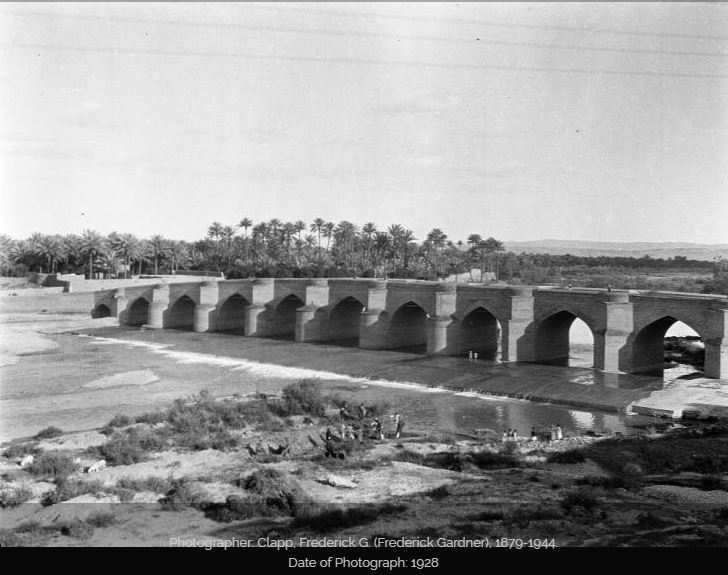
Alwand Bridge
The people of Khanaqin call it Kopri -- from the old Aryan words for arched road. The bridge sits in the center of their city, spanning the Alwand River (which locals still call Alwan, dropping the Arabic letter), connecting the eastern and western banks as it has, in one form or another, since the Sassanid Empire ruled these lands in the third century CE. The current structure dates to the 1860s, but the story of this crossing reaches back through Persian chroniclers and medieval geographers to a time when the road from Baghdad to Khorasan depended on its arches.
Arches Across the Centuries
Persian sources record that the Sassanids built the original bridge around 1,600 years ago, placing it on the road from Baghdad to Khorasan that led to the Shirin Palace. It consisted of twenty-four arches, each spanning twenty cubits, rising six meters above the ground and stretching 150 meters across the water. The medieval geographer Yaqut al-Hamawi, writing in the early thirteenth century, described it as one of the wonders of the world's bridges, set on a road between palm trees, olives, almonds, and snow. By the time the scholar Abdul-Mumin Abdul-Khaliq wrote of it before his death in 1390, the bridge was already legendary -- and already suffering. Severe floods had damaged its pillars and foundations repeatedly over the centuries, and eventually the ancient structure collapsed entirely.
A Princess and Her Pilgrimage
The bridge that stands today owes its existence to a woman whose name has been folded into local legend. In 1855, a princess -- the sister of Shah Mohammad Ali Mirza, the former ruler of Kermanshah -- set out on a religious pilgrimage to the Shia shrines in Karbala and Najaf. When she reached Khanaqin, the old bridge was gone. No safe crossing existed. Rather than simply finding another route, she returned to Iran and commissioned a new bridge. Architects were summoned from Isfahan. Walnut wood was imported from Kermanshah. The designer, a skilled builder named Wali Isfahani, was assisted by Abbas Memar Bashi and Reza al-Banna. Approximately five thousand workers were employed in the construction.
The Cost of Crossing
The construction exacted a terrible price. Roughly two thousand of the five thousand laborers are said to have died during the project -- from floods that swept the work site, from falls during construction, and from other accidents. They were buried in a cemetery that still exists near the bridge, at a shrine called the Imam Alamdar Shrine. Local legend adds darker layers to the story: that the princess ordered sacrificial animals cooked until their bones dissolved, and the resulting broth mixed into the mortar to strengthen the construction. Another tale claims she sealed gold inside one of the bridge's pillars. When the bridge was finally completed, a festival was held, charity was distributed to the poor, and traffic resumed on the ancient road to Baghdad and the holy shrines.
Survival and Restoration
The bridge proved remarkably durable. It handled modern vehicles and heavy loads well into the twentieth century. But its story did not end with construction. Under the previous regime, the original brick parapets were demolished and replaced with iron railings, altering its appearance. After the fall of Saddam Hussein's government and the return of Khanaqin's displaced residents, the stone fence was rebuilt and the bridge's character was restored. Large vehicles were banned from crossing to preserve its engineering. Today the Alwand Bridge rests on twelve arched openings, its tallest pillars reaching twelve meters. It remains what it has been since the Sassanid era: the center of Khanaqin, the point where east meets west, and the arched road the locals have always simply called Kopri.
From the Air
Located at 34.34N, 45.38E in the city of Khanaqin, Diyala Province, eastern Iraq near the Iranian border. The bridge spans the Alwand (Helwan) River through the center of town and is visible as a multi-arched structure from low altitude. Nearest airports include Kirkuk Air Base (ORKK) approximately 130 km to the north. The terrain transitions from Mesopotamian plains to foothills of the Zagros Mountains. Best viewed below 3,000 feet AGL to appreciate the arched structure against the river.