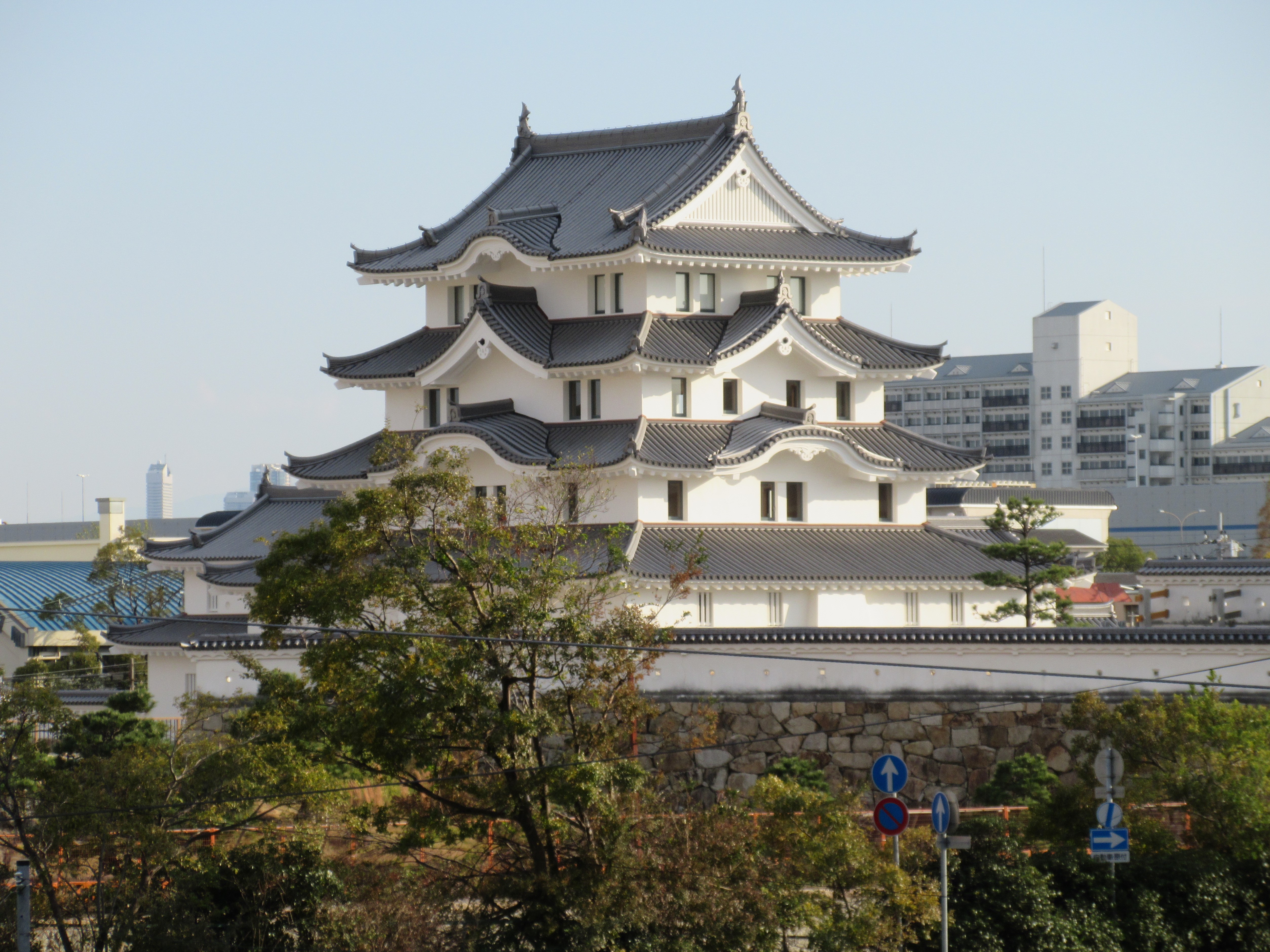
Amagasaki Castle: The Fortress That Disappeared and Came Back
Ships once docked directly at its walls. In 1617, when Toda Ujikane built Amagasaki Castle at the delta where the Omotsu and Shoge rivers flowed into Osaka Bay, he designed a fortress that was also a port. Triple concentric moats surrounded a nearly square central enclosure measuring 115 meters on each side. A four-story tenshu -- the main tower keep -- rose above two-story and three-story yagura turrets at every corner. For two and a half centuries, this flatland castle served as the headquarters of the 50,000-koku Amagasaki Domain in Settsu Province, guarding the western approaches to Osaka. Then the Meiji Restoration arrived, and the castle simply vanished -- sold off piece by piece to merchants who dismantled it and hauled it away. In 2019, it came back.
A Rebel's Refuge
Amagasaki's strategic value was proven before the present castle was even built. In October 1578, the samurai lord Araki Murashige rebelled against the most powerful warlord in Japan, Oda Nobunaga. Murashige held out at Arioka Castle in Itami during a brutal siege, but by August 1579, with Nobunaga's forces closing in, he fled to an earlier, smaller fortification at Amagasaki -- a castle originally built by the Hosokawa clan during the Sengoku period of civil war. Murashige's rebellion ultimately failed, but the episode demonstrated that whoever controlled this delta at the edge of Osaka Bay held a position of real military consequence. When Toda Ujikane arrived as the new daimyo in 1617, he built his larger castle around and over the older Hosokawa fortification, incorporating the site's natural advantages into a grander design.
A Castle Built for Water
Amagasaki Castle was a hirajiro -- a flatland castle -- designed to exploit the waterways rather than the high ground. Its triple moat system drew water from the surrounding rivers, and the castle's position at the river delta meant that oceangoing vessels could navigate directly to the castle walls. The central Honmaru enclosure was compact but heavily fortified, with the four-story tenshu flanked by paired two-story yagura turrets and anchored by three-story turrets at each corner. The enclosure was almost perfectly square, 115 meters east to west and north to south. In 1846, the Honmaru Palace -- the residence where the daimyo actually lived and conducted domain business -- burned down but was reconstructed the following year, a testament to the domain's commitment to maintaining its seat of power even as the Tokugawa shogunate entered its final decades.
Sold at Auction
The Meiji Restoration of 1868 ended the feudal domain system, and Amagasaki Castle met a fate shared by hundreds of Japanese castles: it became surplus property. All of the castle's buildings were put up for auction. Most were purchased by merchants from Osaka, who dismantled the structures timber by timber and carted them away. What they did with the materials remains largely unknown. One fragment survived longer than the rest: a portion of the daimyo's residence was incorporated into the main hall of Shinsho-in, a Buddhist temple in Amagasaki. But even that remnant was destroyed during World War II air raids. By the mid-twentieth century, nothing remained of the original castle above ground. The Honmaru enclosure site became the campus of Amagasaki Municipal Meijo Elementary School. The former moats were filled in and built over with city facilities and residential neighborhoods. Only the northern portion of the grounds was maintained as Amagasaki Castle Ruins Park, and even the stone walls visible there are modern reproductions.
The Entrepreneur's Gift
In 2015, a local Amagasaki entrepreneur made an extraordinary offer: he would personally fund the reconstruction of the castle's tenshu tower keep. Historical drawings and more than twenty archaeological excavations conducted by the Amagasaki City Board of Education provided the research foundation. Additional funds were raised through public donations from residents who wanted their castle back. Construction began in April 2018. By mid-2018, the exterior was complete, including the ornate third-story roof that gives the reconstructed tenshu its distinctive silhouette. The building was finished in March 2019 and opened to the public, housing exhibits about the castle's history and the Amagasaki domain. There is one deliberate imperfection in the reconstruction: the new tenshu stands in the Nishi San-no-maru enclosure area, roughly 300 meters northwest of where the original tower keep once stood. The original site lies beneath the elementary school, untouchable. The castle returned, but not quite to the same spot -- a fitting metaphor for a fortress that has always been shaped by the compromises of its time.
From the Air
Located at 34.714N, 135.421E in the city of Amagasaki, Hyogo Prefecture, between Osaka and Kobe along the northern shore of Osaka Bay. The reconstructed tenshu is visible as a traditional Japanese castle tower in an otherwise dense urban residential area, near the south bank of the former Shoge River channel. Osaka International Airport at Itami (RJOO) is approximately 6 nautical miles to the north. Kansai International Airport (RJBB) is approximately 25 nautical miles to the south-southwest. Kobe Airport (RJBE) is approximately 12 nautical miles to the west. The castle site sits close to the Hanshin Railway Amagasaki Station, identifiable from altitude by the rail convergence in the area.