Amagasaki Derailment
Ninety seconds. That was the delay that set everything in motion on the morning of April 25, 2005. Train 5418M, a seven-car Rapid commuter service on JR West's Fukuchiyama Line, had overshot its stop at Itami Station by more than three car lengths. The 23-year-old driver reversed the train to correct the error, burning precious time on a schedule that allowed just 28 seconds of leeway over a 15-minute run. What happened next would kill 107 people, injure 562 others, and expose a corporate culture so ruthlessly fixated on punctuality that it had turned the simple act of running a train into a psychological pressure cooker.
The Curve at 116
At 9:19 a.m., approaching a curve between Tsukaguchi and Amagasaki stations, Train 5418M was traveling at 116 kilometers per hour. The posted speed limit was 70. Investigators later calculated that the curve would cause a derailment at anything above 106. The front four cars left the rails. The first car slid into the ground-floor parking garage of a nine-story apartment building. The second car slammed into the building's corner and was crushed into an L-shape by the momentum of the cars behind it, compacted so violently that rescuers needed days to reach the victims trapped inside. Of the roughly 700 passengers aboard, 106 died alongside the driver. It was Japan's deadliest rail disaster since the 1963 Tsurumi accident, and it happened not because of mechanical failure or natural disaster, but because a young man was terrified of being late.
The Shadow of Nikkin Kyoiku
JR West's retraining program, known as nikkin kyoiku, was supposed to correct employee errors. In practice, it was something closer to institutionalized humiliation. Drivers who fell behind schedule or made minor mistakes were pulled from their duties and forced into menial labor: weeding rail yards, cutting grass, writing lengthy reports of repentance while enduring severe verbal abuse from supervisors. Many experts later described the program as psychological torture rather than professional development. The official accident investigation concluded that nikkin kyoiku was a probable cause of the crash. The driver, already anxious about having overshot Itami Station, likely pushed the train's speed to make up the lost 90 seconds and avoid another infraction. When he finally noticed the excessive speed, just four seconds before the curve, he reached for the service brake instead of the emergency brake, presumably because pulling the emergency stop would itself require written justification and could trigger yet another round of retraining.
A Schedule Designed to Break
The Fukuchiyama Line's timetable had been tightened repeatedly in the years before the crash. Cumulative schedule changes had reduced the built-in leeway between Takarazuka and Amagasaki from 71 seconds to just 28 seconds over a 15-minute run. The system was designed around precision transfers: rapid and local trains met on opposite sides of the same platform at Amagasaki Station so passengers could step across and continue their journeys without delay. A small hiccup in one train's schedule could cascade through the entire day's timetable. This elegant choreography left no room for human error. Combined with the punitive consequences drivers faced for any deviation, the railroad had constructed a system where the rational response to falling behind schedule was to speed up, regardless of the risk.
Accountability and Its Limits
In July 2009, JR West president Masao Yamazaki was charged with professional negligence for failing to install an Automatic Train Stop system on the curve when the company sharpened it during track reconstruction in 1996. He resigned from the presidency but remained on the board of directors. In January 2012, a Kobe District Court judge found Yamazaki not guilty, ruling that the accident was not sufficiently predictable to merit criminal conviction. The court nonetheless criticized JR West for its faulty risk assessment of the curve. The verdict left many bereaved families frustrated, feeling that the corporate culture responsible for the disaster had escaped meaningful legal consequence.
Inori no Mori
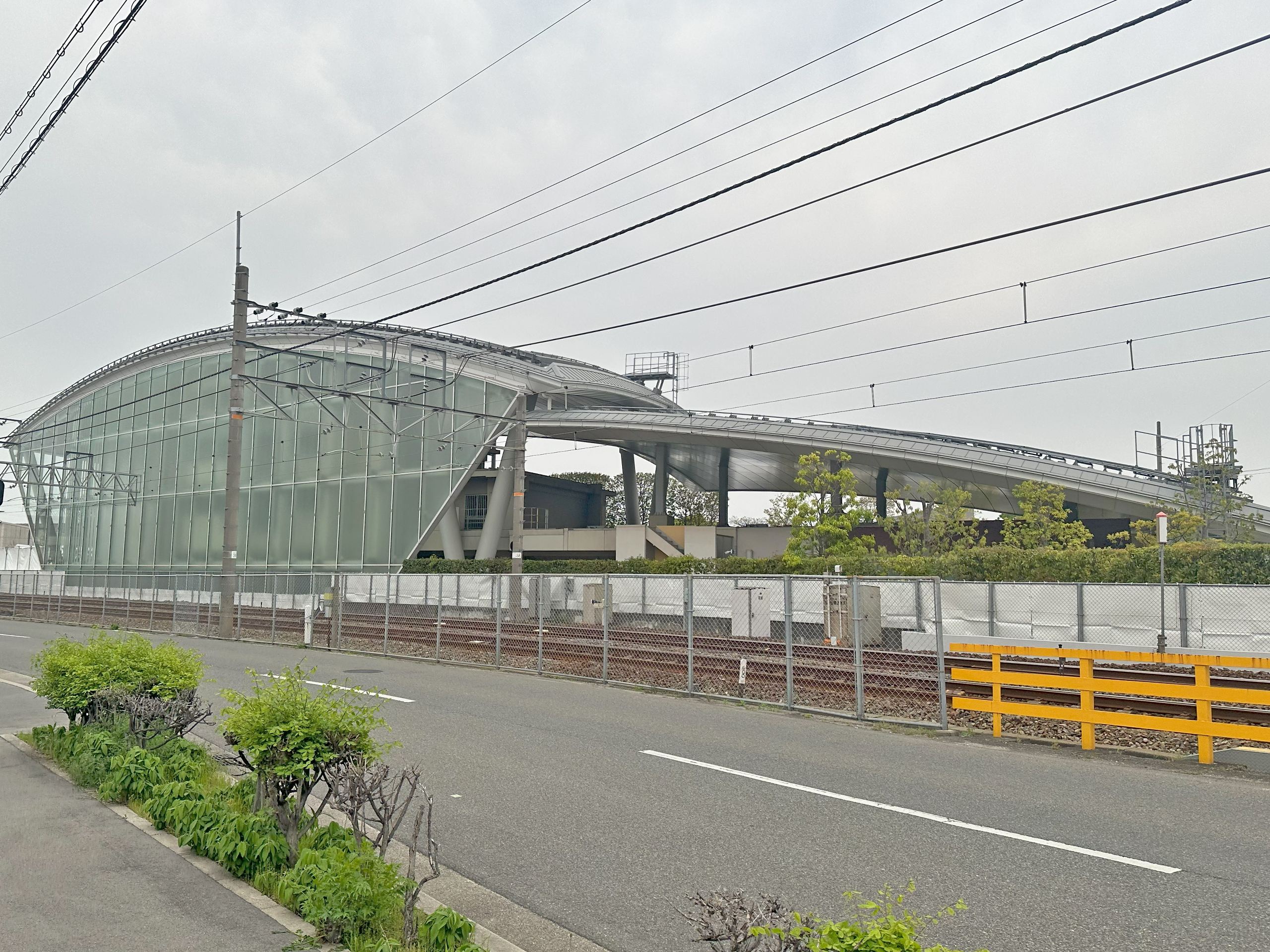
The apartment building struck by the train stood damaged for over a decade before its demolition in 2017. The following year, JR West constructed a memorial facility called Inori no Mori, the Prayer Grove, on the site. Part of the original condominium structure was preserved beneath a protective roof, and the memorial includes a cenotaph, letters from bereaved families, and an information center documenting the accident. In 2023, JR West began building an additional facility at a training center in Suita to display some of the actual train cars from the crash and personal belongings of the victims. As of 2025, JR West's Japanese homepage still opens with a prominent acknowledgment of the disaster. The translated statement reads: 'We will never forget the Fukuchiyama Line train accident that we caused on April 25, 2005. We will continue to put safety first and build a railway that is safe and reliable.'
From the Air
Located at 34.7415°N, 135.4266°E in the dense urban landscape between Osaka and Kobe. The crash site sits along the Fukuchiyama Line rail corridor, identifiable from altitude as it runs through a residential neighborhood in Amagasaki, Hyogo Prefecture. Osaka Itami Airport (RJOO) lies approximately 8 km to the north, making this site visible on approach or departure from runway 32L. Kansai International Airport (RJBB) is roughly 45 km to the southwest. The memorial site is best spotted by following the rail line between Tsukaguchi and Amagasaki stations.