Amara War Cemetery
Hassan Hatif Moson says he took the job in 1977. For decades, he swept the paths and pulled weeds from among the graves of soldiers who died before his grandfather was born. Nobody paid him after 1991. Ba'ath Party officials threatened him. He kept working. The Amara War Cemetery, pressed against a branch of the Tigris in southern Iraq, holds the remains of more than 4,600 Commonwealth soldiers killed during the Mesopotamian Campaign of the First World War. It is one of the largest British military cemeteries in the Middle East, and one of the most neglected.
A Hospital Town on the Tigris
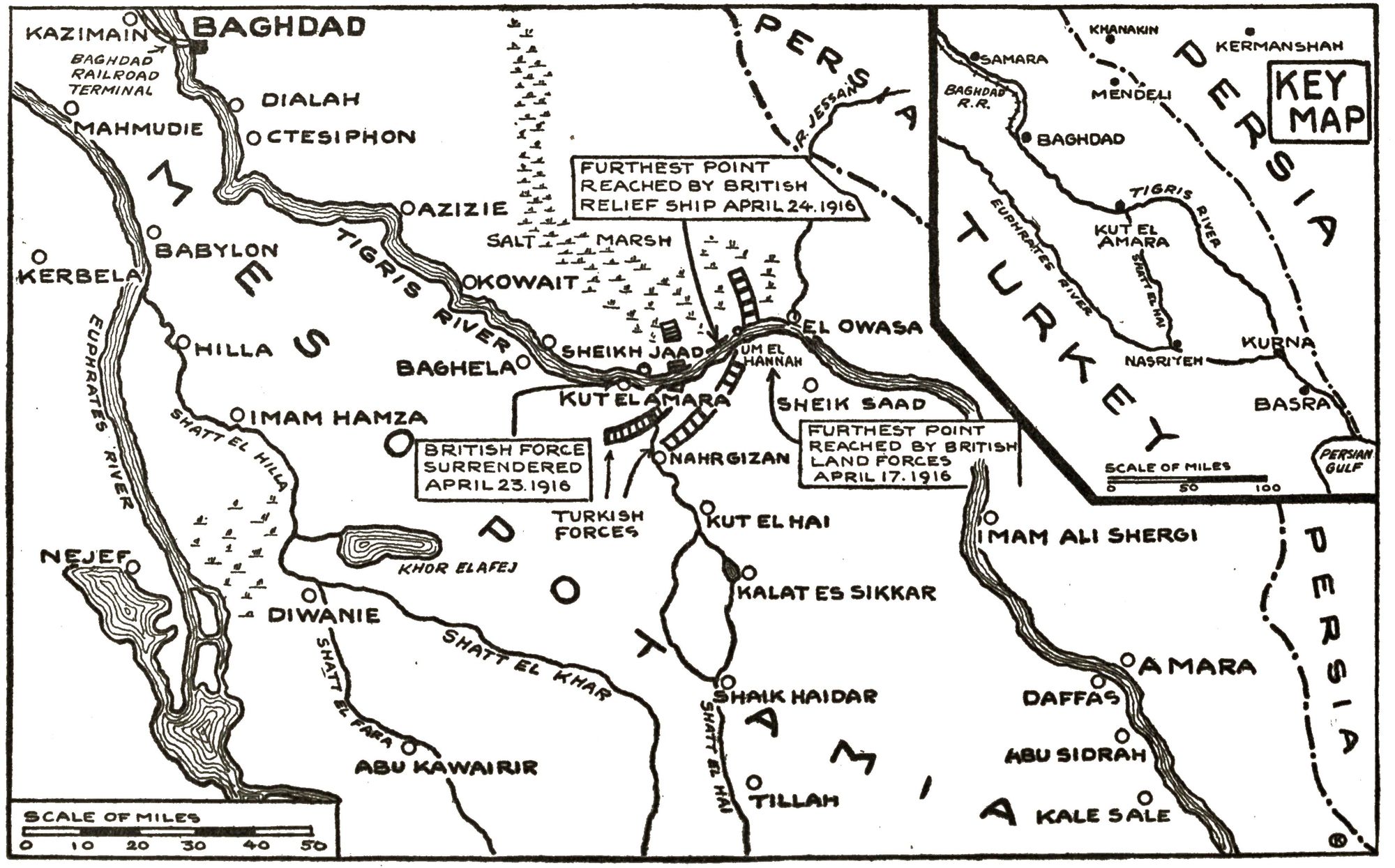
Amarah became a major medical hub during the Mesopotamian Campaign. Seven general hospitals operated on both sides of the river, treating the wounded who arrived by barge and animal cart from battlefields upstream. The Tigris splits into branches here, and the cemetery sits just south of one of them, in a landscape of flat alluvial plain shimmering under desert heat. Soldiers who survived the fighting at Kut and Es Sinn only to succumb to disease, heatstroke, or infected wounds filled the hospital wards. More than 3,000 of the cemetery's 4,621 burials were interred after the armistice, as remains were concentrated from scattered graves across the campaign theater. Of the dead, only 3,696 have ever been identified. The rest lie nameless beneath Iraqi soil.
Victoria Crosses and Friendly Fire
Three recipients of the Victoria Cross rest here. Lieutenant Commander Edgar Christopher Cookson was killed trying to cut through wire hawsers blocking the Tigris during the Battle of Es Sinn in September 1915, climbing onto a dhow under fire with an axe. Edward Elers Delaval Henderson led his battalion across open ground under intense fire, wounded multiple times before a bayonet charge carried the position. Corporal Sidney William Ware, of the Seaforth Highlanders, carried wounded men to safety under heavy fire for more than two hours at Sanna-i-Yat in April 1916, until he was exhausted — he died of wounds ten days later. Also buried here is Captain Alfred Wallace Harvey of the Royal Army Medical Corps, whose death carries a particular cruelty: he was shot by a sentry from his own side. Immediately south of the British cemetery lies the Amara Indian War Cemetery, which holds more than 5,000 Indian soldiers who died in the same campaign. Together, the two cemeteries account for nearly 10,000 dead from a theater of war that many in Britain considered a sideshow.
Salt, Stone, and Memory
The headstones did not last. By 1933, salts in the soil had so badly corroded the grave markers that the Commonwealth War Graves Commission removed them entirely. In their place, a memorial wall was erected with the names of the dead engraved on plaques. A Cross of Sacrifice stood at the center of the grounds, the standard marker used at CWGC sites worldwide. For decades, the arrangement held. But after the CWGC lost access to Iraq in 1991, maintenance ceased. When journalist Martin Fletcher visited in April 2016 for The Times, he found plaques falling from the wall and the Cross of Sacrifice smashed. A man claiming to be the caretaker told him the cross had been blown up one night in 2006.
Kept by Conscience
The question of who has been tending the cemetery remains murky. When the BBC reported on the site in 2003, Hassan Hatif Moson told them he had maintained the grounds for over two decades without pay, supported in part by Baroness Nicholson of Winterbourne, founder of the AMAR charity. The CWGC, however, said Moson had never been in their employ, though they acknowledged they would be appointing a caretaker. The Commission has stated that restoration will happen when conditions allow. Conditions have not allowed for over three decades. The cemetery sits in a country that has endured the Iran-Iraq War, international sanctions, the 2003 invasion, sectarian violence, and the rise of ISIS. Through all of it, the dead have remained, their names slowly becoming unreadable on a wall that is itself falling apart.
The Weight of Forgetting
From the air, the cemetery is a rectangular patch of order in the sprawl of modern Amarah, a city of several hundred thousand people. The grid pattern of the graves is still faintly visible, though the perimeter wall is damaged and vegetation has encroached. The adjacent Indian cemetery, holding its own 5,000 dead, adds to the scale of loss concentrated in this single bend of the river. These soldiers came from Britain, India, Australia, and beyond, sent to fight in a campaign driven by oil, imperial rivalry, and strategic miscalculation. Most never saw the places they were supposed to be defending. They died of bullets and disease in a landscape utterly foreign to them, and now that landscape is slowly reclaiming them.
From the Air
Located at 31.85N, 47.16E on the southern outskirts of Amarah, Iraq, along the Tigris River. The cemetery is a rectangular enclosure visible from moderate altitude. Nearest significant airfield is Al Amarah Airport (ORAM). The adjacent Indian War Cemetery is immediately to the south. The Tigris splits into branches at this location, creating a distinctive geographic feature visible from altitude.