Amarapura
They named it the Immortal City, and then they took it apart. In 1857, when King Mindon decided to build a new capital at Mandalay just eleven kilometers to the north, he ordered the royal palace at Amarapura dismantled piece by piece. Elephants hauled the teak columns and carved panels northward. Workers pulled down the city walls for road and railway fill. What remained was a ghost outline -- a square moat, corner pagodas, and the stubborn memory of a place that had twice served as the seat of Burmese power. Amarapura's name, from the Pali "Amarapura" meaning "City of Immortals," turned out to be aspirational rather than literal. But something did survive the dismantling, and it was not what the kings intended to preserve.
A Capital Twice Crowned
King Bodawpaya of the Konbaung Dynasty founded Amarapura as his capital in May 1783, building it on flat ground between the Irrawaddy River and the older capital of Ava to the south. The new city became a center of Buddhist learning and reform. In 1800, Buddhist clergy from Sri Lanka traveled here to receive higher ordination, founding the Amarapura Nikaya -- a sect that still thrives across Southeast Asia. By 1810, the city held an estimated 170,000 inhabitants. That same year, fire destroyed much of it. Bodawpaya's grandson, King Bagyidaw, moved the court back to Ava in 1821, and by 1827 the population had collapsed to around 30,000. Yet Amarapura was not finished. The capital returned in 1842, only to be abandoned again in 1859 when Mandalay took its place for good. The city officially ceased being the capital on 23 May of that year.
The Bridge That Outlasted the Palace
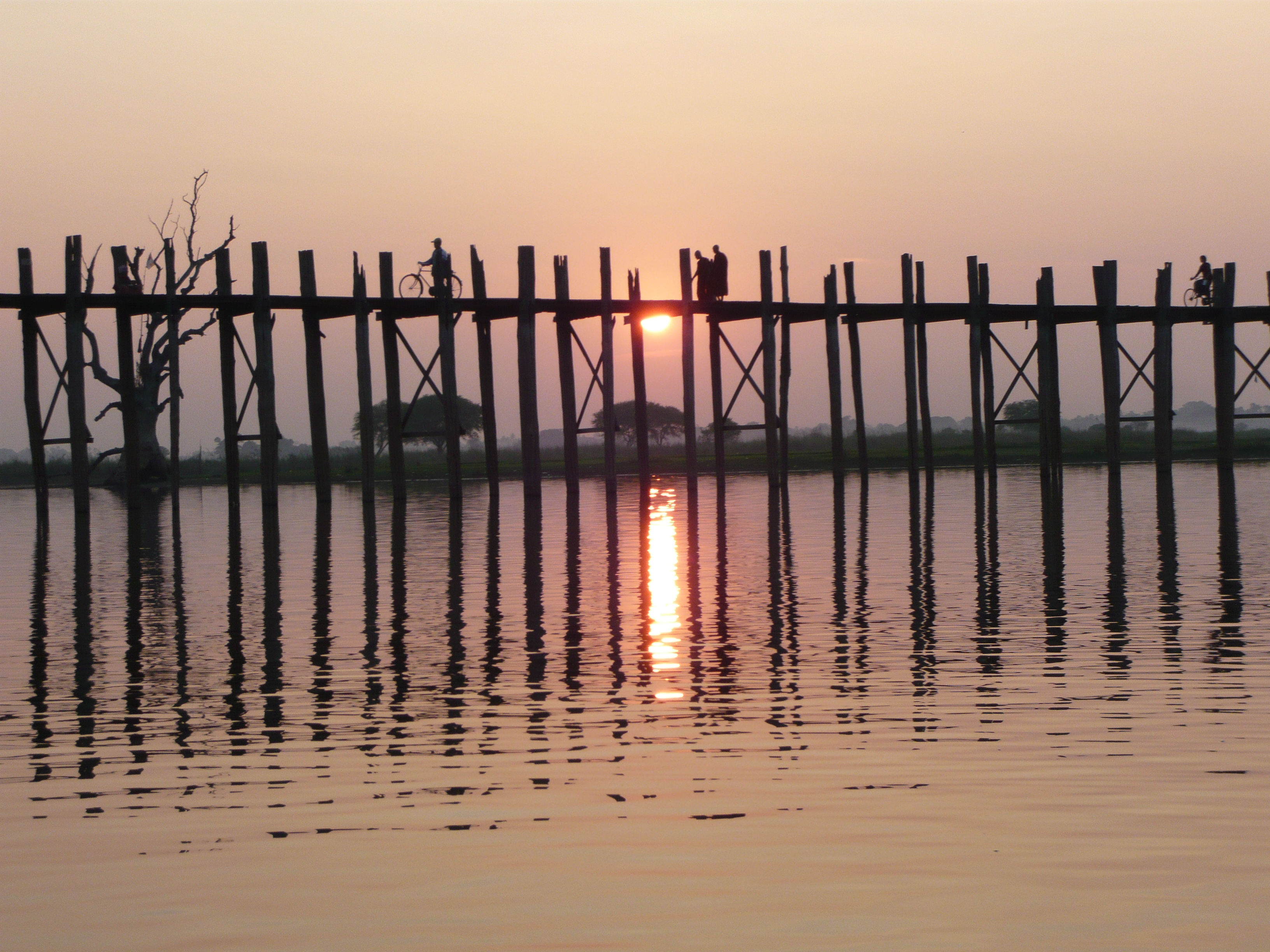
When King Mindon cannibalized Amarapura for building materials, the mayor U Bein saw opportunity in the discarded teak columns. He salvaged them to construct a footbridge across Taungthaman Lake, stretching 1.2 kilometers from shore to shore. Today, U Bein Bridge is the longest teak bridge in the world and the most photographed site in the Mandalay region. At sunrise and sunset, monks in saffron robes cross alongside farmers, students, and tourists, their silhouettes framed against water that shifts from gold to pink as the light changes. The bridge was never meant to be a monument -- it was practical engineering, a way to cross a seasonal lake. But while the royal palace it was made from vanished into Mandalay's foundations, U Bein Bridge still stands, its ancient teak darkened by monsoon rains and polished by a century and a half of bare feet.
Looms and Molten Bronze
Amarapura's identity today is defined not by royalty but by craft. The township remains one of Myanmar's foremost centers for traditional acheik weaving, a technique of producing silk and cotton textiles with intricate wave-like patterns. During the Konbaung dynasty, sumptuary laws dictated who could wear acheik cloth -- it was the fabric of court rank and ceremony. Weavers in Amarapura still work hand looms, producing designs that take days to complete, though cheaper factory-produced imitations from China and India have disrupted the traditional cottage industry in recent years. Alongside the looms, bronze foundries operate as they have for generations. Craftspeople cast Buddha images, bells, and ritual objects using techniques passed down through families. The sound of hammering carries through neighborhoods where the smell of heated metal mingles with the sweeter scent of cotton being sized for the loom.
Ruins and Living Faith
The ruins of Amarapura's city walls trace a square roughly three-quarters of a mile on each side. At each corner once stood a solid brick pagoda about a hundred feet tall. The most remarkable structure was a celebrated temple adorned with 250 lofty pillars of gilt wood and housing a colossal bronze Buddha. Fragments of the old moat survive near the Bagaya Monastery. But Amarapura is no museum piece frozen in loss. The Pahtodawgyi stupa, built by Bodawpaya in 1816 outside the city walls, still draws pilgrims. At the far end of U Bein Bridge, the Kyauktawgyi Pagoda, erected by King Pagan in 1847, anchors the lakeside. The Maha Gandhayon Monastery houses hundreds of monks and novices, and each morning they file out in a long procession for their single daily meal -- a scene that has become one of Myanmar's most recognizable images of Buddhist devotion.
An Immortal City After All
Amarapura has been absorbed into the sprawl of greater Mandalay, its boundaries blurred by modern growth. Yadanabon University brings students from across the Mandalay suburbs, and the township functions as a working neighborhood rather than a heritage park. Yet the name still resonates. The Immortal City endured not through its palace or its walls but through the things that outlasted them: a teak bridge improvised from royal scraps, weaving traditions older than any single dynasty, and monasteries where the daily rhythms of Buddhist life continue without interruption. Amarapura was capital of Myanmar twice, and both times the title was taken away. What remains is something less grand but more durable -- a place where craft, faith, and the ordinary persistence of daily life proved more immortal than any throne.
From the Air
Located at 21.90N, 96.05E, Amarapura sits just south of central Mandalay along the Irrawaddy River. U Bein Bridge is clearly visible stretching across Taungthaman Lake. The nearest major airport is Mandalay International (VYMD), approximately 35 km to the south. Best viewed at 3,000-5,000 feet for the bridge and lake panorama. The flat terrain between Mandalay Hill to the north and the ancient site of Ava (Inwa) to the south provides clear visual references.