Amarnath Temple
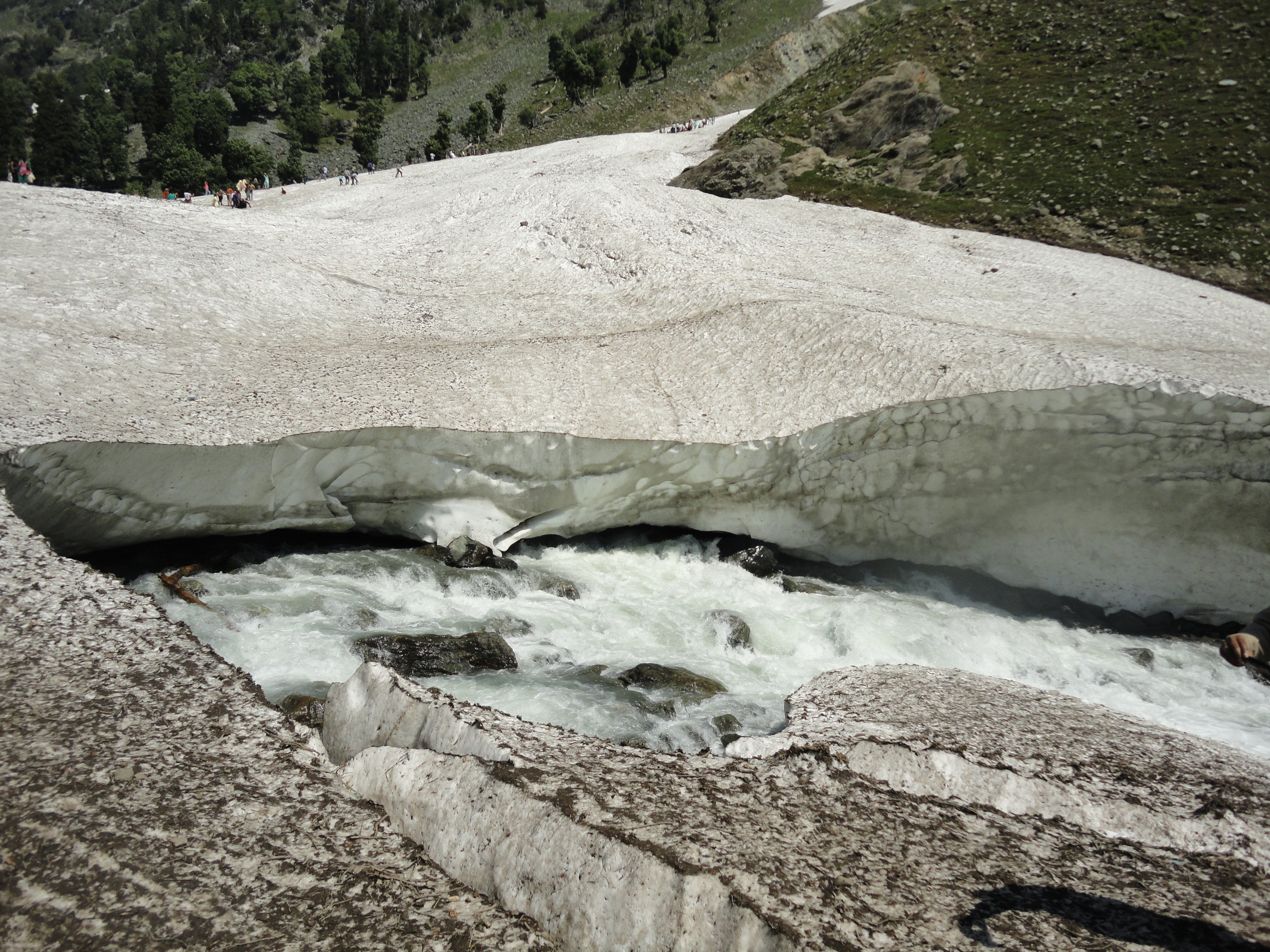
Every summer, water seeps through limestone above a cave in Kashmir's Sind Valley, freezes on the cavern floor, and slowly builds an ice dome that Hindus have venerated for centuries as a living image of Shiva. By August, the stalagmite can stand several feet tall. By winter, it vanishes. This annual cycle of emergence and dissolution, at an altitude where the air itself feels thin enough to tear, has made Amarnath one of the most extraordinary pilgrimage sites on earth. The cave sits at 3,888 meters on the flanks of a mountain whose summit reaches 5,186 meters, surrounded by glaciers and snowfields that remain locked in white for most of the year. For a window of roughly 45 days each summer, the ice relents just enough to let the faithful through.
The Ice That Breathes
The Shiva Lingam at Amarnath is not carved or placed. It is a Swayambhu lingam, a self-manifested formation inside a cave 40 meters tall. Water dripping from the roof freezes on contact with the cavern floor, building an ice stalagmite in a solid dome shape. Two smaller formations flanking it are revered as Parvati and Ganesha. The lingam waxes from May through August as Himalayan snowmelt feeds water through the rock above, then gradually shrinks through autumn and winter. Hindu tradition holds that the lingam grows and shrinks with the phases of the moon, reaching its peak during the summer festival season. Glaciologist M. N. Koul of the University of Jammu has noted that heat generated by the sheer volume of visiting pilgrims may itself affect the stalagmite's size, a tension between devotion and the object of devotion that the shrine board manages by regulating helicopter access and helipad operations nearby.
Centuries of Witnesses
Hindu scripture places Amarnath among the 51 Shakti Pithas, sacred sites commemorating the fallen body parts of the deity Sati. The cave appears in the Mahabharata and the Puranas, and the ancient text Rajavalipataka contains detailed references to the pilgrimage route. But accounts are not limited to Hindu sources. Abu'l Fazl described the cave in his 16th-century work Ain-i-Akbari, noting how the lingam swelled and shrank with the seasons. In 1663, French physician Francois Bernier traveled with Emperor Aurangzeb to Kashmir and wrote of pursuing a journey to a "grotto full of wonderful congelations" before being recalled by his impatient Nawab. Swami Vivekananda visited in 1898, and his companion Sister Nivedita recorded the experience. In the 11th century, Queen Suryamati is said to have gifted trishulas and sacred emblems to the site. Each era has added its own layer of testimony, but the cave itself predates them all.
The Path and Its Perils
Two routes lead to the cave. The shorter northern approach from Baltal covers 13 kilometers of steep terrain. The longer southern route from Pahalgam through Chandanwari stretches 43 kilometers and takes roughly five days on foot. Both are partially motorable, partially raw mountain trail. Pilgrims must pre-register months in advance and receive state-based quotas; each person and vehicle is fitted with a wearable tracking tag scanned at checkpoints along the route. The precautions reflect hard experience. In 2012, 130 pilgrims died during the yatra, most from health complications at extreme altitude. Flash floods from a cloudburst near the cave killed 15 pilgrims in July 2022. Along the way, non-governmental organizations erect free food tents called pandals, and local Muslim Bakarwal-Gujjar communities earn their livelihood offering pony transport and porter services to Hindu pilgrims, a quiet example of interfaith economic interdependence in a region often defined by its divisions.
Shiva's Journey to the Cave
Legend maps Shiva's own pilgrimage onto the landscape. At Pahalgam, whose name means "village of the bull," Shiva left his mount Nandi. At Chandanwari, he released the moon from his matted hair. On the banks of Lake Sheshnag, he let go of his serpent. At Mahagunas Parvat, he parted from his son Ganesha. At Panjtarni, he shed the five elements: earth, water, air, fire, and sky. Having relinquished everything that bound him to the material world, Shiva performed the Tandava dance and entered the cave with Parvati, where both manifested as ice and rock. The pilgrimage, in this telling, is not merely a journey to a sacred place but a reenactment of divine renunciation. Each stop along the route marks a letting go, and by the time the pilgrim reaches the cave, the mountain has stripped away everything but the essential act of witness.
Faith at Scale
The numbers tell a story of explosive growth. In 1989, between 12,000 and 30,000 pilgrims made the journey. By 2011, that figure had surged past 630,000. The pilgrimage season varies between 20 and 60 days depending on when the ice lingam forms sufficiently, and thousands of armed security personnel deploy each year to protect the route from the militant threats that have scarred its recent history. Attacks in 2000, 2001, and 2002 killed dozens of pilgrims and civilians alike. Environmentalists have raised concerns about the ecological impact of so many people traversing fragile alpine terrain, though no formal environmental impact assessment has been conducted. The tension is real: a pilgrimage that depends on glacial melt for its central miracle takes place in an ecosystem increasingly stressed by the warming that accelerates that melt. Whether the ice will continue to form as it has for centuries is a question that science and faith answer differently.
From the Air
Located at 34.22°N, 75.52°E at 3,888 meters elevation in the Sind Valley of Jammu and Kashmir. The cave sits on the flanks of Amarnath Mountain (5,186 m). Approach from the south follows the Lidder Valley. The nearest significant airport is Sheikh ul-Alam International Airport in Srinagar (VISR), approximately 140 km to the west. Helicopter services operate to Panjtarni during pilgrimage season. The terrain is extremely mountainous with glaciers and snowfields visible year-round. Best viewed during summer months (July-August) when the pilgrimage route is active.