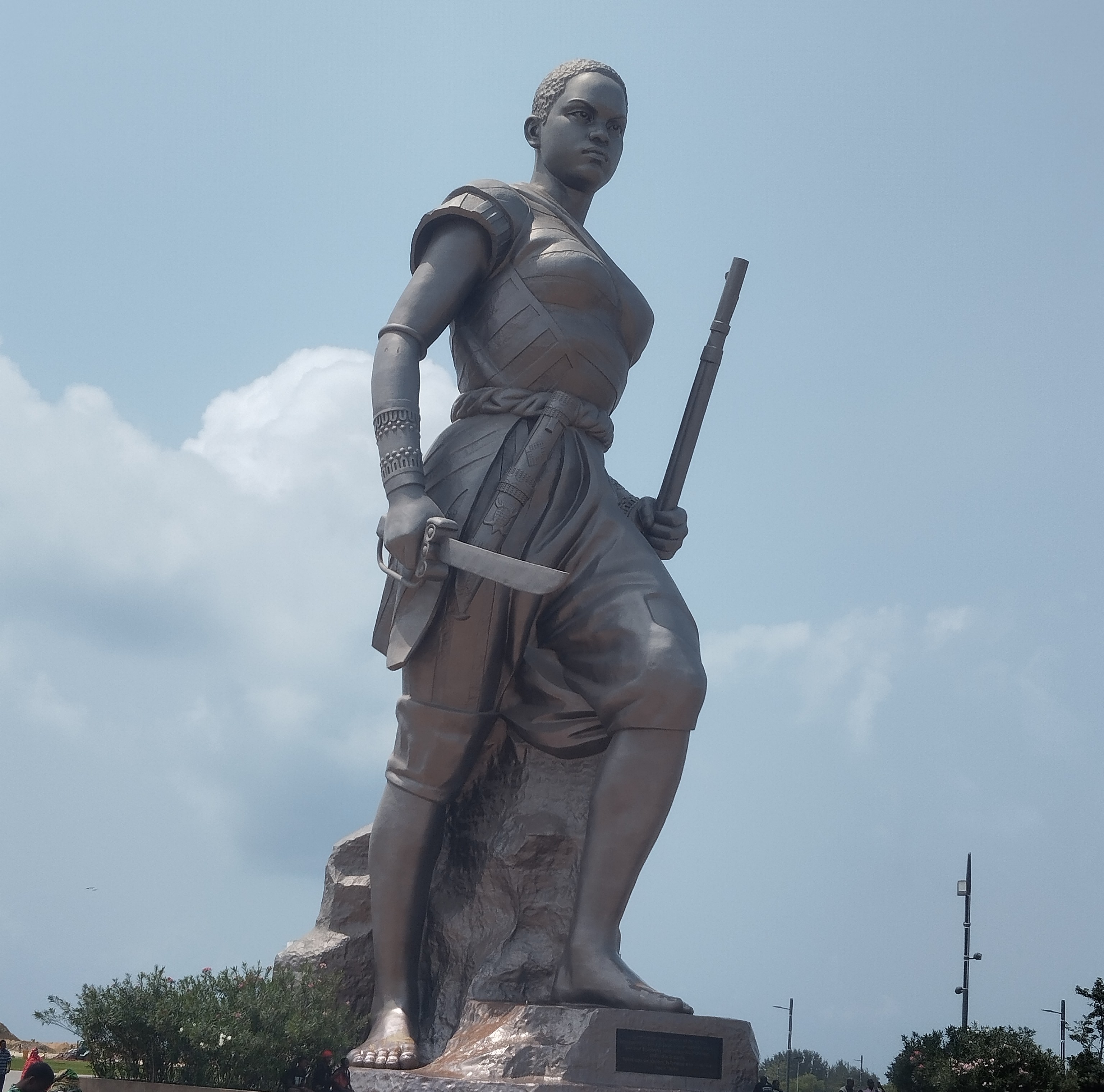
Amazon Monument (Benin)
She stands thirty meters tall, bronze skin catching the equatorial light, a rifle in one hand and a sword in the other. The Amazon Monument in Cotonou is the second tallest statue in Africa, and she faces the Atlantic Ocean with the posture of someone who has no intention of retreating. Unveiled in 2022, she honors the Dahomey Amazons -- the Mino, or "our mothers" in the Fon language -- an all-female military regiment that European observers named after the Amazons of Greek mythology. The real women were more formidable than any myth.
Bronze and Defiance
The statue depicts a young female warrior in a battle-ready pose, armed and alert, as though the centuries between the Dahomey kingdom's height and modern Benin collapsed into a single moment. A metal structure clad in bronze, the monument weighs 150 tons and rises from the Esplanade des Amazones in Cotonou's 12th arrondissement, positioned between Boulevard de la Marina and the Atlantic shoreline. Across the boulevard stand Independence Square and the Presidential Palace, making the placement deliberate -- the warrior faces the ocean that carried enslaved people away from these shores, while behind her the symbols of modern sovereignty keep watch. President Patrice Talon unveiled the statue on July 30, 2022, presenting it as a new visual identity for the Republic of Benin.
The Women Behind the Bronze
The Dahomey Amazons were not ceremonial guards or symbolic figures. From the 17th century through the late 19th century, they served as an elite fighting force for the Kingdom of Dahomey, one of West Africa's most powerful states. European accounts consistently described them as disciplined, fearless, and effective in combat -- some observers called them more capable soldiers than their male counterparts. They trained rigorously, fought in major military campaigns, and were central to Dahomey's expansion across what is now southern Benin. The regiment's existence challenges assumptions about gender roles in precolonial Africa and has drawn increasing international attention, including as inspiration for fictional portrayals in contemporary film. The monument translates that history into a permanent landmark, fixing the Amazons' legacy in the physical landscape of Benin's largest city.
A Chinese Sculptor, a Beninese Vision
The Council of Ministers approved the monument's construction on July 17, 2019, commissioning Chinese artist-sculptor Li Xiangqun and the Beijing Huashi Xiangqun Culture and Art Co. Ltd to design and build it. The choice of a Chinese sculptor for an African national monument reflects the broader pattern of Chinese cultural and infrastructure investment across the continent. Li Xiangqun's task was to create something that would function simultaneously as public art, national symbol, and tourist landmark -- a statue large enough to anchor an entirely new public square. The Esplanade des Amazones was developed specifically for the monument, transforming a stretch of Cotonou's waterfront into a civic gathering space oriented around a single figure.
Identity and Controversy
When construction scaffolding came down in early May 2022, revealing the statue's face and upper body for the first time, social media erupted with speculation that the figure represented Hangbe, a disputed queen of Dahomey whose historical existence remains debated among scholars. The Beninese government issued an official denial on May 14, 2022, clarifying that the statue depicts a generic Dahomey Amazon warrior, not any specific historical individual. The controversy illuminated something real: in a nation where oral traditions, colonial-era records, and modern scholarship often tell different versions of the same events, even a monument intended to unify can become a flashpoint for competing claims on history. The government's insistence on an anonymous warrior rather than a named queen was itself a choice -- celebrating the collective rather than risking the disputes that attach to any single figure.
Facing the Atlantic
From the waterfront, the Amazon's gaze carries across the ocean to the Americas where the Dahomey kingdom's captives were sent. That geographic alignment is inescapable. The Slave Coast -- the historical name for this stretch of West Africa -- exported hundreds of thousands of enslaved people through ports like Ouidah, just forty kilometers to the west. The monument does not directly address that history, focusing instead on military valor and national pride. But the warrior's stance on the shore where so much was lost inevitably carries a double meaning: strength and sorrow, pride and reckoning. For visitors approaching Cotonou from the sea or the air, she is among the first things visible -- a figure large enough to register from considerable distance, bronze against the pale sky, facing outward as if standing guard over a coast that has seen enough.
From the Air
Located at 6.35N, 2.41E on the Cotonou waterfront between Boulevard de la Marina and the Atlantic Ocean. The 30-meter statue is visible from low altitude approaches. Cadjehoun Airport (DBBB) is approximately 3 km to the northwest. Independence Square and the Presidential Palace are directly across the boulevard. Best viewed at 1,500-3,000 ft from the south, approaching over the ocean to see the monument against the cityscape.