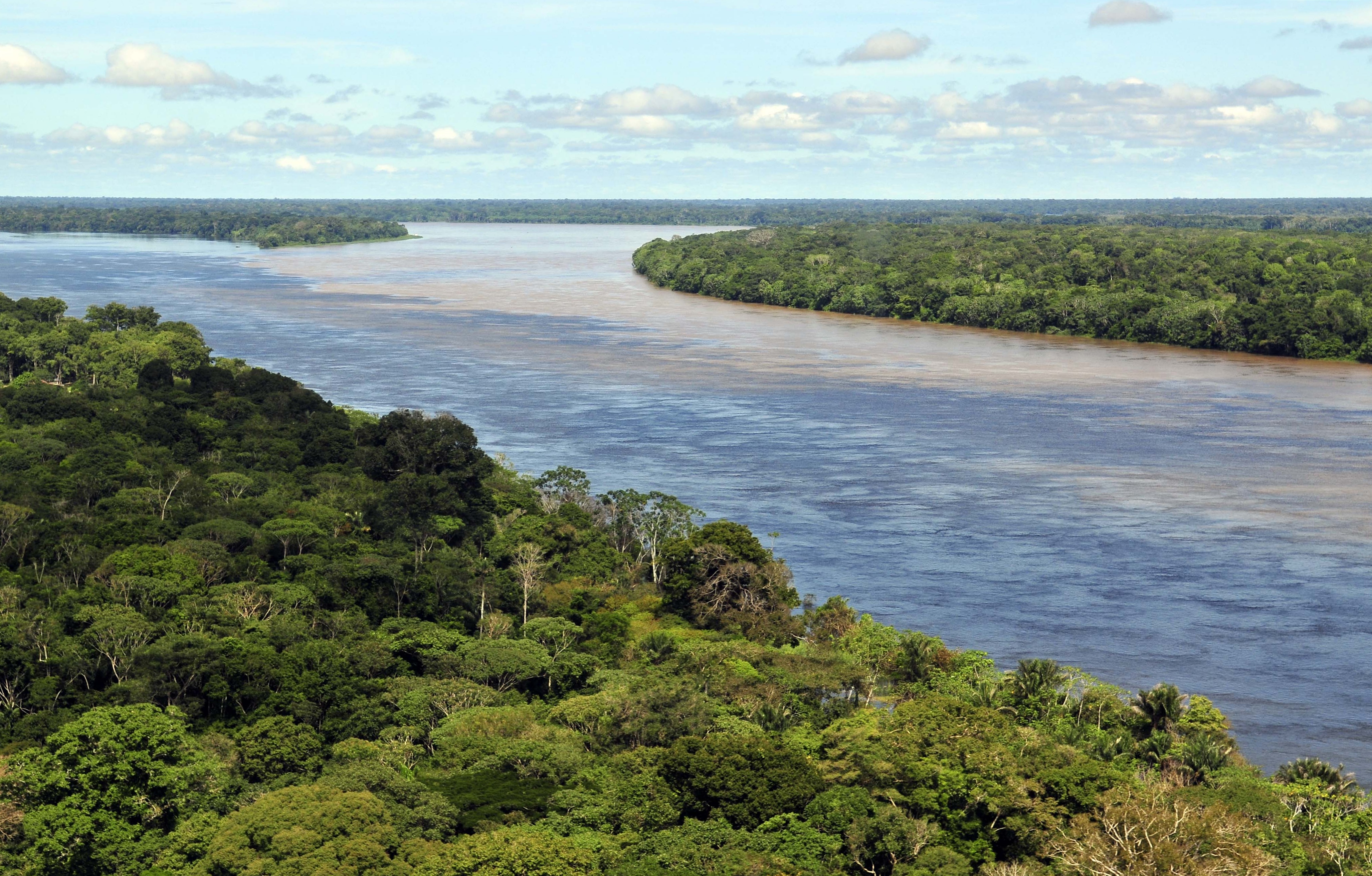
The Amazon: The Forest That Makes Its Own Rain
The Amazon rainforest is so vast it creates its own weather. Trees release water vapor through transpiration, forming clouds that rain back down, sustaining the forest in a self-perpetuating cycle. This 'flying river' carries more water than the Amazon River itself. The forest stores 150-200 billion tons of carbon. It contributes significantly to oxygen production (though the oft-cited '20%' figure is disputed by scientists). It contains 10% of all species on Earth. And it's disappearing - deforestation claims an area the size of a football field every minute. The Amazon that has existed for 55 million years may not survive the 21st century.
The Basin
The Amazon basin covers 2.7 million square miles across nine countries - 60% in Brazil. The rainforest itself spans 2.1 million square miles, making it the largest tropical forest on Earth. The Amazon River discharges more water than the next seven largest rivers combined.
Approximately 390 billion individual trees grow in the Amazon, representing 16,000 species. Scientists estimate 10% of all species on Earth live here - including 2.5 million insect species, 40,000 plant species, and 3,000 fish species. New species are discovered regularly. Many will go extinct before being catalogued.
The Rain
The Amazon generates half its own rainfall. Trees pump water from the soil through their roots and release it as vapor through their leaves - transpiration. This moisture forms clouds that rain back down. The process creates 'flying rivers' of atmospheric moisture that water the forest and regions far beyond.
Without the forest, rainfall would collapse. Climate models suggest deforestation past a certain threshold - perhaps 20-25% - could trigger a 'tipping point' where the forest can no longer sustain itself. The Amazon would gradually become savanna. That threshold may be approaching.
The People
An estimated 400-500 indigenous groups live in the Amazon, totaling about 1 million people. Many have had no contact with the outside world - Brazil's FUNAI agency monitors approximately 100 uncontacted tribes. They live as their ancestors did, hunting, fishing, and farming small plots.
First contact with isolated tribes is often fatal - they lack immunity to common diseases. Some tribes actively resist contact, attacking helicopters and intruders with arrows. They've learned that outsiders bring death. The Amazon is one of the last places on Earth where humans live as they did 10,000 years ago.
The Destruction
Approximately 17% of the Amazon has been destroyed since 1970 - mostly for cattle ranching (80%) and soy farming. Deforestation rates fluctuate with political will: Brazil reduced destruction 80% between 2004 and 2012, then allowed it to surge again after 2019.
Fires, often set illegally to clear land, have become more frequent and severe. The 2019 fire season saw 80,000 fires burn simultaneously. Smoke darkened Sao Paulo's skies 1,700 miles away. The forest that creates its own rain increasingly burns in its own drought.
The Stakes
The Amazon stores 150-200 billion tons of carbon. If released through deforestation and fire, that carbon would accelerate climate change catastrophically. The forest that helps regulate global climate could, if destroyed, tip the planet into runaway warming.
Conservationists fight to preserve what remains. Indigenous communities protect their territories. International pressure fluctuates with politics. The outcome is uncertain. The Amazon has existed for 55 million years. Whether it exists in 2100 depends on decisions made in the next few decades. The lungs of the Earth are struggling to breathe.
From the Air
The Amazon basin center (3.00S, 60.00W) is roughly at Manaus, Brazil. Eduardo Gomes International Airport (SBEG) in Manaus serves as the main gateway. From the air, the forest stretches unbroken to every horizon - a green carpet crossed by brown rivers. The Meeting of the Waters, where the Rio Negro and Solimoes join to form the Amazon, is visible near Manaus. Deforestation patches appear as geometric clearings. Weather is tropical - hot and humid year-round with distinct wet and dry seasons.